What Can I Do With My Raw DNA Data?
Your raw DNA file can give you health and medication findings, a second ancestry opinion, relative matches and a haplogroup. What each use needs, and where to start for your testing company.
Your raw DNA file can do five things the company that tested you probably doesn't: read health and medication genes, give a second opinion on your ancestry, find relatives in other databases, trace your maternal and paternal lines, and answer specific questions about your genome. The fastest free start is healthosx.com/dna. Choose your file and your browser reads it into up to about 50 plain-language findings, with nothing uploaded by default. Your DNA story needs no account; the full report opens in the HealthOS app after a code sent to your email.
Here's each use in turn, what it needs, and the honest limits.
1. Health, food and medication genes
This is what most people are after. A consumer chip reads several hundred thousand positions, and a few dozen of them are well-studied enough to tell you something real:
- Food: lactose tolerance, caffeine clearance, alcohol flush, folate, vitamin D, celiac genes
- Medications: CYP2C19 (clopidogrel, some antidepressants), CYP2C9 and VKORC1 (warfarin), SLCO1B1 (statins), TPMT, DPYD
- Inherited risk factors you can act on: lipoprotein(a), iron overload, alpha-1 antitrypsin
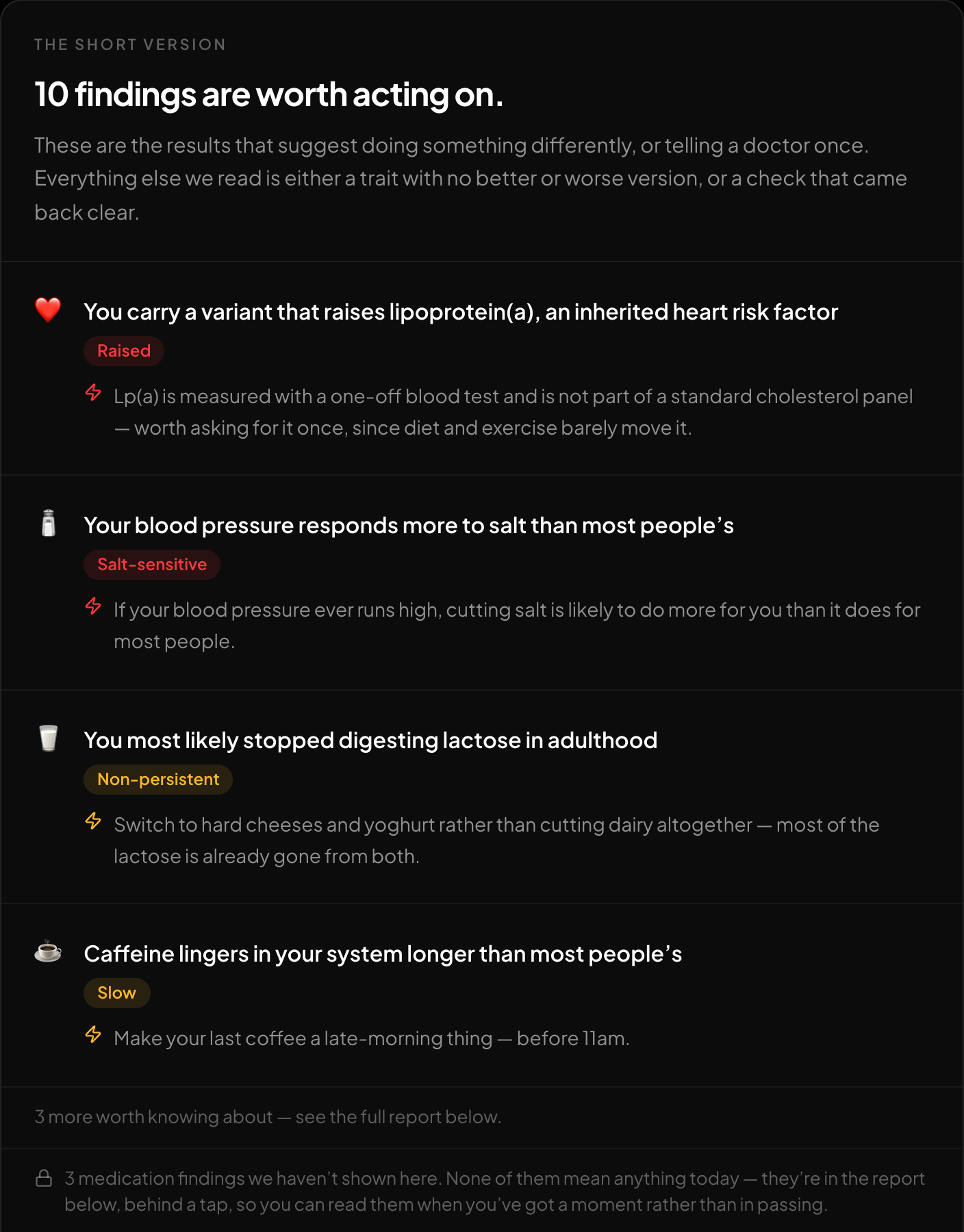
The short version: what is worth acting on, first.
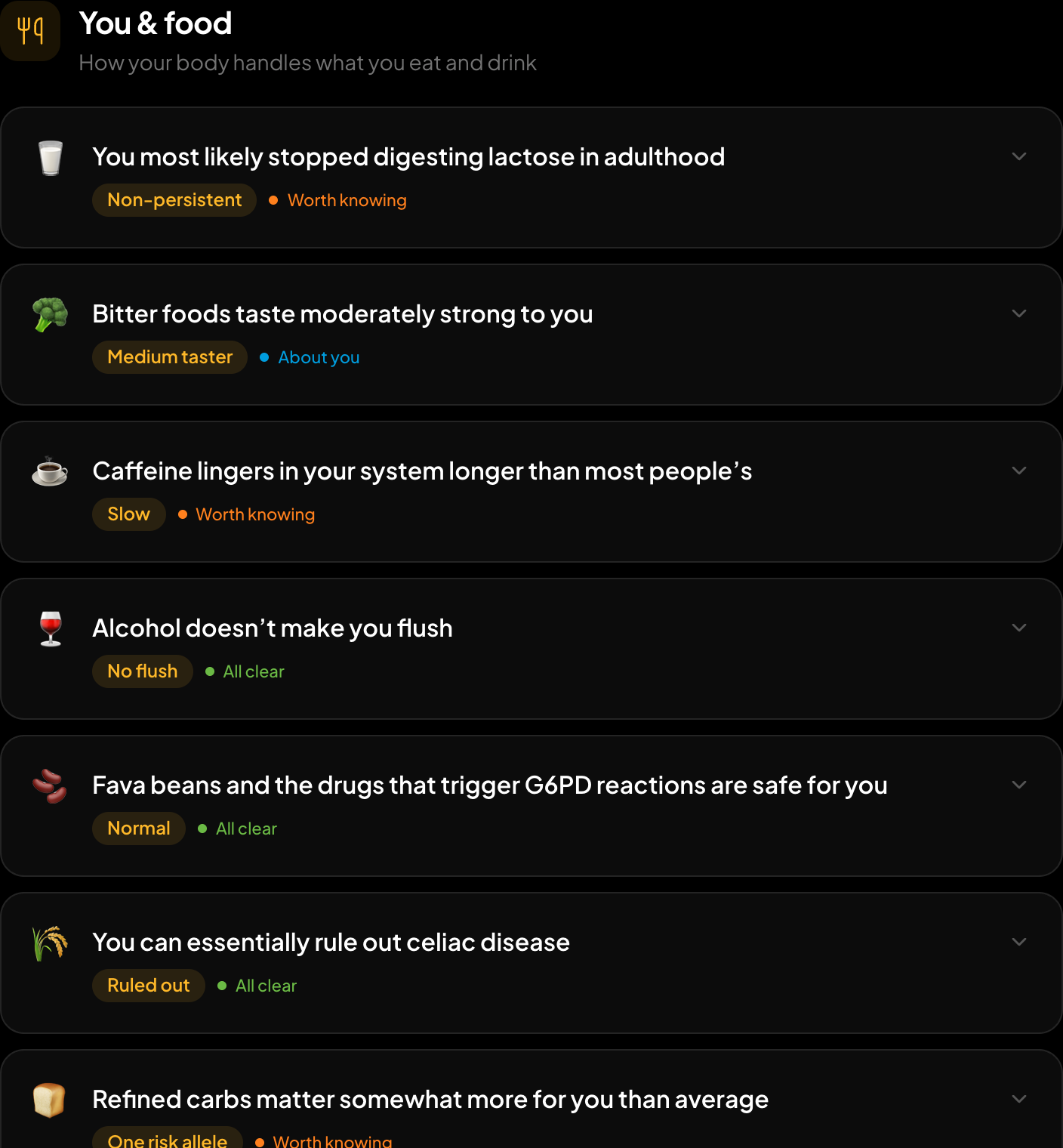
Findings grouped the way you would think about them.
The sample genome, read in the browser. Your own file produces the same report from your own genotypes.
The rule for reading any of it: a finding from a chip is a strong hint, not a diagnosis. Confirm anything consequential in an accredited lab. And a variant that isn't in your file is untested, not absent.
| What you want | From this file | Why |
|---|---|---|
| Traits, food and drink | Yes | Lactose, caffeine, alcohol flush, bitter taste, vitamin D, folate |
| Medication genes | Yes | CYP2C19, CYP2C9, VKORC1, SLCO1B1, TPMT, DPYD, HLA-B markers |
| CYP2D6 (codeine, tramadol) | No | Needs copy-number calling, which SNP data cannot do |
| Ancestry breakdown | Yes | 15 regions against 157 reference populations, plus the closest of 298 groups and 133 ancient ones |
| Maternal / paternal haplogroup | Partly | A chip carries some mtDNA and Y positions: a solid major branch, not the recent ones |
| Rare disease variants | Barely | A chip tests a handful per gene, and rare calls are often false positives |
| Finding relatives | No | Matching needs a database of other people: GEDmatch, MyHeritage, FamilyTreeDNA |
Scroll the table sideways for the rest →
Read on /dna in your browser, except ancestry, which — only if you agree — sends the markers it needs and keeps them with your result until you delete them.
2. A second opinion on your ancestry
Every company's ethnicity estimate depends on its reference panel, so the same DNA gives different percentages at different companies. Running your file through an independent panel is the easiest way to see which parts of your result are solid. On /dna the optional ancestry analysis compares your markers with 157 reference populations across 15 regions. It splits the Middle East into five regions: the Levant, Arabia, Anatolia and Iran, the Caucasus, and North Africa. How ancestry breakdowns work.
3. Finding relatives
Relative matching needs a database of other people, so it only happens where others have uploaded too. GEDmatch, MyHeritage and FamilyTreeDNA accept uploads from other companies. Each one only matches you against its own users, so uploading to more than one widens the net. Read each site's policy on law-enforcement matching before you upload.
4. Your maternal and paternal lines
Your mtDNA haplogroup traces your mother's mother's line, and your Y-DNA haplogroup (if you have a Y chromosome) traces your father's father's. Consumer chips carry a sample of both. What a raw file can and can't tell you about haplogroups.
5. Asking specific questions
Want to know about one gene, or what your results mean together? Ask your DNA is the optional chat on /dna. The first five questions are free. If you choose to store your file with it (encrypted, deletable any time), it answers from the whole file, including things the free report leaves out on purpose, like APOE.
Start with your testing company
- 23andMe
- AncestryDNA
- MyHeritage
- FamilyTreeDNA
- Living DNA
- WeGene
- Nebula Genomics
- Dante Labs
- Sequencing.com
- Any whole-genome VCF
Before you upload anywhere
- Know where the file goes. Some tools read it in your browser, some upload and delete it, some keep it. Is it safe to upload my DNA file?
- Don't paste it into a chatbot and trust the answer. Why ChatGPT can't read a raw DNA file reliably.
- Keep a copy. If you're a 23andMe customer thinking of deleting your account, download first.
Start with the free read. Choose your file and see what's in it, in about a minute: healthosx.com/dna
Common questions
- What to do with my raw DNA data file
- Five things: read your health, food and pharmacogenomics genes, get a second opinion on your ancestry, find relatives on matching sites, trace your maternal and paternal haplogroups, and ask questions about your own genome. healthosx.com/dna does all but relative matching free, from a 23andMe, AncestryDNA, MyHeritage, FamilyTreeDNA, Living DNA, WeGene or whole-genome VCF file. It is free: the file is read in your browser, and your DNA story opens straight away with no account. The full report opens in the HealthOS app after a 6-digit code sent to your email, and your file stays on your device.
- What is an rsID in my raw data?
- An rsID is the standard name of a position in the genome, such as rs4988235 for lactose tolerance or rs4244285 for CYP2C19*2. Each row of a 23andMe or AncestryDNA file is an rsID, a chromosome, a position and your two letters there. Tools look findings up by rsID.
- Can my raw DNA file show carrier status?
- Only for a handful of common variants. A chip tests a few positions per gene, where a clinical carrier screen sequences whole genes, and rare “pathogenic” calls from chips are often false positives. If you are planning a family, ask for a clinical carrier screen.
- Where can I upload my raw DNA to find relatives?
- GEDmatch, MyHeritage and FamilyTreeDNA accept files from other companies, and each matches you only against its own users. They keep your file, because matching needs it, so read each site’s policy on law-enforcement matching first.
No raw DNA file yet?
Get a HealthOS DNA Kit: spit in a tube at home, and your ancestry, lineages and traits arrive in your HealthOS account, with the raw file.
See the DNA kitWritten by
HealthOS Research