Can ChatGPT Read My 23andMe Raw Data?
ChatGPT can sometimes open a raw DNA file, but it can’t interpret it reliably: strand flips, missing positions and no ancestry reference. What goes wrong, and what to use instead.
ChatGPT can't reliably read a 23andMe raw data file. It can sometimes open the file with its code tool and look up a few rsIDs, but it interprets them from memory, with no validated table of which letter means what. That's how a strand flip turns "lactose tolerant" into "intolerant". It also has no reference panel, so it can't calculate ancestry at all. To read the file properly, use a tool built for it: healthosx.com/dna is free, reads the file in your browser, and checks every finding against a validated marker table.
It's a reasonable thing to try. Here's exactly where it breaks.
| Step | ChatGPT with your file | A purpose-built reader |
|---|---|---|
| Open a 600,000-line file | Usually, via its code tool | Streams it, even at several GB |
| Find a given rsID | Yes | Yes |
| Know which allele carries the effect | From memory — strand flips happen | Validated against Ensembl before release |
| Say “this position wasn’t tested” | Often reports it as “you don’t carry it” | Marks it not covered |
| Ancestry percentages | No reference panel — invented | 157 reference populations, 15 regions |
| Where your genome ends up | Uploaded to the provider | Stays in your browser by default |
Scroll the table sideways for the rest →
The lookup is the easy part. Everything after it is where accuracy comes from.
What happens when you upload the file
A 23andMe export is a .zip holding a text file of around 600,000 lines. Given the file, ChatGPT will usually do one of three things:
- Read the start of it and describe the format, which tells you nothing about you.
- Write Python to search it for a handful of rsIDs it remembers, and report your genotypes. The lookup is usually right. The interpretation is where it goes wrong.
- Answer from general knowledge without really using the file, in a tone that sounds like it did.
The trouble is the second case, because it looks the most convincing.
Problem 1: which letter is the risky one
A genotype like AG means nothing until you know which allele carries the effect, and on which DNA strand. Genes sit on either strand, papers report either one, and chips report the plus strand. Get that wrong and the answer comes out exactly backwards, with total confidence.
This isn't hypothetical. We validate every marker against Ensembl before it goes live, and that process caught effect alleles recorded on the wrong strand in our own early rules. One was TPMT and another DPYD — both genes where a wrong call tells a carrier they can take a full dose of a drug that would harm them. A language model answering from memory has no step that catches this.
Problem 2: "not in the file" is not "normal"
A chip reads chosen positions. If a variant isn't there, you weren't tested for it. A chatbot that searches for an rsID, finds nothing, and says "you don't carry it" has turned a gap into false reassurance. For some variants — the Arabian lactase-persistence allele, G6PD, the drug-reaction HLA markers — that's the difference between a useful answer and a harmful one.
Problem 3: ancestry isn't a lookup
Ancestry percentages come from comparing tens of thousands of your markers against a panel of reference genomes. That means gigabytes of reference data and a statistical model. ChatGPT has neither, so any percentage it gives you is invented.
Problem 4: where your genome went
Uploading the file sends your genome to the chatbot provider. Depending on your settings it may be kept, or used to improve models. A genome identifies you and your relatives, and unlike a password you can't change it. How to think about that.
What ChatGPT is good for
Explaining a result once you have a trustworthy one. "What does CYP2C19 intermediate metabolizer mean for clopidogrel?" is a good question for a chatbot. "Read my file and tell me my CYP2C19 status" isn't.
What to use instead
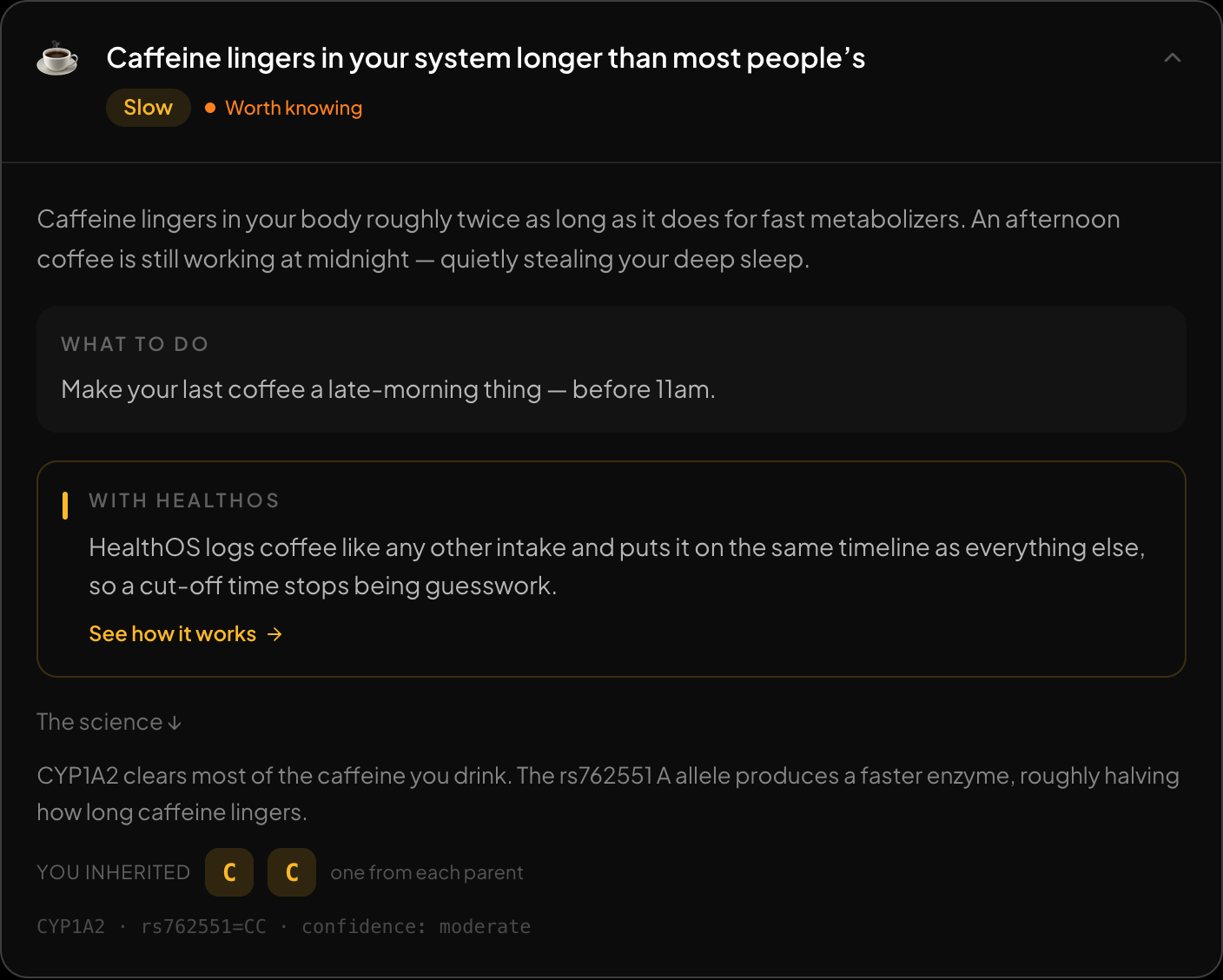
Every finding opens up: what it means, what to do, and the genotype behind it.
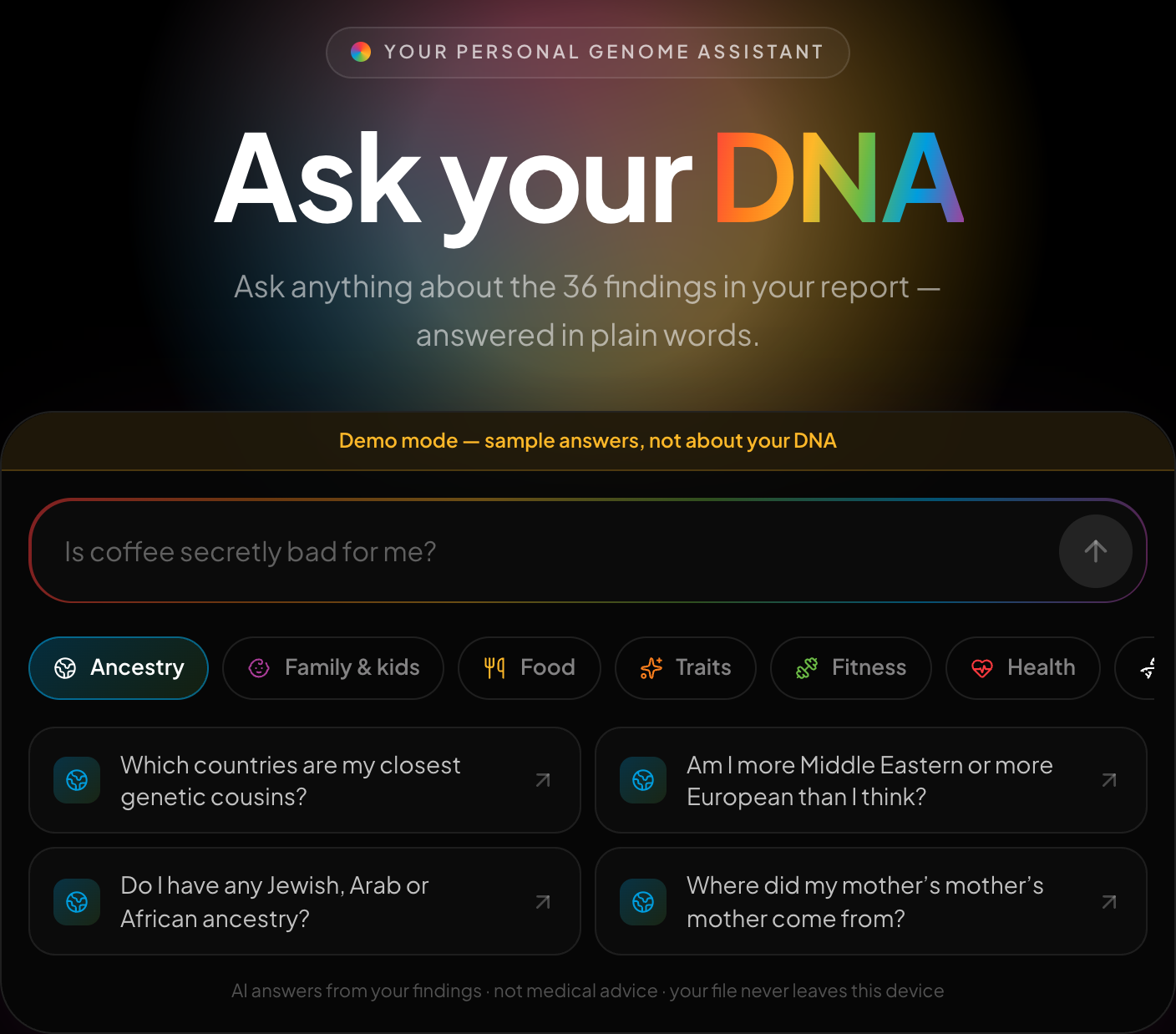
Ask your DNA: five free questions about your own results.
Each finding shows the genotype it was read from and the source behind it — the part a chatbot has to invent.
On /dna, your file is read in your browser against a marker table where every position, effect allele and strand has been checked. You get up to about 50 findings, and each one shows your genotype and its source. When your file doesn't cover a position, the report says so. If you want to talk it through, Ask your DNA is a chat that answers from your actual results rather than from memory, and the first five questions are free.
Get the answer ChatGPT can't give you. Read your 23andMe file free: healthosx.com/dna
New to raw DNA files? Start with the full guide: How to Download & Analyze Your 23andMe Raw Data Free
Common questions
- Can ChatGPT analyze my 23andMe raw data file?
- Not reliably. ChatGPT can sometimes open the file with its code tool and look up a few rsIDs, but it interprets them from memory, with no validated table of which allele carries the effect, so a strand flip can turn a result backwards. It also reads a variant missing from the chip as "you don’t carry it", and it has no reference panel, so it cannot calculate ancestry. A tool built for the file, such as healthosx.com/dna, reads it in your browser against a validated marker table, free.
- Is there an AI I can ask about my DNA results?
- Yes. Ask your DNA, on healthosx.com/dna, answers questions about your own results in plain language, in English or Arabic. By default it sees a short summary of your results, not the file. If you choose to store your file with HealthOS (encrypted, linked to your email, deletable any time), it answers from the whole file.
- Is it safe to upload my DNA file to a chatbot?
- Uploading it sends your whole genome to that company’s servers under its data terms. A genome can’t be changed like a password, and it says a lot about your relatives too. A reader that works in your browser keeps the file on your device.
No raw DNA file yet?
Get a HealthOS DNA Kit: spit in a tube at home, and your ancestry, lineages and traits arrive in your HealthOS account, with the raw file.
See the DNA kitWritten by
HealthOS Research