How to Find Your Maternal and Paternal Haplogroup From Raw DNA
Your mtDNA haplogroup traces your mother’s line, your Y-DNA haplogroup your father’s. What a 23andMe or Ancestry raw file can tell you about each, and how deep it can go.
No DNA test yet?
The HealthOS DNA Kit reads your maternal line, your paternal (Y) line if you have a Y chromosome, your ancestry across 15 regions and the ancient peoples you sit closest to. Spit in a tube at home; the lab is in Germany and the raw file is yours.
See the DNA kitYou can find your maternal (mtDNA) haplogroup, and your paternal (Y-DNA) haplogroup if you have a Y chromosome, from a raw DNA file, as long as the file includes those positions. 23andMe and AncestryDNA exports usually do. Whole-genome VCFs do. FamilyTreeDNA's Family Finder file doesn't. On healthosx.com/dna the report shows both lines, read on your device: it places you on PhyloTree for mtDNA and on the YFull tree for Y-DNA, and says how confident the placement is. Each main line also has its own page, with where it is common and the ancient people who carried it: paternal and maternal lineages.
To get only the two haplogroups, use the free haplogroup finder: drop the same raw file and it shows each code, the branch path and how sure the placement is, read in your browser with nothing uploaded.
What a haplogroup is
- Maternal (mtDNA): mitochondrial DNA passes from a mother to all her children, almost unchanged. Your mtDNA haplogroup traces your mother, her mother, her mother, and so on back tens of thousands of years.
- Paternal (Y-DNA): the Y chromosome passes only from father to son. Your Y haplogroup traces your father, his father, and so on. Women don't have one. A woman's paternal line shows up in her father's or brother's file.
Each is one line out of thousands of ancestors. Ten generations back you have about a thousand ancestors, and a haplogroup follows exactly two of them. So it's a lineage marker, not your ancestry. Your autosomal ancestry breakdown is the broad picture.
How deep a raw file can go
Haplogroups are a tree: a broad branch like J splits into J1, then J-M267, then J-P58, and on down to branches only a few centuries old. How far down you get depends on which defining positions your file contains.
- Consumer chips carry a few hundred to a few thousand Y and mitochondrial positions. That's usually enough for a solid major branch and often a few levels below it, but not the most recent branches.
- Whole-genome sequencing covers nearly every defining position, so it can go much deeper.
- Dedicated tests (a full mtDNA sequence, or FamilyTreeDNA's Big Y) are built for exactly this. They go deepest and connect you to surname and clan projects.
A careful tool stops where the evidence stops. The placement on /dna counts only positions your file actually tested. Missing ones are treated as untested, not as matching the reference. A shallower answer you can trust beats a deep one that's invented.
What your haplogroup tells you
- Where the lineage is common today, and roughly how old the branch is
- Shared deep ancestry with others on the same branch
- Not your nationality, your ethnicity, or who your recent ancestors were
How to get it
- 1.Download your raw file: 23andMe, AncestryDNA, Living DNA or a whole-genome VCF.
- 2.Choose it at healthosx.com/dna. The free report runs in your browser.
- 3.Your maternal and paternal lines appear in the report, worked out on your device. For follow-up questions, open Ask your DNA and choose to store your file (encrypted, deletable any time). The first five questions are free.
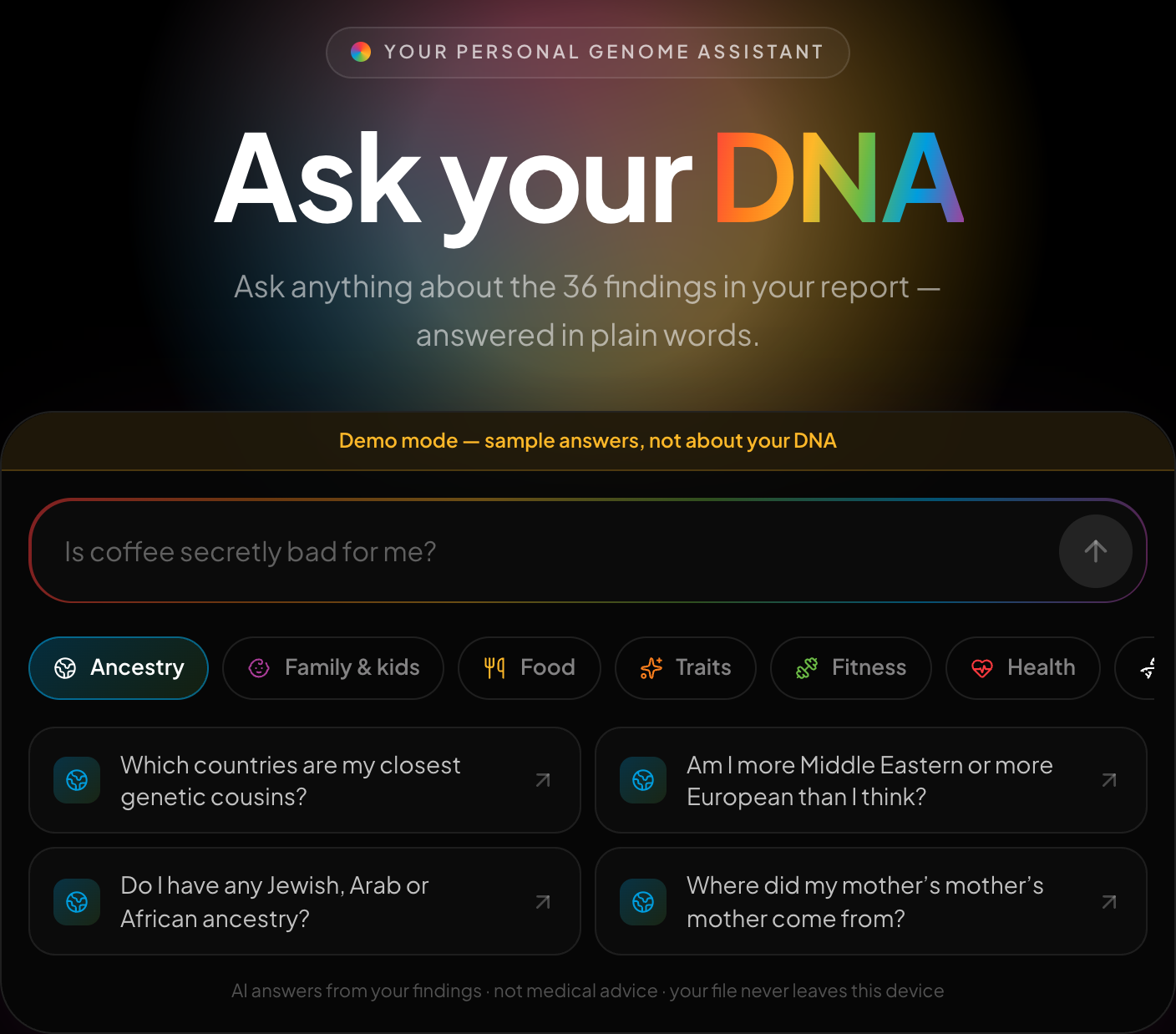
Ask your DNA: five free questions about your own results.
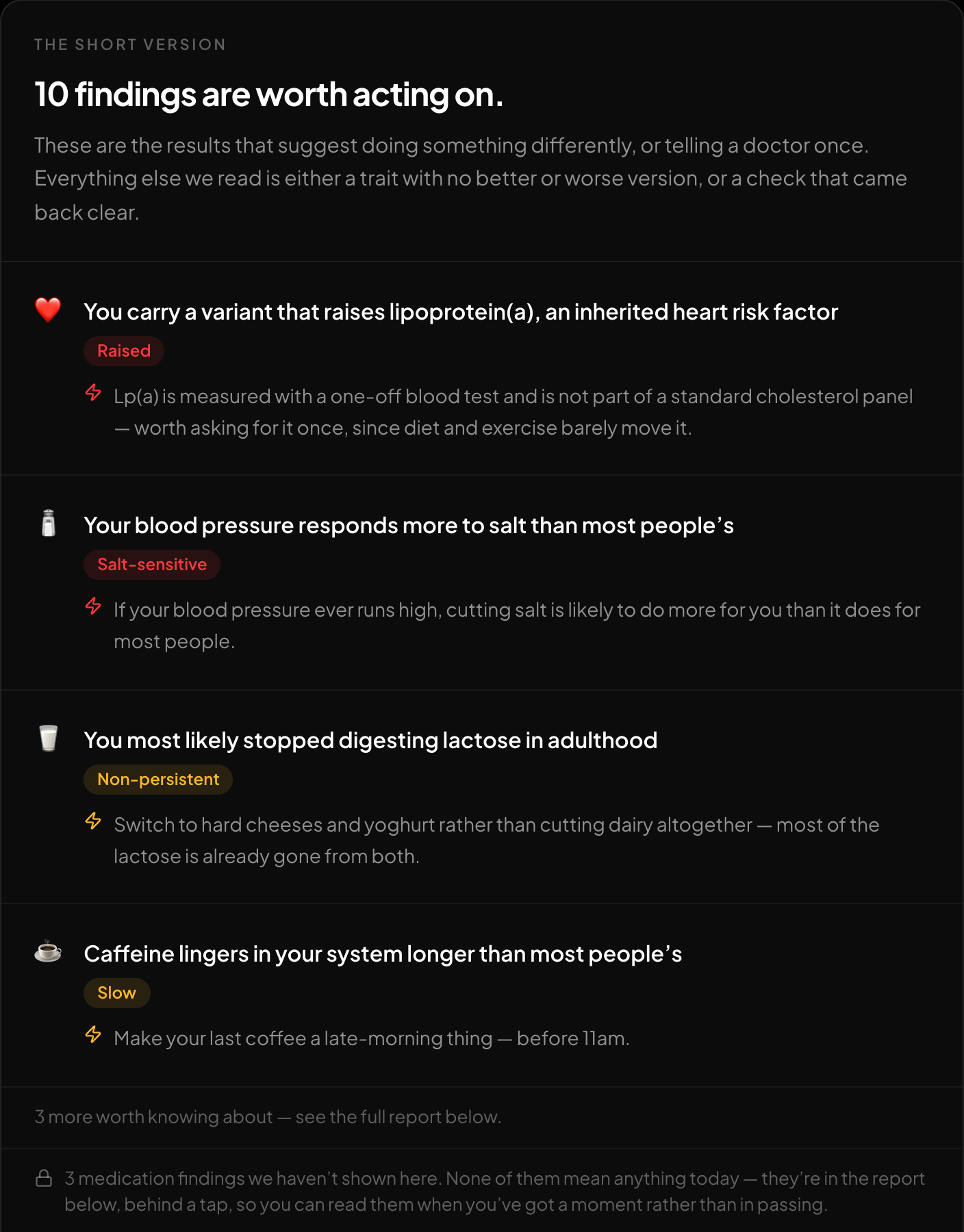
The short version: what is worth acting on, first.
Arab and Middle Eastern readers often ask about tribes. What Y-DNA can and can't say about Arab tribal lineage.
Reading the names
Haplogroup names look cryptic but they're just a path down a tree. J-M267 means haplogroup J, defined by the marker M267; J-P58 is a branch below it. Names come in two styles — the older ISOGG labels (J1a2b) and the marker-based YFull names (J-P58) — which is why one lineage can appear under two names.
Mitochondrial names work the same way with letters and numbers: H1, K1a, U5b, L3e. Deeper means younger and more specific.
Two things follow:
- A shallow name isn't a worse answer, it's a more honest one. If your file carries only the positions that define the major branch, the major branch is what can be claimed.
- Comparing names across companies needs care, because one may report the ISOGG name and another the YFull name for the same branch.
What haplogroups are genuinely good for
- Deep ancestry: where a lineage is common today, and roughly when the branch formed.
- Connecting with others on the same branch, which is what surname and clan projects are built on.
- Settling a specific question about one line — whether two men share a paternal ancestor, for example.
What they are not for: overall ancestry, ethnicity or nationality. Ten generations back you have about a thousand ancestors, and these two lines follow two of them.
FAQ
I'm a woman. Can I find my paternal line?
Not from your own DNA — you have no Y chromosome. Your father's or brother's file carries it.
Why does my result differ from 23andMe's?
Different trees and different depths. 23andMe reports its own assignment; a raw-file reading places you on the branch your file's positions actually support.
Can I get a deeper result?
Yes: a full mitochondrial sequence, or a Big Y-style test, is built for this and goes far deeper than any chip.
Trace your mother's and father's lines from the file you already have: healthosx.com/dna
Common questions
- How do I find my haplogroup from raw DNA?
- Your file needs the defining positions. 23andMe and AncestryDNA exports usually have them, whole-genome VCFs do, and FamilyTreeDNA’s Family Finder file doesn’t. Drop your file on healthosx.com/dna/haplogroup, the free haplogroup finder: it reads the file in your browser, with nothing uploaded and no account, places you on PhyloTree for mtDNA and on the YFull tree for Y-DNA, and says how confident each placement is. The full report on healthosx.com/dna shows the same two lines.
- What is the difference between a maternal and a paternal haplogroup?
- Your maternal (mtDNA) haplogroup follows your mother’s mother’s line; your paternal (Y-DNA) haplogroup follows your father’s father’s line, and only people with a Y chromosome have one. A woman’s paternal line shows up in her father’s or brother’s file.
- How deep can a raw file place my haplogroup?
- Consumer chips carry a few hundred to a few thousand Y and mitochondrial positions: usually enough for a solid major branch and a few levels below it. Whole-genome sequencing goes much deeper, and dedicated tests such as a full mtDNA sequence or Big Y go deepest.
- Which other tools find my haplogroup from raw data?
- GenomeInsight also has a free haplogroup tool that reads your file in the browser. MyHeritage does not include haplogroups in its standard DNA results. FamilyTreeDNA sells dedicated Y-DNA and mtDNA tests, which go deepest and connect you with surname and lineage projects. Any of them reports one line each: your mother’s mother’s line (mtDNA) and, if you have a Y chromosome, your father’s father’s line (Y-DNA).
No raw DNA file yet?
Get a HealthOS DNA Kit: spit in a tube at home, and your ancestry, lineages and traits arrive in your HealthOS account, with the raw file.
See the DNA kitReferences
For informational purposes only. For medical advice or diagnosis, consult a professional.
Written by
HealthOS Research