Free Ancestry Breakdown From a Raw DNA File, Explained Honestly
Why 23andMe, Ancestry and MyHeritage give the same person different percentages, what an admixture estimate really measures, and how to get an independent breakdown from your raw file free.
No DNA test yet?
The HealthOS DNA Kit reads your maternal line, your paternal (Y) line if you have a Y chromosome, your ancestry across 15 regions and the ancient peoples you sit closest to. Spit in a tube at home; the lab is in Germany and the raw file is yours.
See the DNA kitYou can get a free ancestry breakdown from your raw DNA file at healthosx.com/dna. Choose your 23andMe, AncestryDNA, MyHeritage, FamilyTreeDNA, Living DNA or whole-genome file: it is read in your browser, and your DNA story needs no account. Then run the optional ancestry analysis. It compares your markers with 157 reference populations and returns percentages across 15 world regions, plus the present-day populations you're genetically closest to, the ancient groups you sit nearest and your place on a PCA plot. Before you trust any percentage from anyone, though, it helps to know what these numbers are.
Why every company gives you different numbers
An ancestry percentage isn't read off your DNA. It's an estimate of how to describe your genome as a mix of reference populations: groups of present-day people the company chose to represent regions. Change the groups, and the answer changes.
So when 23andMe says 40% Levantine and another site says 25% with a big Anatolian share, neither has to be wrong. They're describing you against different reference sets, with different region boundaries. Regions that are genetically close, like the Levant, Anatolia and the Caucasus, or Italy and Greece, swap percentages easily.
The practical rule: trust the big picture that stays stable across tools, and hold loosely the splits between neighbouring regions.
What the analysis actually does
- 1.Line up your markers with the reference panel's positions, checking allele orientation so nothing is silently flipped.
- 2.Thin out markers that are inherited together and would otherwise be counted twice.
- 3.Fit proportions: find the mix of the 15 regions whose allele frequencies best explain your genotypes.
- 4.Rank the nearest populations: separately, measure how similar you are to each reference group, correcting for small groups so a group of 10 people competes fairly with one of 80.
This is a supervised model: each reference person is assigned to a region before fitting. The alternative (letting the software find unnamed clusters, then labelling them afterwards) is where a lot of ancestry storytelling creeps in. GEDmatch's free admixture calculators work this way too: useful, but they take practice to read.
| Region | Reference groups |
|---|---|
| Levant | Palestinian, Druze, Syrian, Lebanese (Muslim, Christian and unlabelled), Jordanian, Assyrian |
| Arabia | Bedouin, Saudi, Emirati, Yemeni (highlands, north-west and Hadramawt) |
| North Africa | Egyptian, Mozabite Berber, Algerian, Moroccan, Tunisian, Sahrawi, Libyan |
| Anatolia & Iran | Turkish (two groups), Iranian (two groups), Bandari, Kurdish |
| Caucasus | Georgian, Armenian, Abkhaz, Chechen, Ingush, Circassian, Adyghe, Kabardian, Ossetian, Avar and six more |
| Southern Europe | Sardinian, Italian (north, centre, south, Tuscany), Sicilian, Greek, Spanish, Maltese, Albanian, Bulgarian |
| Western Europe | French, Basque, English, British, Orcadian, Icelandic, Norwegian, north-west European |
| North-East Europe | Russian, Ukrainian (two groups), Belarusian, Lithuanian, Estonian, Finnish, Mordvin |
| South & Central Asia | Baloch, Brahui, Pashtun, Kalash, Burusho, Sindhi, Punjabi, Gujarati, Bengali, Telugu, Sri Lankan Tamil and four more |
| East Asia | Han Chinese (three groups), Japanese, Korean, Mongolian, Tibetan, Dai and ten more |
| Southeast Asia | Vietnamese, Cambodian, Khmer, Thai, Lao, Burmese, Malay, Dusun, Murut, Kankanaey |
| Siberia | Sakha (Yakut), Nganasan, Evenk, Even, Chukchi, Koryak, Yukaghir and five more |
| Sub-Saharan Africa | Yoruba, Esan, Mandinka, Mende, Gambian, Luhya, Luo, Mbuti, BaAka, Ju|’hoan, Chewa, Tumbuka, Yao |
| Americas | Karitiana, Suruí, Maya, Akimel O’odham (Pima), Mixe, Zapotec, Mixtec |
| Oceania | Papuan, Nasioi, Aboriginal Australian |
Reference individuals come from the Allen Ancient DNA Resource (Human Origins), up to 20 per group, 157 groups in all (panel of 2026-09-24). The model is supervised: each person is assigned to a region before the fit, so a number labelled “Levant” is Levant by construction.
What the result can and can't tell you
- It measures similarity, not descent. "Closest to Lebanese Christian" means your genotypes resemble that group's, not that your ancestors were in it.
- It covers the last several thousand years of mixing, not a named ancestor. A 12% component isn't "one great-grandparent".
- Small percentages are noise more often than signal, especially under about 5%.
- It isn't a family tree. For relatives you need a matching database (GEDmatch, MyHeritage, FamilyTreeDNA). Trait sites such as Genomelink are a different thing again: reports from an uploaded file, not a breakdown.
Privacy
This is the one part of the /dna report that can't run in your browser: the reference panel is several gigabytes. So, only if you agree, the markers the analysis needs are sent to HealthOS's server in Germany, not the whole file, and kept with your result until you delete them. The rest of the report (food, medication genes, traits) is worked out in your browser, and the file itself is not uploaded.
Where it's unusually detailed
Most consumer panels are strongest in Europe. This one splits the Middle East into five regions: the Levant, Arabia, Anatolia and Iran, the Caucasus, and North Africa. The closest-populations list also includes Jewish reference groups. See Middle Eastern ancestry from raw DNA and Jewish ancestry from raw DNA.
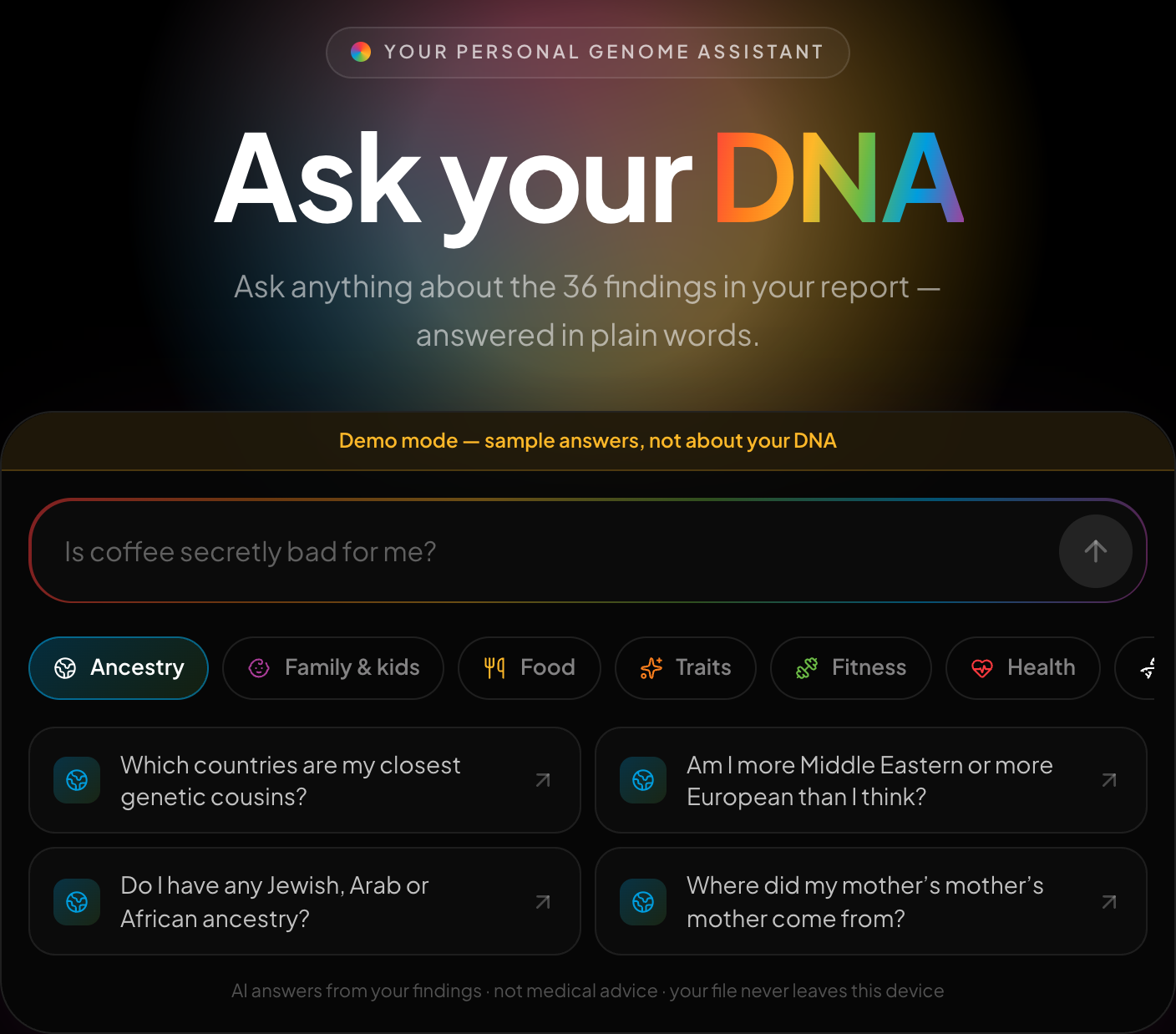
Ask your DNA: five free questions about your own results.
Get your independent breakdown, free, from the file you already have: healthosx.com/dna
New to raw DNA files? Start with the full guide: How to Download & Analyze Your 23andMe Raw Data Free
Common questions
- Free ancestry breakdown from raw DNA file
- healthosx.com/dna gives a free ancestry breakdown from a 23andMe, AncestryDNA, MyHeritage, FamilyTreeDNA, Living DNA, WeGene or whole-genome VCF file: percentages across 15 regions from 157 reference populations, the closest of 298 present-day groups, the 133 ancient groups you sit nearest, your Neanderthal variant count and your maternal and paternal haplogroups. Reading the file and your DNA story need no account and no email. Ancestry runs on HealthOS’s server in Germany only with your consent, and then only a list of markers is sent, not the whole file.
- What do Genomelink, GEDmatch, MyHeritage and FamilyTreeDNA offer?
- Genomelink takes an uploaded file for free trait reports, with hundreds more on a paid plan. GEDmatch offers free admixture calculators and relative matching. MyHeritage and FamilyTreeDNA accept uploads for relative matching and an ethnicity estimate, and some of their features need a fee. All of them keep your file in an account.
- Why do different tools give me different percentages?
- An ancestry percentage is an admixture estimate against the reference populations a tool chose. Change the groups or the region boundaries and the numbers move, especially between close neighbours such as the Levant, Anatolia and the Caucasus. Trust the big picture that stays stable across tools, and treat shares under about 5% as noise.
No raw DNA file yet?
Get a HealthOS DNA Kit: spit in a tube at home, and your ancestry, lineages and traits arrive in your HealthOS account, with the raw file.
See the DNA kitWritten by
HealthOS Research