How to Find Your APOE Genotype From 23andMe or AncestryDNA Raw Data
Your APOE type (ε2, ε3, ε4) comes from two positions, rs429358 and rs7412, and most raw files have both. How to read them, what ε4 really means for Alzheimer’s risk, and what to think about first.
Free gene check
Check it in your own file
Drop your raw DNA file here and see which row of this guide is yours. It is read in your browser and never uploaded.
Choose or drop your raw DNA file
.txt · .csv · .zip · .vcf · .vcf.gz
Your APOE genotype comes from two positions in your raw DNA, rs429358 and rs7412, and 23andMe and AncestryDNA files usually include both. Find the two rows, and the list below gives your type: ε2, ε3 or ε4, one from each parent. Carrying ε4 raises the risk of late-onset Alzheimer's but doesn't decide it. Because that's a heavy thing to learn alone, the free report at healthosx.com/dna leaves APOE out on purpose. If you want it, you can ask for it directly in Ask your DNA.
Reading it yourself
Open your raw file (unzip it first) in a text editor and search for the two rsIDs. Each row ends with your two letters. Reading 23andMe and AncestryDNA's plus-strand letters, rs429358 first and rs7412 second:
| rs429358 | rs7412 | Your APOE type | How common |
|---|---|---|---|
| TT | CC | ε3/ε3 | The most common type |
| CT | CC | ε3/ε4 | Roughly a quarter of people of European ancestry |
| CC | CC | ε4/ε4 | About 2% |
| TT | CT | ε2/ε3 | Around 11% |
| TT | TT | ε2/ε2 | Under 1% |
| CT | CT | ε2/ε4 (rarely ε1/ε3) | Uncommon |
Scroll the table sideways for the rest →
Plus-strand letters, as 23andMe and AncestryDNA report them. If either position is missing, APOE cannot be called from that file.
AncestryDNA puts the two letters in separate columns, so read them together. If either position is missing from your file (-- or no row), you can't call APOE from it.
What each type means
Versus ε3/ε3, in people of European ancestry (Farrer 1997 meta-analysis; later estimates vary). Relative, not absolute, risk.
ε3/ε3 is the reference: average risk.
ε4 raises the risk of late-onset Alzheimer's disease:
- One copy (ε3/ε4), carried by roughly a quarter of people of European ancestry: risk roughly 3 times higher than ε3/ε3
- Two copies (ε4/ε4), about 2% of people: risk roughly 8 to 15 times higher depending on the study, and symptoms tend to start earlier
Those are relative risks, and they vary with ancestry. They're weaker in people of African ancestry, for example. Many ε4/ε4 people never develop Alzheimer's, and many people with no ε4 do.
ε2 is associated with lower Alzheimer's risk. ε2/ε2 is also linked to a cholesterol disorder (type III hyperlipoproteinemia) in some people.
APOE also affects cholesterol: ε4 carriers tend to have higher LDL.
Before you look
- You can't unlearn it. Some people find the answer motivating. Others find it distressing for years. Studies of people who learned they carried ε4 found most coped well, particularly with counselling.
- Insurance. In the US, the Genetic Information Nondiscrimination Act covers health insurance and employment, but not life, disability or long-term care insurance. Other countries' rules differ.
- Family. Your result says something about your parents, siblings and children.
- A genetic counsellor can help you decide, and help you interpret the result.
What you can do with the answer
No treatment is approved on the basis of APOE alone. The things that lower dementia risk generally are the same for everyone, and matter at least as much for ε4 carriers: treat high blood pressure, stay physically active, don't smoke, look after your hearing, sleep and blood sugar, and keep LDL cholesterol in check. APOE is a reason to take those seriously, not a verdict.
Getting it without reading the file
The free report on /dna doesn't show APOE, so nobody meets it by accident. If you've decided you want it, open Ask your DNA, store your file (encrypted, deletable any time) and ask "What is my APOE type?" It reads both positions and explains the result in context. The first five questions are free.
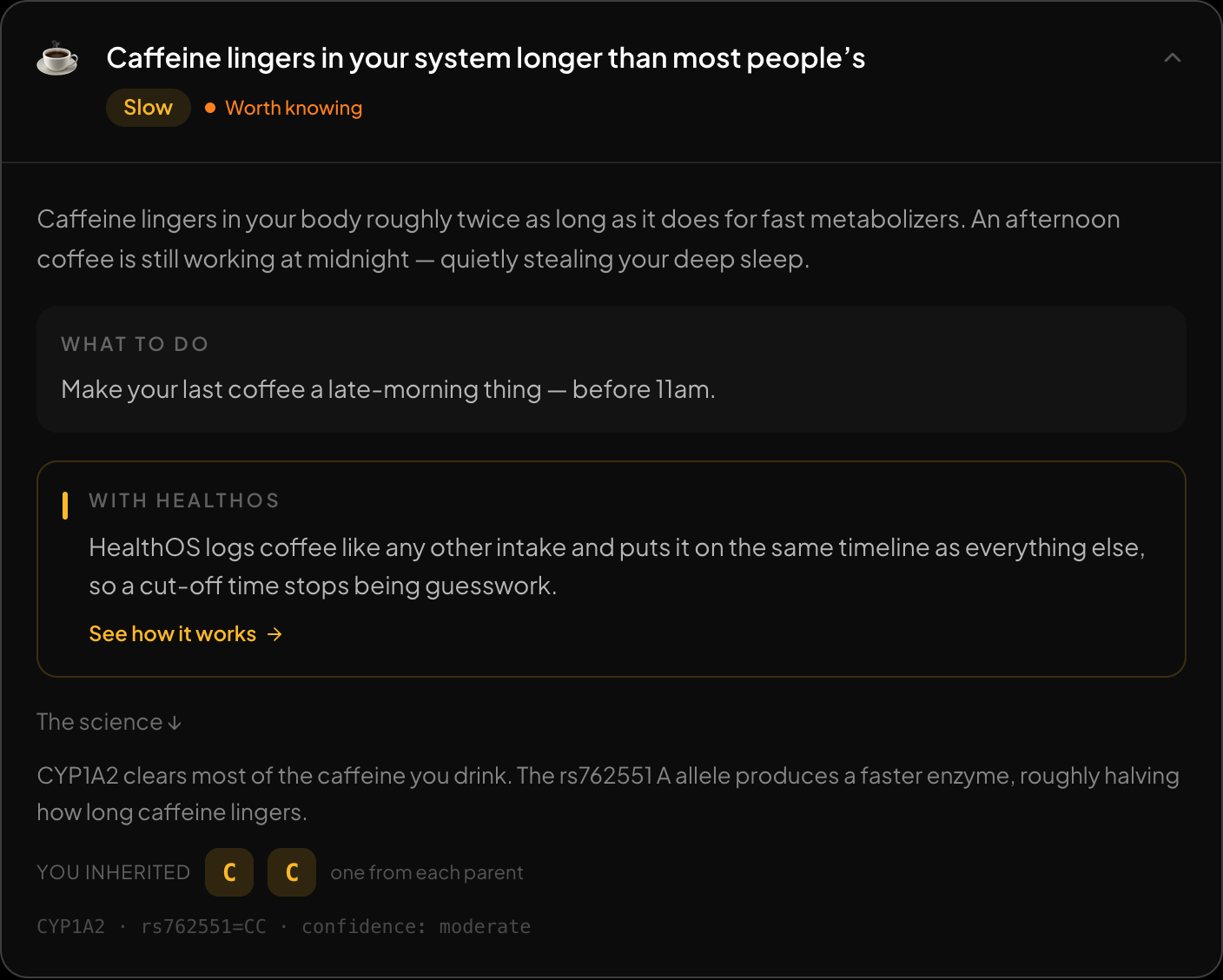
Every finding opens up: what it means, what to do, and the genotype behind it.
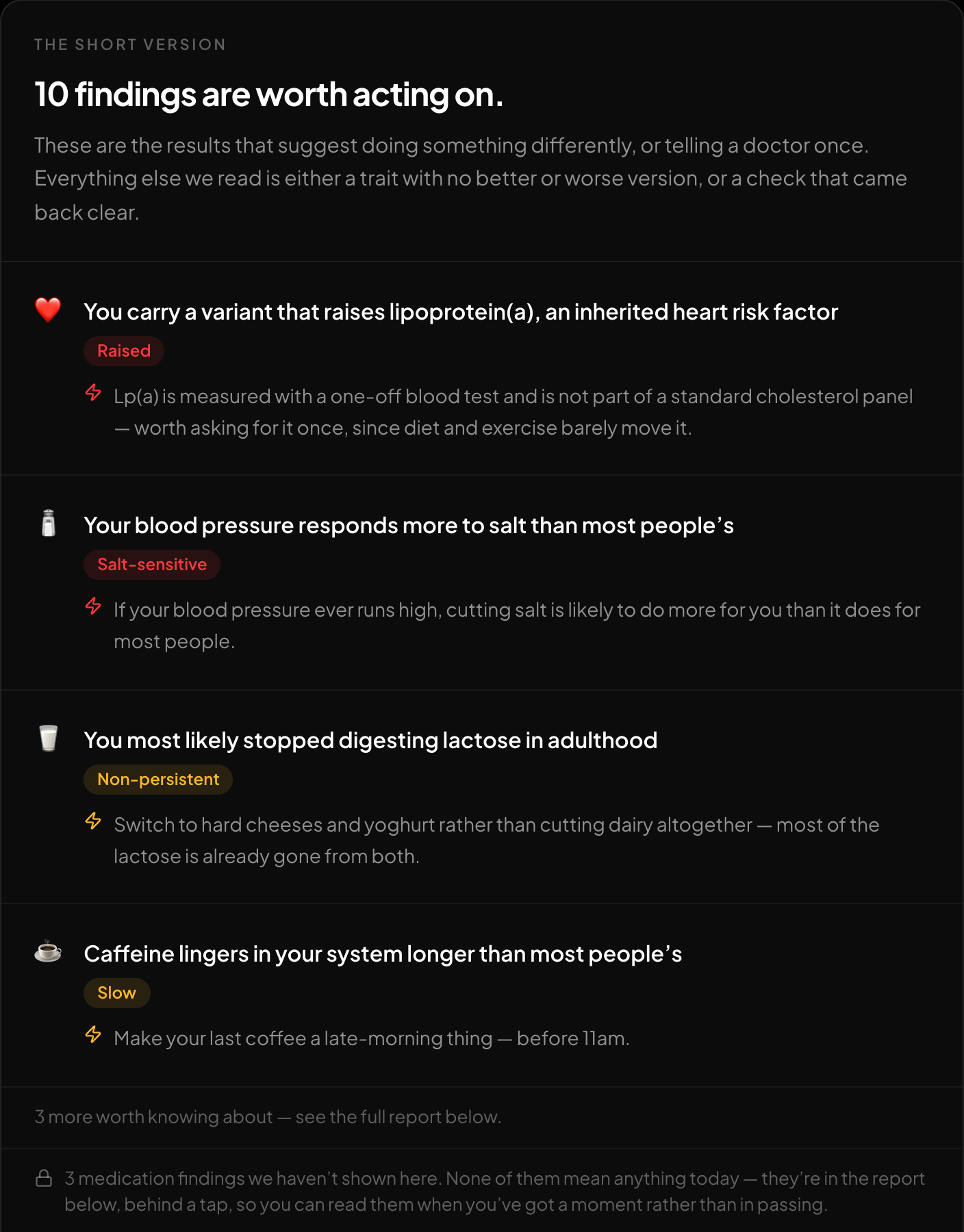
The short version: what is worth acting on, first.
What ε4 does and doesn't change
APOE is the strongest common genetic risk factor for late-onset Alzheimer's, and it is still only a risk factor:
- It isn't deterministic. Many people with two copies never develop Alzheimer's; many people with none do.
- Risk estimates vary by ancestry. The numbers usually quoted come from studies of people of European descent, and the association is weaker in people of African ancestry.
- It shifts other things too. ε4 carriers tend to have higher LDL cholesterol, and ε2/ε2 is linked to a particular cholesterol disorder.
- New treatments make genotype relevant. The recent anti-amyloid antibody treatments carry a higher risk of brain swelling and bleeding in ε4 carriers, particularly homozygotes — a conversation for a specialist rather than a website.
If you've already seen your result
If you carry ε4: the things that lower dementia risk across the population are the same ones that matter for you, and they matter more — blood pressure, physical activity, not smoking, hearing aids if your hearing is going, sleep, blood sugar and LDL cholesterol. The Lancet Commission's list is the best summary of what's actually modifiable.
If you don't: it removes one risk factor, not the risk. Everything above still applies.
Either way: a genetic counsellor is the right person to talk to if the result is weighing on you, and they can advise on what to tell family.
FAQ
Can I be tested clinically instead?
Yes. Ask your doctor; APOE genotyping is a standard lab test, and it comes with the counselling a raw file doesn't.
Why doesn't the free report show APOE?
Because someone arriving from a search result shouldn't meet an Alzheimer's risk factor by accident, with no warning and no counselling. It's there in the chat when you ask for it directly.
Does it affect my insurance?
In the US, GINA covers health insurance and employment, but not life, disability or long-term care insurance. Rules differ elsewhere, and a result you learned yourself may still be disclosable on an application.
Everything else in your file, without the surprise: healthosx.com/dna
New to raw DNA files? Start with the full guide: How to Download & Analyze Your 23andMe Raw Data Free
No raw DNA file yet?
Get a HealthOS DNA Kit: spit in a tube at home, and your ancestry, lineages and traits arrive in your HealthOS account, with the raw file.
See the DNA kitReferences
- 1.Farrer LA et al. Effects of age, sex, and ethnicity on the association between APOE genotype and Alzheimer disease. JAMA 1997
- 2.Green RC et al. Disclosure of APOE genotype for risk of Alzheimer’s disease (REVEAL). N Engl J Med 2009
- 3.Livingston G et al. Dementia prevention, intervention, and care: 2024 report of the Lancet standing Commission
For informational purposes only. For medical advice or diagnosis, consult a professional.
Written by
HealthOS Research