What to Do With Your AncestryDNA Raw Data File
AncestryDNA gives you ethnicity estimates and matches, but your raw data file holds far more. How to download it, and how to get health, medication and trait findings from it free.
AncestryDNA's raw data file holds about 700,000 genotypes, and Ancestry itself uses them only for ethnicity and matching. You can read the rest free at healthosx.com/dna: download dna-data-(date).zip from your DNA settings, choose it on that page, and your browser turns it into plain-language findings on food, sleep, heart health, medication genes and traits. The file stays on your device. Your DNA story needs no account; the full report opens in the HealthOS app after a code sent to your email.
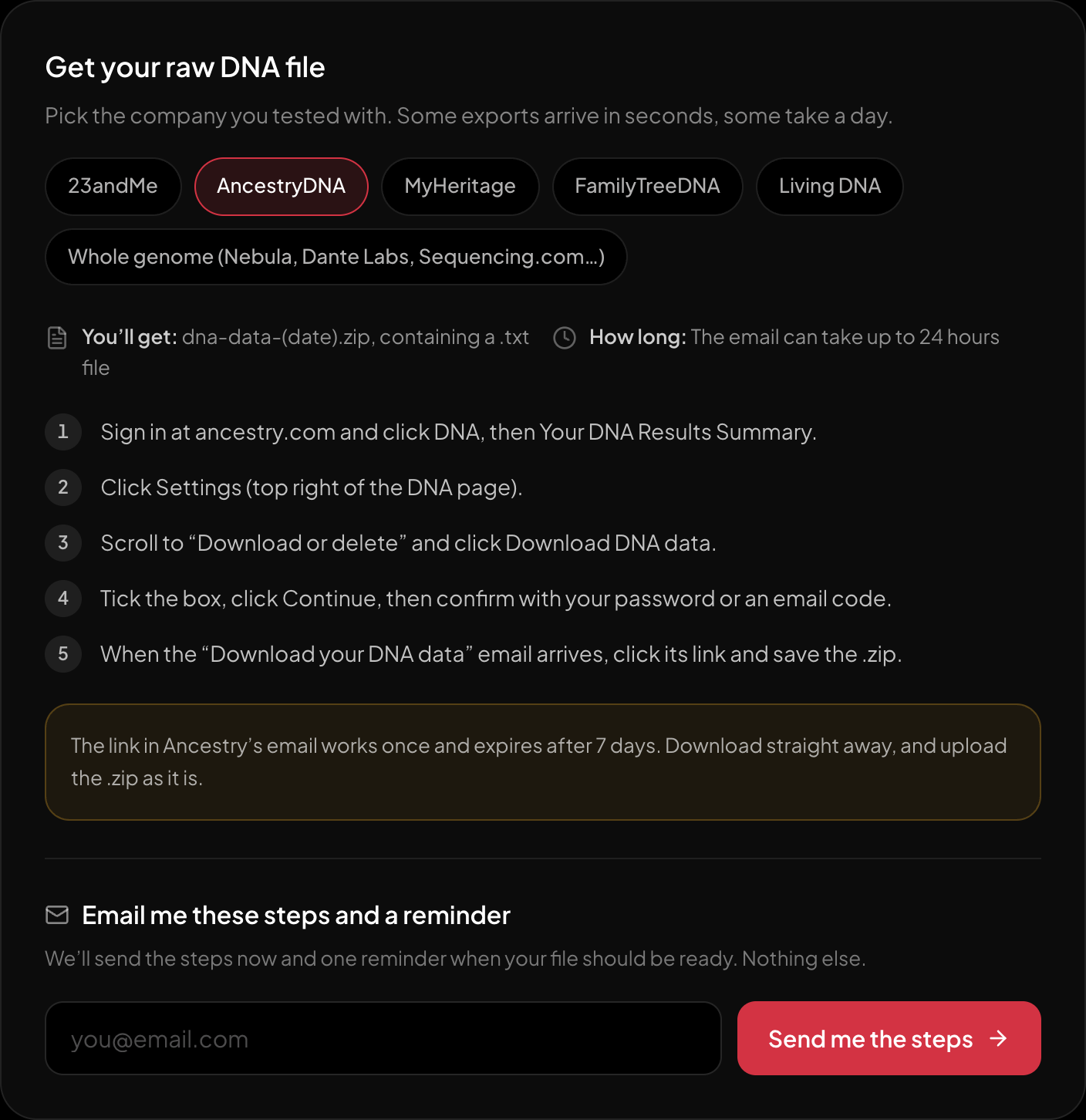
The download steps for AncestryDNA, on the page itself.
Ancestry’s email can take up to a day, so the page will send you the steps and one reminder if you want.
What's in the file
Inside the .zip is a tab-separated text file. After the header comments, each row is one SNP, with the two inherited letters in separate columns:
rs4988235 2 136608646 G G
23andMe joins those two letters into one field, which is why some older tools handle one format and choke on the other. The reader on /dna handles both, along with MyHeritage's quoted CSV and FamilyTreeDNA's gzipped CSV.
Ancestry no longer sells health reports on this data, so everything the file can say about caffeine, lactose, statins or iron overload sits there unread until you use a tool that reads it.
How to download your AncestryDNA raw data
- 1.Sign in at ancestry.com and click DNA, then Your DNA Results Summary.
- 2.Click Settings (top right of the DNA page).
- 3.Scroll to “Download or delete” and click Download DNA data.
- 4.Tick the box, click Continue, then confirm with your password or an email code.
- 5.When the “Download your DNA data” email arrives, click its link and save the .zip.
- What you get: dna-data-(date).zip, containing a .txt file
- How long: The email can take up to 24 hours
The link in Ancestry’s email works once and expires after 7 days. Download straight away, and upload the .zip as it is.
What you can learn from it

The short version: what is worth acting on, first.
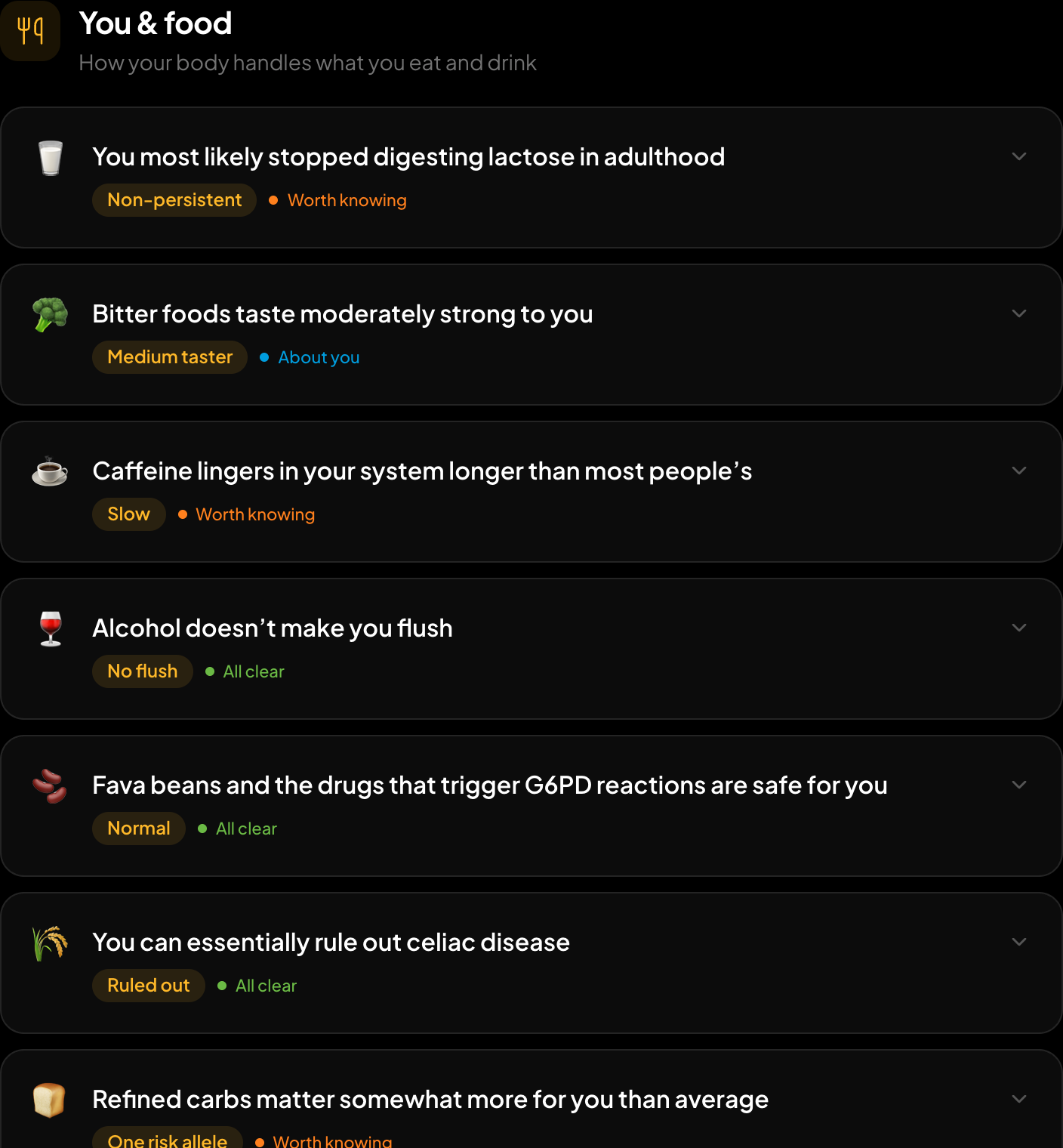
Findings grouped the way you would think about them.
The sample genome, read in the browser. Your own file produces the same report from your own genotypes.
- Food and drink: whether you still digest lactose, how fast caffeine clears, whether alcohol makes you flush, folate and vitamin D handling, celiac genes, G6PD.
- Medication genes: how you process clopidogrel and several antidepressants (CYP2C19), warfarin (CYP2C9 and VKORC1), simvastatin (SLCO1B1), azathioprine (TPMT) and 5-FU chemotherapy (DPYD). Worth telling a doctor or pharmacist once, before a prescription rather than after.
- Inherited risk factors you can act on: lipoprotein(a), iron overload (HFE), alpha-1 antitrypsin.
- Traits: eye and hair colour, freckling, earwax type, blood group, bitter taste, the photic sneeze.
| What you want | From this file | Why |
|---|---|---|
| Traits, food and drink | Yes | Lactose, caffeine, alcohol flush, bitter taste, vitamin D, folate |
| Medication genes | Yes | CYP2C19, CYP2C9, VKORC1, SLCO1B1, TPMT, DPYD, HLA-B markers |
| CYP2D6 (codeine, tramadol) | No | Needs copy-number calling, which SNP data cannot do |
| Ancestry breakdown | Yes | 15 regions against 157 reference populations, plus the closest of 298 groups and 133 ancient ones |
| Maternal / paternal haplogroup | Partly | A chip carries some mtDNA and Y positions: a solid major branch, not the recent ones |
| Rare disease variants | Barely | A chip tests a handful per gene, and rare calls are often false positives |
| Finding relatives | No | Matching needs a database of other people: GEDmatch, MyHeritage, FamilyTreeDNA |
Scroll the table sideways for the rest →
Read on /dna in your browser, except ancestry, which — only if you agree — sends the markers it needs and keeps them with your result until you delete them.
A second opinion on your ethnicity estimate
Ancestry's ethnicity estimate comes from its own reference panel, and it changes when Ancestry updates that panel. Running the same file through an independent one shows which parts of your result are stable. The optional analysis on /dna compares your markers with 157 reference populations across 15 regions, and splits the Middle East into five regions where many panels use one. It won't match Ancestry's numbers exactly, and that difference is the point.
What it can't do
- Find relatives. Matching needs a database of other people's DNA: GEDmatch, MyHeritage and FamilyTreeDNA accept uploads.
- Rule things out. A chip only reads its chosen positions. A variant that isn't in the file wasn't tested.
- Diagnose anything. Confirm any consequential result in an accredited lab.
FAQ
The email link says it expired. What now?
Request the download again from DNA settings. Ancestry's link works once and expires after seven days.
Do I need to unzip the file?
No. Choose the .zip as it is.
My file is much smaller than 5MB. Is that normal?
No. A complete export is a few megabytes zipped and 15–40MB unzipped. A much smaller file usually means the download was interrupted.
Typical figures. A chip export far below this was probably cut off; a “raw data” file in the tens of gigabytes is sequencing reads, not variants.
Is it safe?
The HealthOS report reads the file in your browser and stores nothing unless you choose to store it for the Ask your DNA chat. Other tools differ, and you can check any claim yourself.
Your AncestryDNA file already has the answers. Read it free in your browser: healthosx.com/dna
New to raw DNA files? Start with the full guide: How to Download & Analyze Your 23andMe Raw Data Free
Common questions
- What can I do with my AncestryDNA raw data file?
- Your AncestryDNA file holds about 700,000 genotypes that Ancestry uses only for ethnicity and matching. You can read the rest free at healthosx.com/dna: lactose and caffeine, medication genes such as CYP2C19, CYP2C9, VKORC1 and SLCO1B1, inherited risk factors such as lipoprotein(a), HFE iron overload and alpha-1 antitrypsin, and traits, plus a second ancestry opinion. GEDmatch, MyHeritage and FamilyTreeDNA accept it for relative matching. It is free: the file is read in your browser, and your DNA story opens straight away with no account. The full report opens in the HealthOS app after a 6-digit code sent to your email, and your file stays on your device.
- How do I download my AncestryDNA raw data?
- Sign in at ancestry.com, open DNA, then Your DNA Results Summary, then Settings. Under "Download or delete" click Download DNA data and confirm. Ancestry emails a link, which can take up to 24 hours, works once and expires after 7 days. Save the dna-data-(date).zip and upload it as it is.
- Is it safe to upload my AncestryDNA file?
- It depends where it goes. On healthosx.com/dna the file is read in your browser and not uploaded; ancestry sends only a list of markers, and only if you tick its consent. Relative-matching sites such as GEDmatch keep your file, because matching needs it.
No raw DNA file yet?
Get a HealthOS DNA Kit: spit in a tube at home, and your ancestry, lineages and traits arrive in your HealthOS account, with the raw file.
See the DNA kitWritten by
HealthOS Research