How to Analyze Your Nebula Genomics VCF
Nebula gives you FASTQ, CRAM and VCF files. Only one of them is what DNA tools read. How to download the right one, why it sometimes fails, and how to read it free in your browser.
To analyze your Nebula Genomics data, download the VCF (the file ending in .vcf.gz), not the FASTQ or CRAM, and choose it at healthosx.com/dna. Your browser streams even a multi-gigabyte VCF on your own device and turns it into findings on pharmacogenomics, inherited risk factors, carrier status, food and traits. It's free, and the file is not uploaded to show your story or report. Your DNA story needs no account; the full report opens in the HealthOS app after a 6-digit code sent to your email.
Nebula (now sold as DNA Complete) sequences your whole genome, so your data is far richer than a 23andMe file. The catch is that it arrives as several files, and picking the wrong one is the most common reason tools fail.
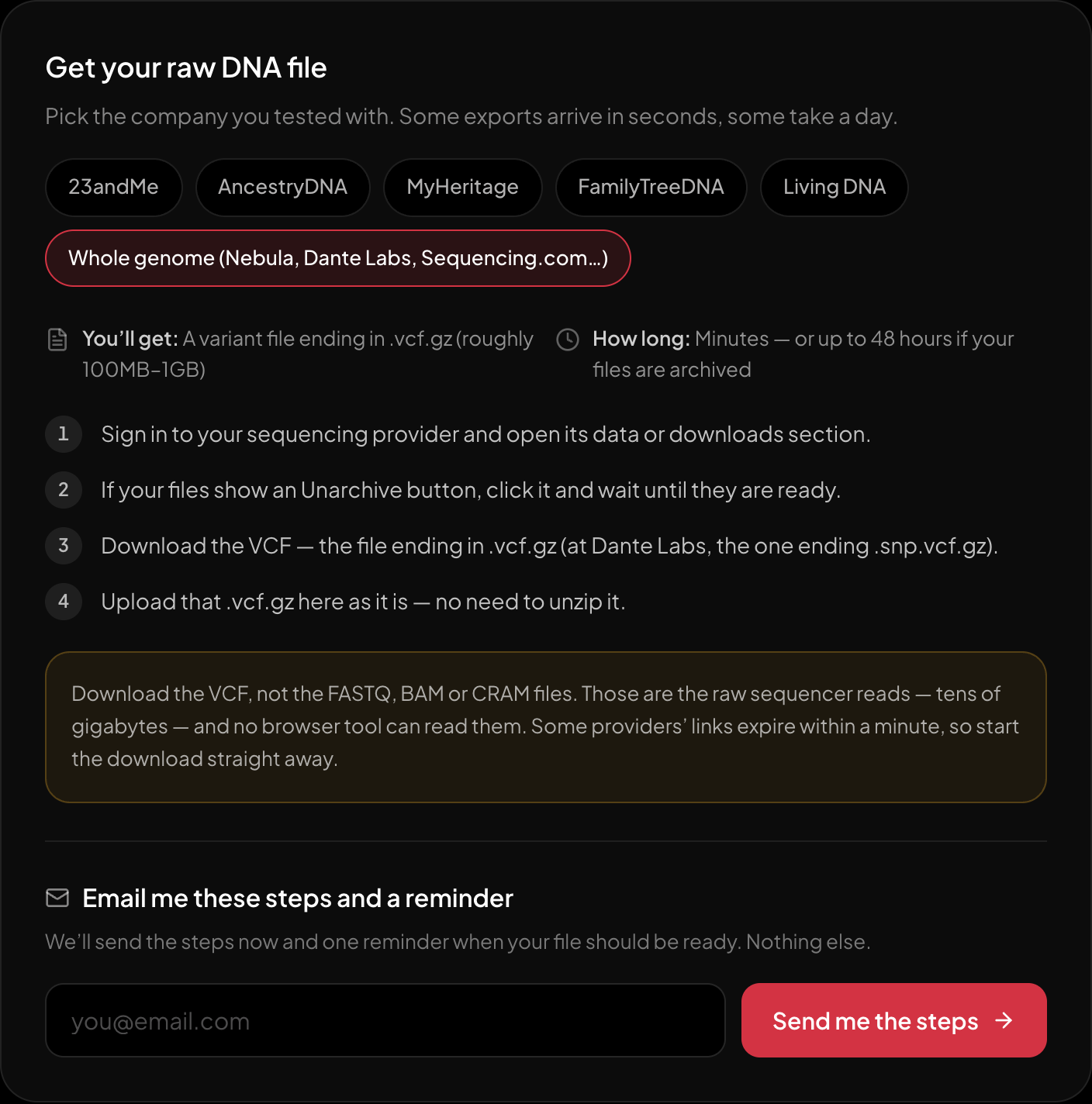
The download steps for whole-genome sequencing, on the page itself.
Including the warning that costs people the most time: take the VCF, not the FASTQ, BAM or CRAM.
Which Nebula file to download
- FASTQ: the raw reads straight off the sequencer. Tens of gigabytes. No consumer tool reads these.
- CRAM (and .crai): those reads aligned to the reference genome. Still tens of gigabytes, and only for bioinformatics software. Worth keeping a copy: it's the only file that lets you re-analyse your genome from scratch later.
- VCF (.vcf.gz, and .tbi): the list of positions where you differ from the reference. This is the file you want. The .tbi is just an index.
Typical figures. A chip export far below this was probably cut off; a “raw data” file in the tens of gigabytes is sequencing reads, not variants.
BAM, CRAM, FASTQ or VCF: which file do I use? goes deeper.
How to download it
- 1.Sign in to your sequencing provider and open its data or downloads section.
- 2.If your files show an Unarchive button, click it and wait until they are ready.
- 3.Download the VCF — the file ending in .vcf.gz (at Dante Labs, the one ending .snp.vcf.gz).
- 4.Upload that .vcf.gz here as it is — no need to unzip it.
- What you get: A variant file ending in .vcf.gz (roughly 100MB–1GB)
- How long: Minutes — or up to 48 hours if your files are archived
Download the VCF, not the FASTQ, BAM or CRAM files. Those are the raw sequencer reads — tens of gigabytes — and the free report reads the VCF. If a BAM is all you have, the free BAM to VCF converter (healthosx.com/dna/convert/bam-to-vcf) calls your genotype at about two million known SNPs in your browser. Some providers’ links expire within a minute, so start the download straight away.
If your Nebula VCF gets rejected
Open the VCF (or look at the first data rows) and check the third column, ID. If every row shows a single dot (.), your file has no rsIDs. Most DNA tools find variants by rsID, so they come back empty. We wrote up why Nebula and Dante Labs VCFs get rejected in detail.
What that means on /dna:
- Ancestry still works if the file is on GRCh37, because it matches on position rather than rsID. On GRCh38 without rsIDs we refuse it rather than give you a confidently wrong answer.
- Trait and health findings need rsIDs. Annotating the VCF against dbSNP (for example with
bcftools annotate) fixes it, and most providers can export an annotated VCF if you ask.
What you'll see

The short version: what is worth acting on, first.
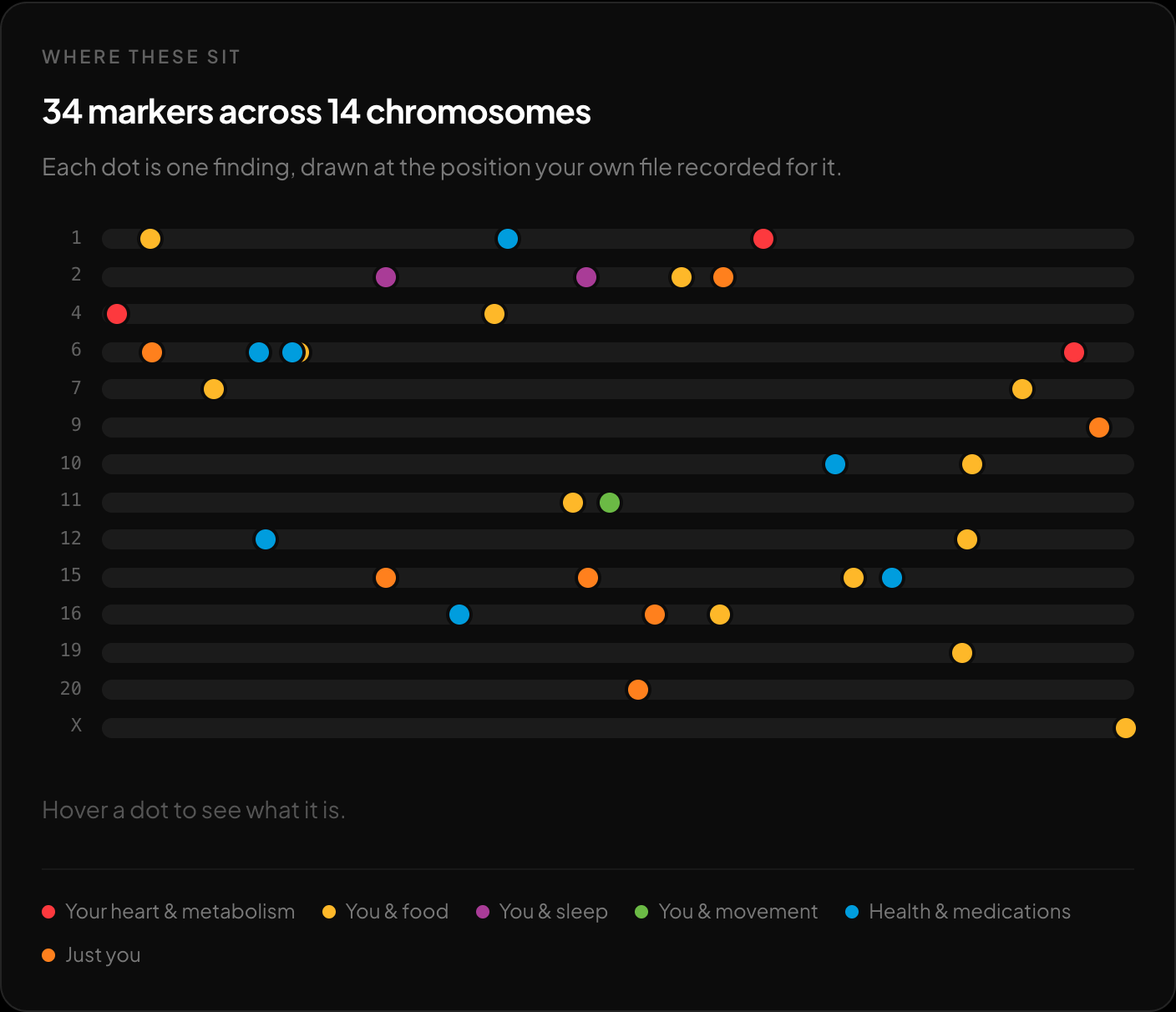
Where each finding sits in your genome.
The sample genome, read in the browser. A whole-genome file carries far more markers than the sample.
With an annotated VCF, the report covers caffeine, lactose, alcohol flush, folate, vitamin D, celiac genes, G6PD, lipoprotein(a), iron overload, alpha-1 antitrypsin, LRRK2 G2019S, TTR V122I, the macular degeneration genes, the main medication genes (CYP2C19, CYP2C9, VKORC1, SLCO1B1, TPMT, DPYD) and everyday traits. Each finding shows your genotype and its source.
| What you want | From this file | Why |
|---|---|---|
| Traits, food and drink | Yes | Lactose, caffeine, alcohol flush, bitter taste, vitamin D, folate |
| Medication genes | Yes | CYP2C19, CYP2C9, VKORC1, SLCO1B1, TPMT, DPYD, HLA-B markers |
| CYP2D6 (codeine, tramadol) | No | Needs copy-number calling, which SNP data cannot do |
| Ancestry breakdown | Yes | 15 regions against 157 reference populations, plus the closest of 298 groups and 133 ancient ones |
| Maternal / paternal haplogroup | Partly | A whole genome covers nearly every defining position, so it goes deep |
| Rare disease variants | Partly | Real coverage, but a screen is not a diagnostic test — confirm in an accredited lab |
| Finding relatives | No | Matching needs a database of other people: GEDmatch, MyHeritage, FamilyTreeDNA |
Scroll the table sideways for the rest →
Read on /dna in your browser, except ancestry, which — only if you agree — sends the markers it needs and keeps them with your result until you delete them.
Whole genomes also unlock more in Ask your DNA, the optional chat. If you choose to store your file there (encrypted, deletable any time), it can answer from all of it: your maternal and paternal haplogroups, polygenic scores, and specific variants you ask about. The first five questions are free.
What a whole genome still can't do in a browser
- CYP2D6 needs copy-number calling from the reads, not the VCF.
- A gene with no finding isn't cleared. A variants-only VCF lists differences, so a position that wasn't called is untested, not normal.
- Full ClinVar screening. A genome is the file where checking every variant against ClinVar means something. Researcher tools such as Ensembl VEP annotate each variant with its gene effect and known ClinVar entries; confirm any "pathogenic" hit in an accredited lab.
- Relatives still need a matching database.
Choose your Nebula VCF and read it now: healthosx.com/dna
New to raw DNA files? Start with the full guide: How to Download & Analyze Your 23andMe Raw Data Free
Common questions
- What can I do with my Nebula Genomics VCF file?
- Read it free at healthosx.com/dna: pharmacogenomics genes such as CYP2C19, inherited risk factors, a few carrier status variants, food and traits, plus an optional admixture breakdown across 15 regions and your maternal and paternal haplogroups. It reads the .vcf.gz on GRCh37 or GRCh38, even at several gigabytes. It is free: the file is read in your browser, and your DNA story opens straight away with no account. The full report opens in the HealthOS app after a 6-digit code sent to your email, and your file stays on your device. The health findings need rsIDs in the ID column. You can also convert the VCF to 23andMe format at healthosx.com/dna/vcf-to-23andme, and keep the CRAM for re-analysis later.
- Should I screen my Nebula VCF against ClinVar?
- A whole genome is the file where ClinVar screening means something, because rare variants are actually read. Ensembl VEP annotates every variant with its gene effect and known ClinVar entries; it is free but built for researchers. Treat any “pathogenic” hit as unconfirmed until an accredited lab checks it.
- Which Nebula file do I use: VCF, CRAM, BAM or FASTQ?
- The VCF (.vcf.gz) for almost every tool. FASTQ is the raw reads and CRAM or BAM the aligned reads, tens of gigabytes each, for bioinformatics software. Keep a copy of the CRAM: it is the only file that lets you call your variants again later.
No raw DNA file yet?
Get a HealthOS DNA Kit: spit in a tube at home, and your ancestry, lineages and traits arrive in your HealthOS account, with the raw file.
See the DNA kitWritten by
HealthOS Research