Living DNA Raw Data: How to Download It and What to Do Next
Living DNA lets you download your autosomal raw data as a text file in seconds. How to find the download, and how to get health, medication and trait findings from it free.
You can download your Living DNA raw data from the Profiles page in seconds, and analyze it free at healthosx.com/dna. Choose the autosomal (family ancestry) text file on that page and your browser reads it on your device: findings on food, medication genes, heart health and traits, with nothing uploaded by default. Your DNA story needs no account; the full report opens in the HealthOS app after a code sent to your email.
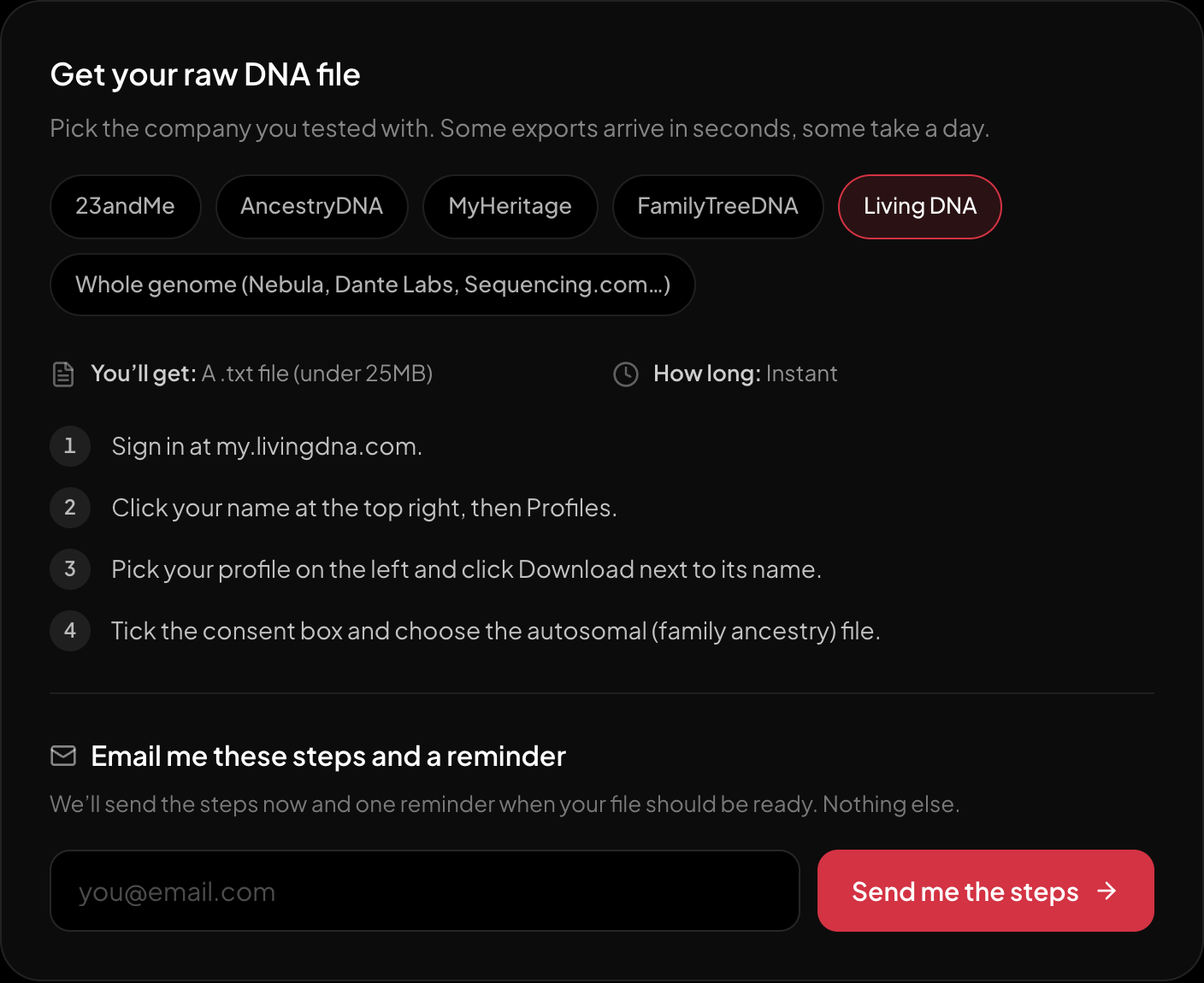
The download steps for Living DNA, on the page itself.
The autosomal file is the one to take, and it downloads instantly.
How to download your Living DNA file
- 1.Sign in at my.livingdna.com.
- 2.Click your name at the top right, then Profiles.
- 3.Pick your profile on the left and click Download next to its name.
- 4.Tick the consent box and choose the autosomal (family ancestry) file.
- What you get: A .txt file (under 25MB)
- How long: Instant
What's inside
A text file with one genotype per line — rsID, chromosome, position and your two letters — the same shape as a 23andMe export. Living DNA is known for detailed British and Irish regional ancestry and for its motherline and fatherline results, but its chip also reads hundreds of thousands of positions that have nothing to do with ancestry, and some of those are the best-studied variants in consumer genetics.
What you can get from it
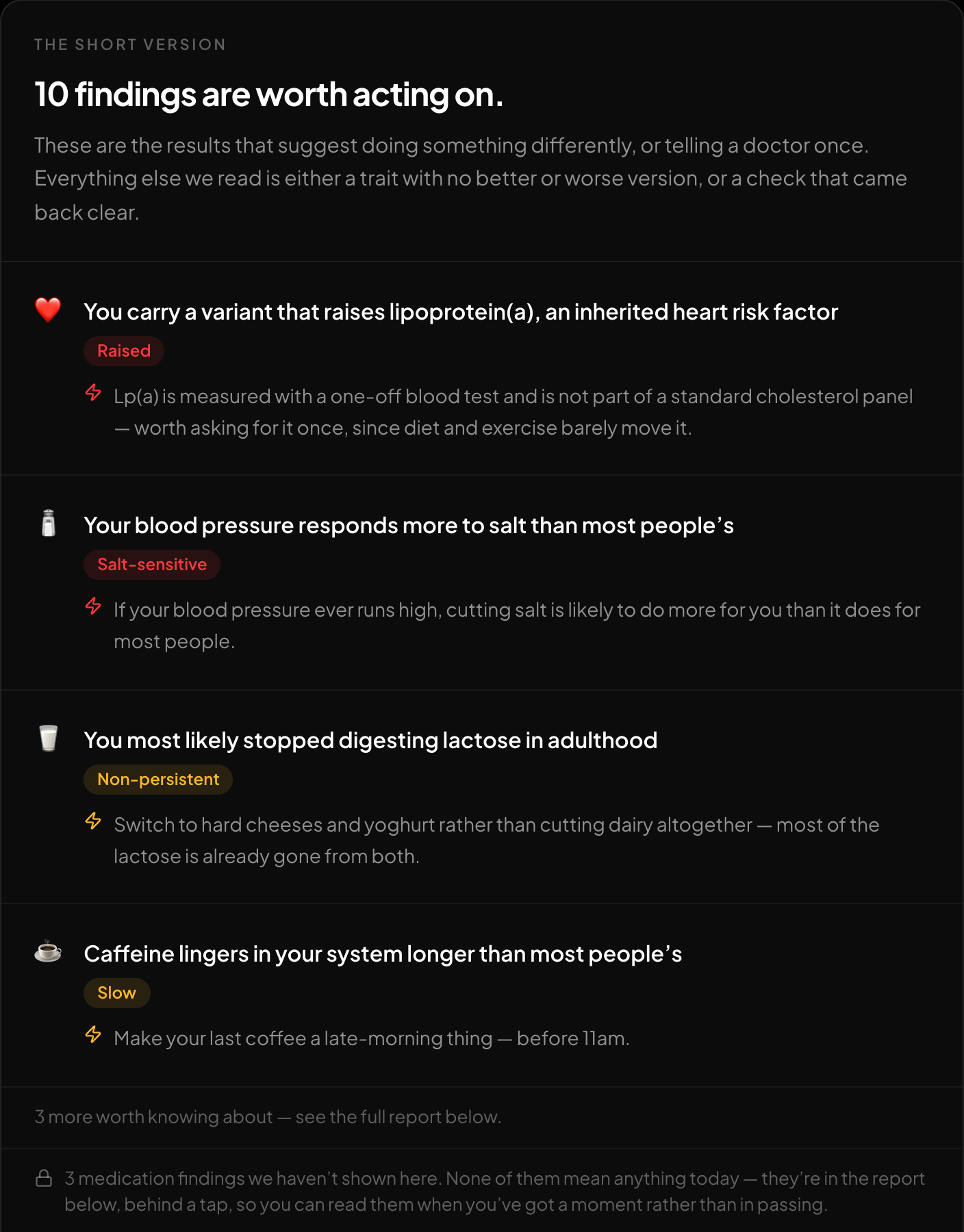
The short version: what is worth acting on, first.
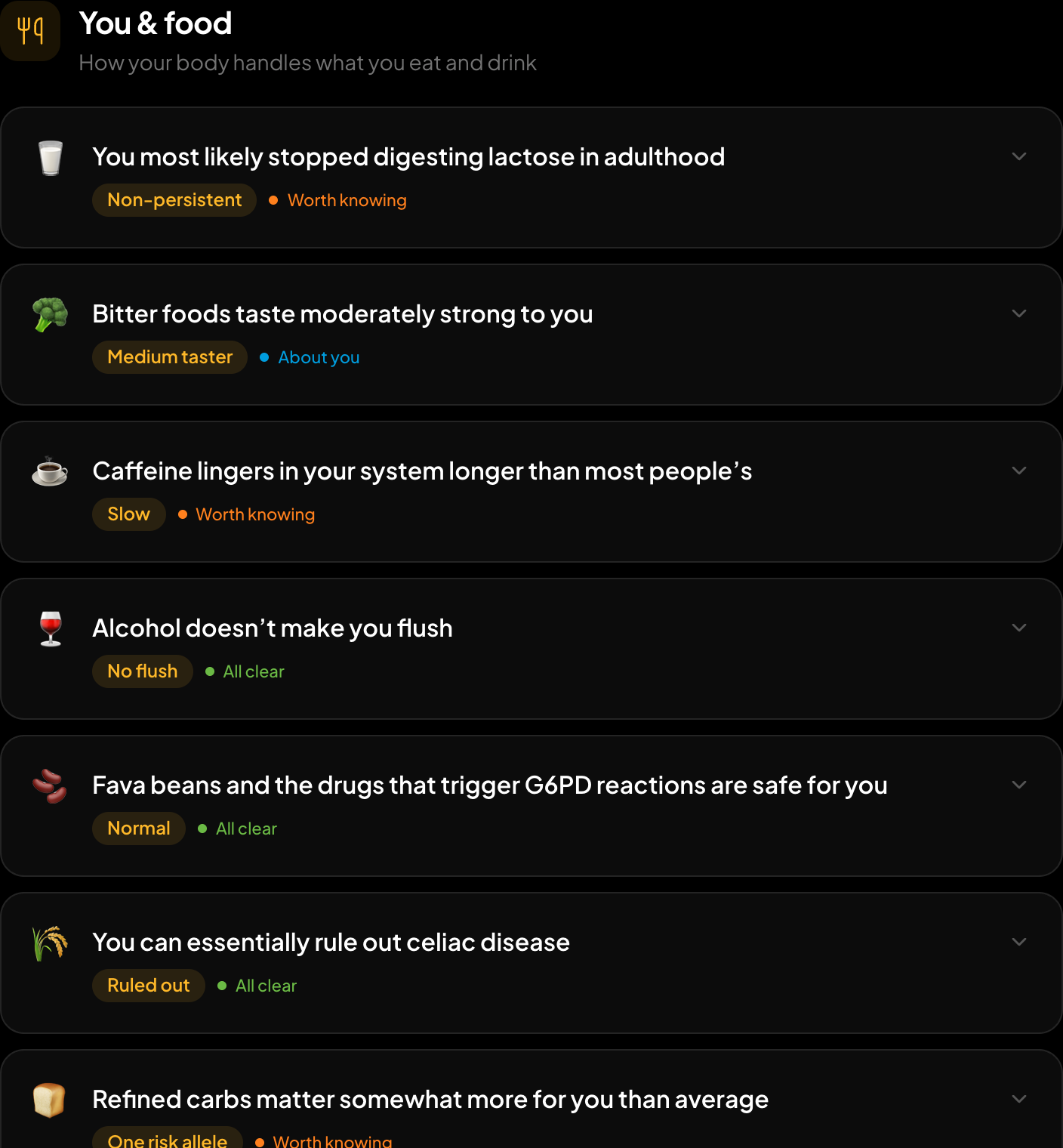
Findings grouped the way you would think about them.
The sample genome, read in the browser.
- Food: lactose persistence, caffeine clearance, alcohol flush, plant omega-3 conversion, folate, vitamin D, celiac genes.
- Medications: CYP2C19, CYP2C9, VKORC1, SLCO1B1, TPMT, DPYD, and HLA markers linked to reactions to abacavir and allopurinol.
- Inherited risk factors you can act on: lipoprotein(a), iron overload, alpha-1 antitrypsin.
- Traits: eye colour, freckles, earwax, blood group and more.
Every finding shows the genotype behind it, and the report says plainly when your file doesn't cover a position.
| What you want | From this file | Why |
|---|---|---|
| Traits, food and drink | Yes | Lactose, caffeine, alcohol flush, bitter taste, vitamin D, folate |
| Medication genes | Yes | CYP2C19, CYP2C9, VKORC1, SLCO1B1, TPMT, DPYD, HLA-B markers |
| CYP2D6 (codeine, tramadol) | No | Needs copy-number calling, which SNP data cannot do |
| Ancestry breakdown | Yes | 15 regions against 157 reference populations, plus the closest of 298 groups and 133 ancient ones |
| Maternal / paternal haplogroup | Partly | A chip carries some mtDNA and Y positions: a solid major branch, not the recent ones |
| Rare disease variants | Barely | A chip tests a handful per gene, and rare calls are often false positives |
| Finding relatives | No | Matching needs a database of other people: GEDmatch, MyHeritage, FamilyTreeDNA |
Scroll the table sideways for the rest →
Read on /dna in your browser, except ancestry, which — only if you agree — sends the markers it needs and keeps them with your result until you delete them.
Why the ancestry numbers differ
If you run the optional ancestry breakdown, expect it to disagree with Living DNA's. Living DNA's model is built for fine detail within Britain and Ireland; this one is built for breadth: 15 world regions with the Middle East split into five, and a ranked list of the closest of 298 present-day populations. Different reference panels answer different questions, and neither is the "true" one. How admixture estimates actually work.
FAQ
Which Living DNA file do I choose?
The autosomal (family ancestry) file. Motherline and fatherline results are shown inside Living DNA's own reports.
Is it private?
The report runs in your browser. Nothing is stored unless you choose to store the file for the Ask your DNA chat, and you can delete it any time.
Can I get my haplogroups from the raw file?
Partly. Chips carry some mitochondrial and Y positions — enough for a solid major branch, not the recent ones. What's possible, and what needs a dedicated test.
What Living DNA is unusually good at, and what it isn't
Living DNA's strength is fine-grained British and Irish regional ancestry — sub-regions within Britain that broader panels can't separate. It also reports motherline and fatherline results, which most autosomal-only companies don't.
What it doesn't do is health. There are no medication-gene results, no lipoprotein(a), no alpha-1 antitrypsin. Those variants are in your file; they're simply not part of the product. That's the gap a free read fills.
The medication findings worth writing down
If you read nothing else from your file, read these once and record them:
- CYP2C19 — clopidogrel after a stent, several antidepressants, stomach-acid drugs
- CYP2C9 and VKORC1 — warfarin dose
- SLCO1B1 — muscle pain on simvastatin
- TPMT — azathioprine and mercaptopurine
- DPYD — 5-FU and capecitabine chemotherapy
None of them mean anything today. They matter at the moment something is prescribed, which is exactly when nobody thinks to look. What a chip can and can't say about drug response.
FAQ
Will my ancestry result contradict Living DNA's?
Probably, and that's expected: different reference panels, different questions. Ours splits the world into 15 regions with the Middle East in five; Living DNA's goes deep inside Britain.
Can I upload a Living DNA file to GEDmatch too?
Yes, Living DNA files are widely accepted for matching. GEDmatch alternatives.
Does the file include my motherline and fatherline?
The autosomal export doesn't carry those results; Living DNA shows them in its own reports. A raw file can still support a haplogroup reading from the mitochondrial and Y positions the chip happens to include.
Read your Living DNA file free, in your browser: healthosx.com/dna
New to raw DNA files? Start with the full guide: How to Download & Analyze Your 23andMe Raw Data Free
No raw DNA file yet?
Get a HealthOS DNA Kit: spit in a tube at home, and your ancestry, lineages and traits arrive in your HealthOS account, with the raw file.
See the DNA kitWritten by
HealthOS Research