FamilyTreeDNA Family Finder Raw Data: Download and Analyze It
FamilyTreeDNA gives you a Build 37 raw data file instantly. Which of the downloads to pick, and how to get health, medication and trait findings from your Family Finder data free.
Your FamilyTreeDNA Family Finder raw data is a .csv.gz file you can download instantly, and you can analyze it free at healthosx.com/dna. Pick the "Build 37 Concatenated Raw Data" download, choose it on that page as it is, and your browser reads it into findings on food, medication genes, heart health and traits. Your DNA story needs no account; the full report opens in the HealthOS app after a 6-digit code sent to your email.
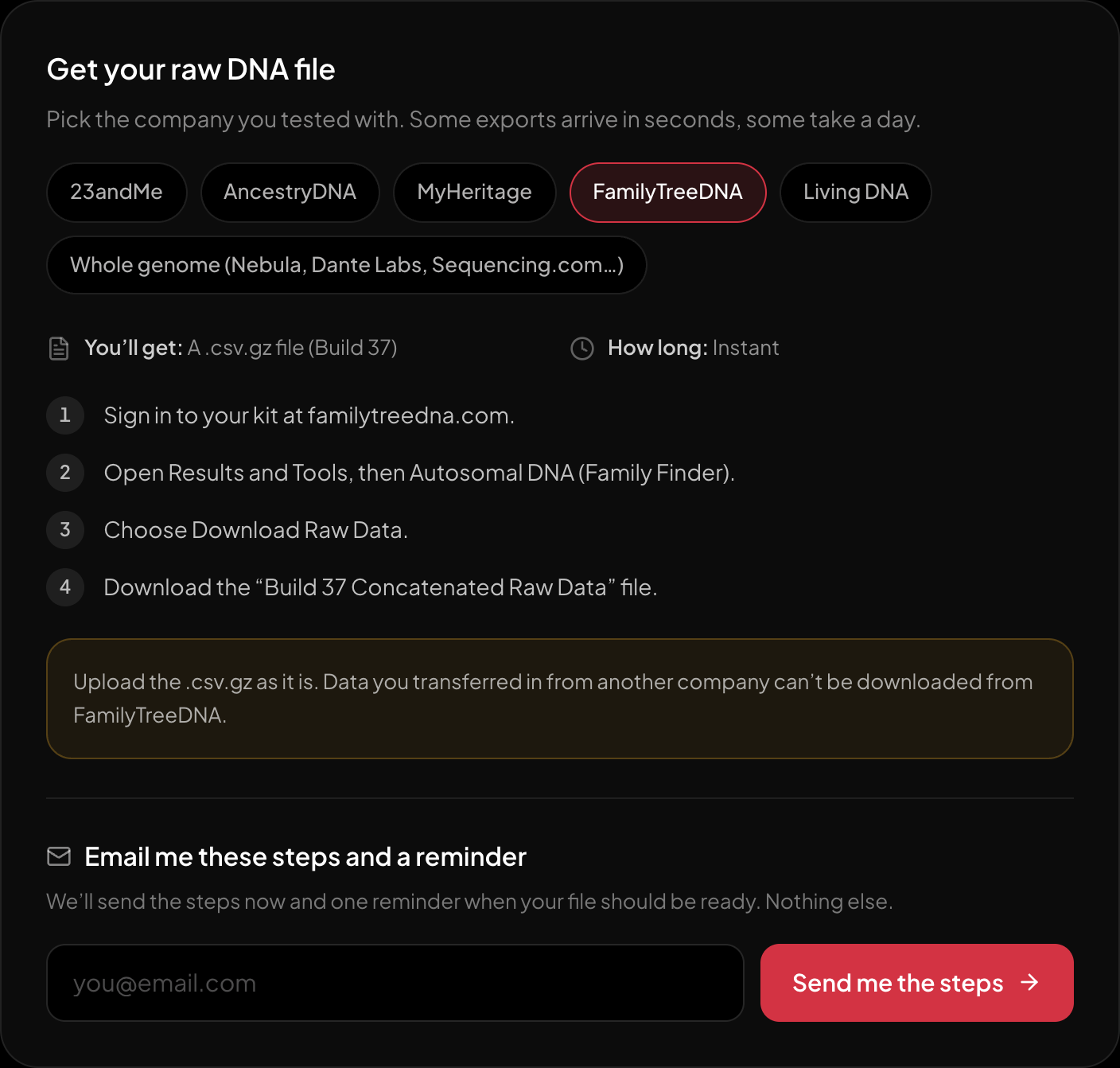
The download steps for FamilyTreeDNA, on the page itself.
Which of the downloads to take, and what the file looks like when it arrives.
Which FamilyTreeDNA file you want
The Family Finder download page offers more than one file, which is where people go wrong. You want the autosomal file, on Build 37, concatenated into one file.
Build 37 (also called GRCh37 or hg19) is the version of the human reference genome the coordinates are measured against. Build 38 is newer, and the same number points to a different place in each, so most third-party tools expect Build 37. Because a chip file is keyed by rsID rather than by position, the build matters less here than it does for a whole-genome VCF, where it can decide whether the file is readable at all.
Y-DNA and mtDNA tests are separate products with their own downloads, and they aren't part of Family Finder.
How to download it
- 1.Sign in to your kit at familytreedna.com.
- 2.Open Results and Tools, then Autosomal DNA (Family Finder).
- 3.Choose Download Raw Data.
- 4.Download the “Build 37 Concatenated Raw Data” file.
- What you get: A .csv.gz file (Build 37)
- How long: Instant
Upload the .csv.gz as it is. Data you transferred in from another company can’t be downloaded from FamilyTreeDNA.
What the file can tell you
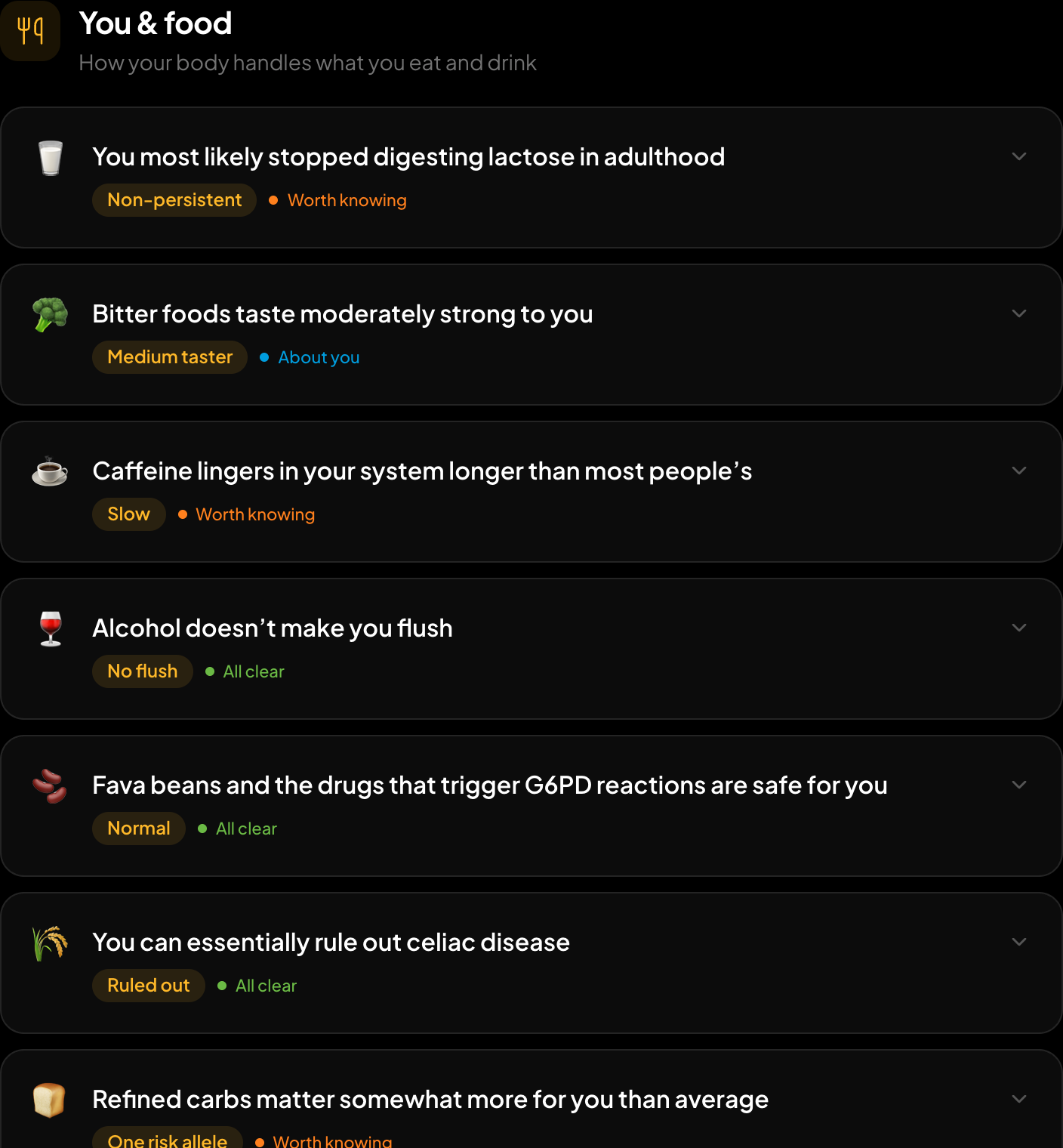
Findings grouped the way you would think about them.
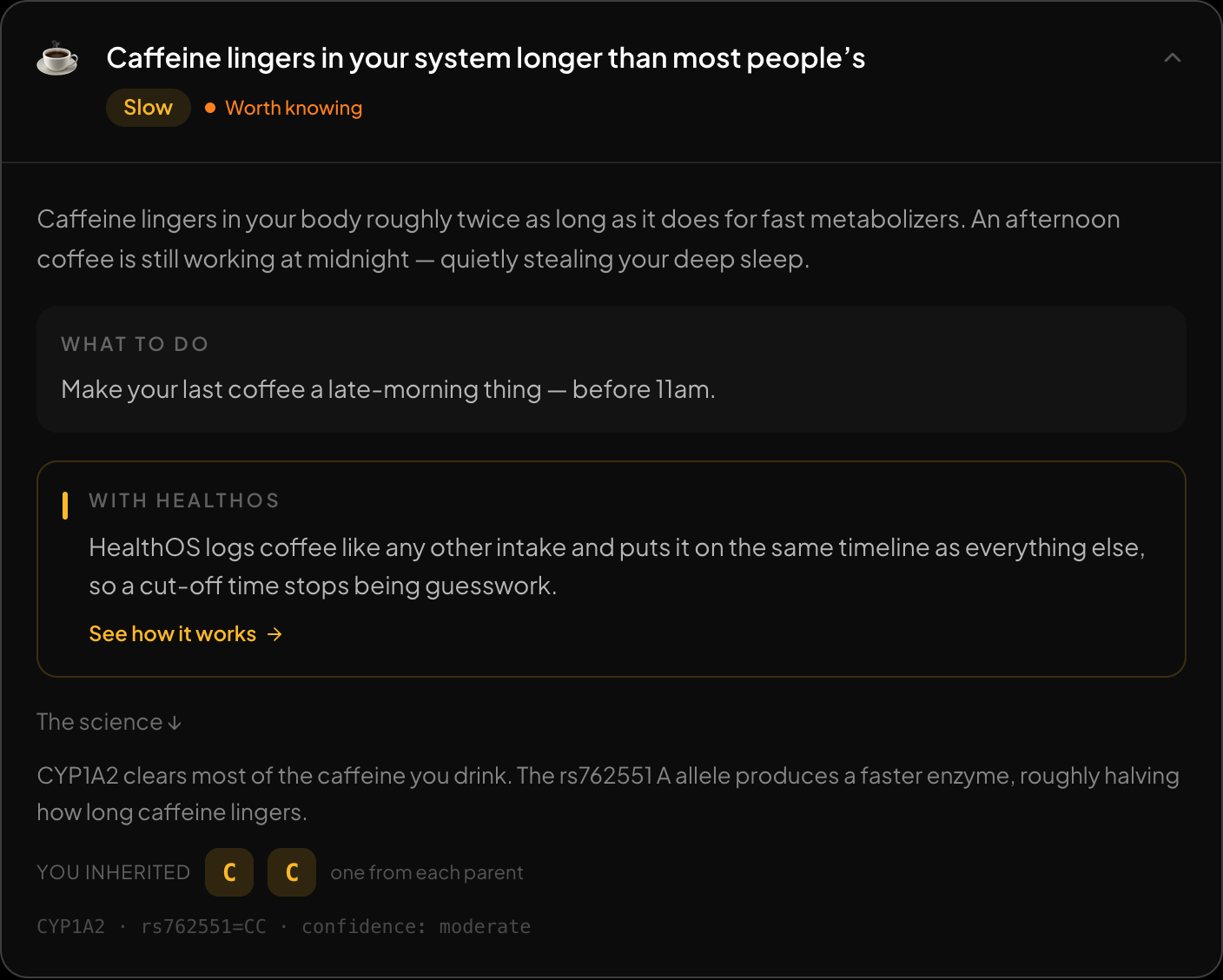
Every finding opens up: what it means, what to do, and the genotype behind it.
The sample genome, read in the browser.
FamilyTreeDNA is built for genealogy: matches, myOrigins and the chromosome browser. The same genotypes carry well-studied health and trait variants, and the free report on /dna reads them:
- How you handle caffeine, lactose, alcohol, folate and vitamin D
- Medication genes worth recording once: CYP2C19, CYP2C9, VKORC1, SLCO1B1, TPMT, DPYD
- Lipoprotein(a) and iron overload (HFE) — both inherited, both easy to check with a blood test once you know to ask
- Alpha-1 antitrypsin, which is badly under-diagnosed
- Everyday traits: eye colour, freckles, earwax, blood group
| What you want | From this file | Why |
|---|---|---|
| Traits, food and drink | Yes | Lactose, caffeine, alcohol flush, bitter taste, vitamin D, folate |
| Medication genes | Yes | CYP2C19, CYP2C9, VKORC1, SLCO1B1, TPMT, DPYD, HLA-B markers |
| CYP2D6 (codeine, tramadol) | No | Needs copy-number calling, which SNP data cannot do |
| Ancestry breakdown | Yes | 15 regions against 157 reference populations, plus the closest of 298 groups and 133 ancient ones |
| Maternal / paternal haplogroup | Partly | A chip carries some mtDNA and Y positions: a solid major branch, not the recent ones |
| Rare disease variants | Barely | A chip tests a handful per gene, and rare calls are often false positives |
| Finding relatives | No | Matching needs a database of other people: GEDmatch, MyHeritage, FamilyTreeDNA |
Scroll the table sideways for the rest →
Read on /dna in your browser, except ancestry, which — only if you agree — sends the markers it needs and keeps them with your result until you delete them.
The optional ancestry analysis gives you proportions across 15 regions and your closest present-day reference populations — a useful cross-check on myOrigins rather than a replacement for your match list.
Limits worth knowing
- Transferred data can't be downloaded. If you uploaded another company's file into FamilyTreeDNA, get the original from that company.
- An autosomal chip isn't a Y-DNA or mtDNA test. The Family Finder file doesn't carry your Y or mitochondrial results. What raw files can say about haplogroups.
- It isn't diagnostic. Confirm anything consequential in an accredited lab.
FAQ
Do I need to decompress the .csv.gz?
No. Choose it exactly as downloaded; the browser decompresses it while reading.
Is my file uploaded?
Not for the report, which runs in your browser. Ancestry, if you choose to run it, sends only the markers it needs and keeps them with your result until you delete them.
I have a Big Y test too. Can this read it?
No. Big Y results are a different product in a different format. This reads autosomal data, and far more from a whole genome.
Read your Family Finder file free: healthosx.com/dna
New to raw DNA files? Start with the full guide: How to Download & Analyze Your 23andMe Raw Data Free
No raw DNA file yet?
Get a HealthOS DNA Kit: spit in a tube at home, and your ancestry, lineages and traits arrive in your HealthOS account, with the raw file.
See the DNA kitWritten by
HealthOS Research