BAM, CRAM, FASTQ or VCF: Which Whole-Genome File Do I Use?
Your whole-genome sequencing comes as four kinds of file. For almost every consumer DNA tool you want the VCF. What each file is, how big it is, and when you would ever need the others.
For almost every consumer DNA tool, use the VCF (the file ending .vcf.gz). It lists where your genome differs from the reference, and it's what trait, health, medication and ancestry tools read. FASTQ, BAM and CRAM are the raw sequencing reads underneath it: tens of gigabytes, and only for bioinformatics software. You can read a VCF free, in your browser, at healthosx.com/dna.
| File | What it holds | Size | Use it for consumer tools? |
|---|---|---|---|
| FASTQ | Raw sequencer reads, unplaced | ~100 GB | No |
| BAM | Reads aligned to the reference | tens of GB | No |
| CRAM (+ .crai) | The same, compressed against the reference | tens of GB | No — but keep a copy |
| VCF (+ .tbi) | Your ~4–5M variants | 100 MB – 1 GB | Yes — this one |
| gVCF | Variants plus matching stretches | much larger | Only if there is no plain VCF |
Scroll the table sideways for the rest →
Sizes are typical for 30x whole-genome sequencing.
The files are steps in a pipeline
Sequencing produces your data in stages, and each file is the output of one stage:
FASTQ: the raw reads
The sequencer reads your DNA as hundreds of millions of short fragments, each around 150 letters. The FASTQ file lists every fragment and a quality score for every letter. At 30x coverage that's roughly 100GB uncompressed, often split across several files. Nothing is placed on the genome yet.
When you need it: only to re-run the whole analysis from scratch with different software.
BAM and CRAM: the reads, aligned
Alignment works out where on the human reference genome each fragment belongs. A BAM stores the aligned reads. A CRAM stores the same thing, compressed further against the reference. Both come with an index (.bai or .crai). Expect tens of gigabytes.
When you need them: to call variants again with better software, to look at the evidence behind one particular variant, or for things a VCF can't capture — copy-number changes such as CYP2D6 being the classic consumer example.
VCF: your variants
Variant calling compares the aligned reads with the reference and writes down every position where you differ. That's about 4 to 5 million rows for a whole genome, typically 100MB to 1GB compressed. The .tbi file beside it is an index.
When you need it: almost always. Every consumer report, ancestry tool and variant lookup reads this.
Some providers split it up: Dante Labs, for example, ships a .snp.vcf.gz and an .indel.vcf.gz. Consumer findings are nearly all SNPs, so use the SNP file. A gVCF also records stretches where you match the reference, which makes it much larger; use the ordinary VCF if you have one.
Two things to check in your VCF
- 1.rsIDs. If the third column is
.on every row, tools that search by rsID find nothing. How to check and fix it. - 2.Build. The
##referenceor##contigheader lines say whether it's GRCh37 or GRCh38. Positions differ between the two.
Need your VCF as a 23andMe-style file for a tool that only takes those? Convert it free in your browser. The same VCF also gives your maternal and paternal haplogroups, and the file checker reads its build and rsIDs for you.
What your VCF gets you on /dna
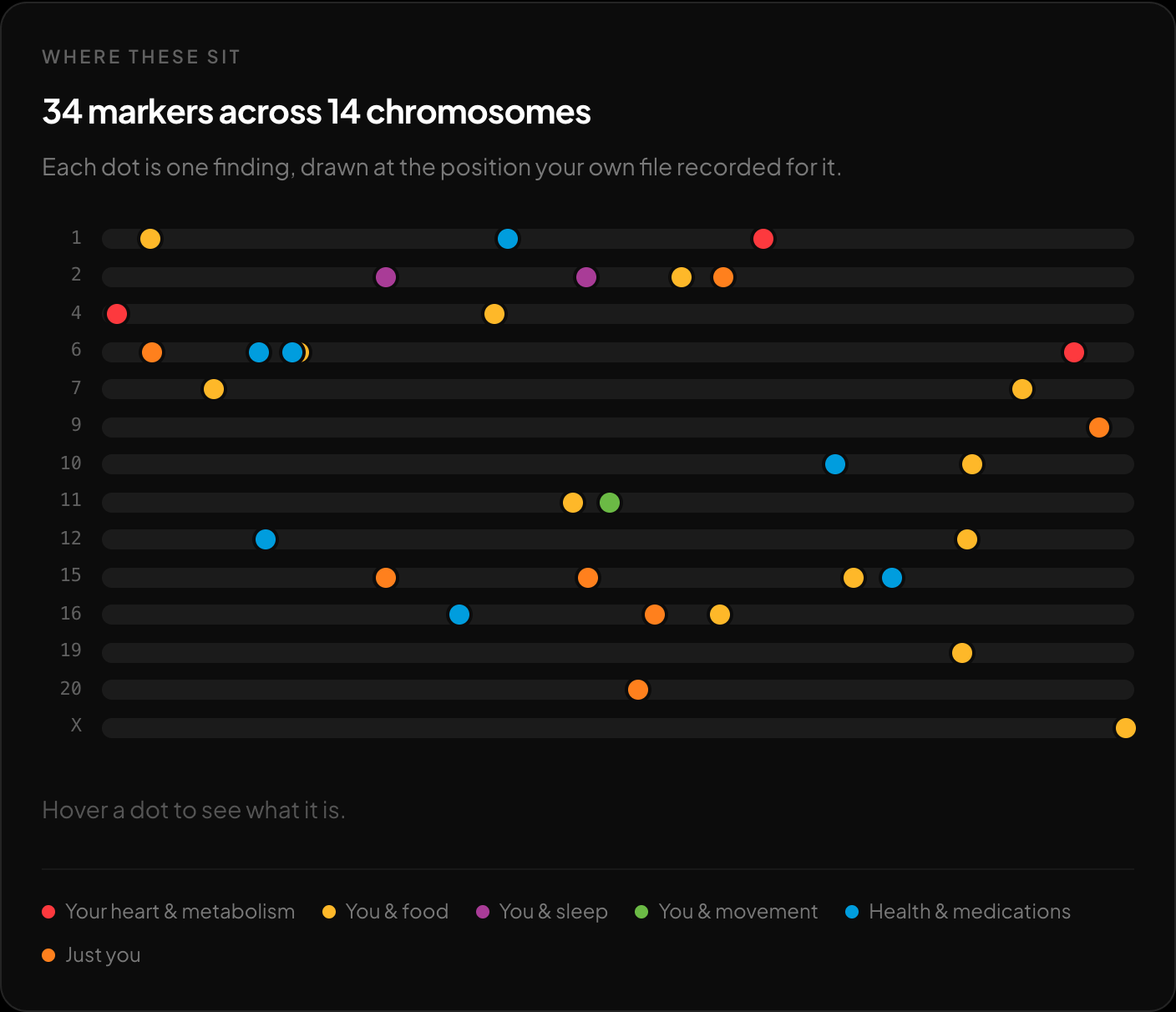
Where each finding sits in your genome.
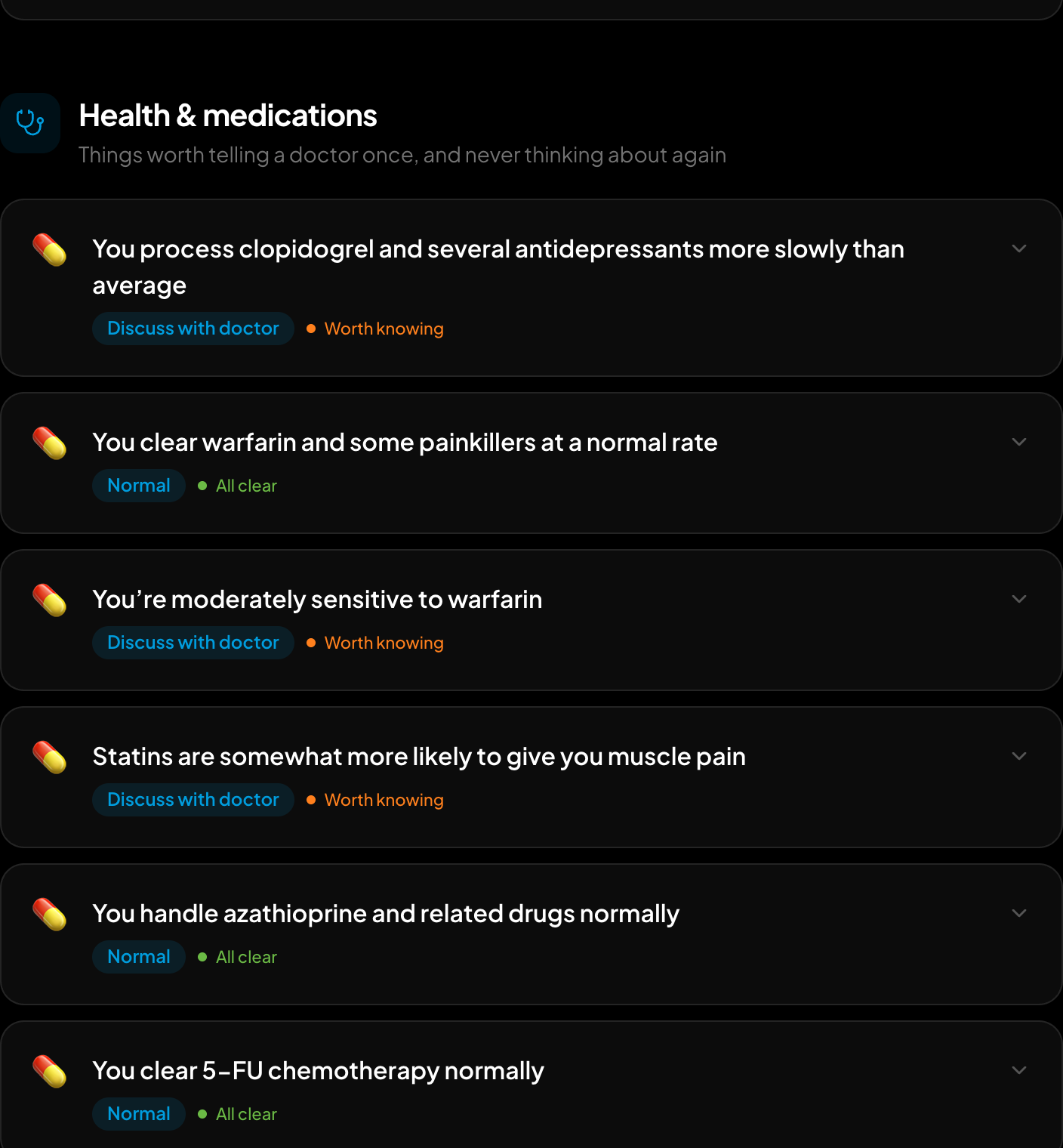
Medication genes, kept behind a tap rather than sprung on you.
The sample genome, read in the browser. A whole-genome VCF carries far more markers than the sample.
Your browser streams even a multi-gigabyte VCF, locally, into findings on medication genes, inherited risk factors (lipoprotein(a), iron overload, alpha-1 antitrypsin, LRRK2, TTR), food and traits. Ancestry is optional. Ask your DNA can go deeper on a stored whole genome, with haplogroups, polygenic scores and any variant you name. Company notes: Nebula · Dante Labs · Sequencing.com.
What to keep, and what to delete
Storage is the practical question once you have all four files:
- Keep the VCF forever. It's small, and it's what every tool reads.
- Keep the CRAM if you can. It's the only file that lets anyone re-call your variants later with better software, or work out something a VCF can't capture — CYP2D6 copy number being the standard example. A CRAM is smaller than the BAM it came from.
- FASTQ is usually safe to delete once you have a CRAM or BAM, because the reads are in there, aligned. Keep it only if you plan to re-align against a different reference.
- Store what you keep encrypted. A genome identifies you and your relatives permanently.
Checking a file is what it claims to be
You don't need bioinformatics tools for a sanity check:
- A VCF starts with header lines beginning
##, and its data rows have the chromosome and position in the first two columns. - A FASTQ repeats in blocks of four lines, the first starting with
@. - A BAM or CRAM is binary. Opening it in a text editor shows unreadable characters — that's normal, not corruption.
- Size is the quickest tell. Hundreds of megabytes means variants; tens of gigabytes means reads.
FAQ
My provider only gave me a BAM. Can I get a VCF?
Yes, but it needs variant calling, which is real bioinformatics work (bcftools or GATK against a matching reference). Ask the provider first — most can export a VCF.
What's a .tbi or .csi file?
An index that lets software jump to a position without reading the whole file. Harmless, and not needed for a browser read.
Is a gVCF fine?
It works, but it's much bigger because it also records the stretches where you match the reference. Use the plain VCF if you have one.
Found your VCF? Choose it and read it now: healthosx.com/dna
New to raw DNA files? Start with the full guide: How to Download & Analyze Your 23andMe Raw Data Free
Common questions
- Which whole genome file should I use for analysis tools: BAM, CRAM, FASTQ or VCF?
- Use the VCF, the file ending .vcf.gz, for almost every consumer DNA tool: trait, health, medication and ancestry reports all read it. FASTQ holds the raw sequencing reads and BAM or CRAM the aligned reads. They run to tens of gigabytes and are for bioinformatics software that calls variants again or checks the evidence behind one variant. At Dante Labs, use the .snp.vcf.gz.
- Can I analyze my whole-genome VCF for free?
- Yes. healthosx.com/dna reads a .vcf or .vcf.gz from any lab, including Nebula, Dante Labs and Sequencing.com, even at several gigabytes. It is free: the file is read in your browser, and your DNA story opens straight away with no account. The full report opens in the HealthOS app after a 6-digit code sent to your email, and your file stays on your device.
- How do I check whether my VCF has rsIDs, and which build it is?
- Look at the third column of the first data rows: a dot on every row means the file has no rsIDs, so tools that search by rsID find nothing. The ##reference or ##contig header lines name the build, GRCh37 (hg19) or GRCh38 (hg38).
Related questions
- What is the difference between a 23andMe chip and whole genome sequencing?
- Why was my DNA file rejected when I uploaded it?
- GenomeInsight alternatives
- Find my maternal and paternal haplogroup from raw DNA data free
- Is there a free tool that reads my 23andMe file without uploading it to a server?
- What to do with my raw DNA data file
No raw DNA file yet?
Get a HealthOS DNA Kit: spit in a tube at home, and your ancestry, lineages and traits arrive in your HealthOS account, with the raw file.
See the DNA kitWritten by
HealthOS Research