Genotyping Chip vs Whole Genome: What Each DNA File Can Tell You
A 23andMe or AncestryDNA chip reads about 0.02% of your genome; whole-genome sequencing reads nearly all of it. What that means for common traits, rare variants and false positives.
A genotyping chip (23andMe, AncestryDNA, MyHeritage) reads about 600,000 to 700,000 chosen positions, roughly 0.02% of your genome. Whole-genome sequencing (Nebula, Dante Labs, Sequencing.com) reads nearly all of its 3 billion letters. For common, well-studied variants — caffeine, lactose, the main medication genes, ancestry — a chip is enough, and it's accurate. For rare disease variants, a chip misses most of them and is unreliable about the ones it does report. Both file types can be read free at healthosx.com/dna: the file is read in your browser, and your DNA story needs no account.
What a chip does well
Chips are designed around common variation: positions where a meaningful share of people differ. That covers most of what consumer genetics can honestly tell you:
- Food and drink: lactose persistence, caffeine clearance (CYP1A2), alcohol flush (ALDH2)
- Medication genes (pharmacogenomics): CYP2C19, CYP2C9, VKORC1, SLCO1B1, TPMT, DPYD
- Inherited risk factors: lipoprotein(a), HFE iron overload, the alpha-1 antitrypsin Z allele
- Traits: eye colour, earwax, bitter taste, blood group
- Ancestry: hundreds of thousands of common markers is plenty to compare you with reference populations
For these, chip accuracy is very high. The variants were chosen because they're common and the probes for them are well tested.
| Question | Genotyping chip | Whole genome |
|---|---|---|
| Common traits and food response | Yes | Yes |
| Main medication genes | Yes | Yes |
| Ancestry breakdown | Yes | Yes |
| Rare disease variants | Mostly missed, and unreliable when reported | Covered — still confirm clinically |
| ClinVar-style screening | False reassurance | Meaningful |
| CYP2D6 | No | Needs the reads, not the VCF |
| Deep haplogroups | Major branch only | Deep subclades |
| Typical cost today | Already paid for, if you tested | Hundreds of dollars |
Scroll the table sideways for the rest →
Where a chip falls short
Rare variants: missed, or falsely reported
A chip tests only the rare variants its designers chose. Most disease-causing variants in genes like BRCA1 aren't on it, so "no variant found" means little. The ones it does report are often wrong. In a 2021 BMJ study of UK Biobank data, most very rare variants called by chips turned out to be false positives when checked against sequencing. An earlier study found that 40% of variants in consumer raw data sent for clinical confirmation were false positives.
The rule: never act on a rare pathogenic variant from a chip without confirming it in an accredited lab.
Genes that need more than SNPs
CYP2D6 depends on whole-gene deletions and duplications. APOL1 and some HLA types need several positions read together. A chip gets partway on some of these and nowhere on others.
What whole-genome sequencing adds
- Coverage: about 4 to 5 million of your variants, including rare ones in any gene.
- Accuracy on rare variants: each position is read around 30 times at 30x, so a rare call is far more trustworthy — though it still needs clinical confirmation.
- Screening panels: checking genes against ClinVar, the database of known disease variants, is only meaningful with a genome. On a chip it gives false reassurance.
- Polygenic scores from your actual genotypes rather than imputed ones.
What it doesn't fix: a variants-only VCF still doesn't tell you whether an absent position was read well, and CYP2D6 still needs the reads (BAM/CRAM), not the VCF.
Which do you have, and what to do with it
- A chip file: you already have the common, well-validated findings. Read them free. Treat any rare "pathogenic" result as unconfirmed.
- A whole genome: use the VCF (which file?) and check it has rsIDs.
- Deciding whether to buy sequencing: if you want traits, medication genes and ancestry, the chip you already own is enough. If you want rare-variant screening, a genome is the minimum, and a clinical test ordered by a doctor is better.
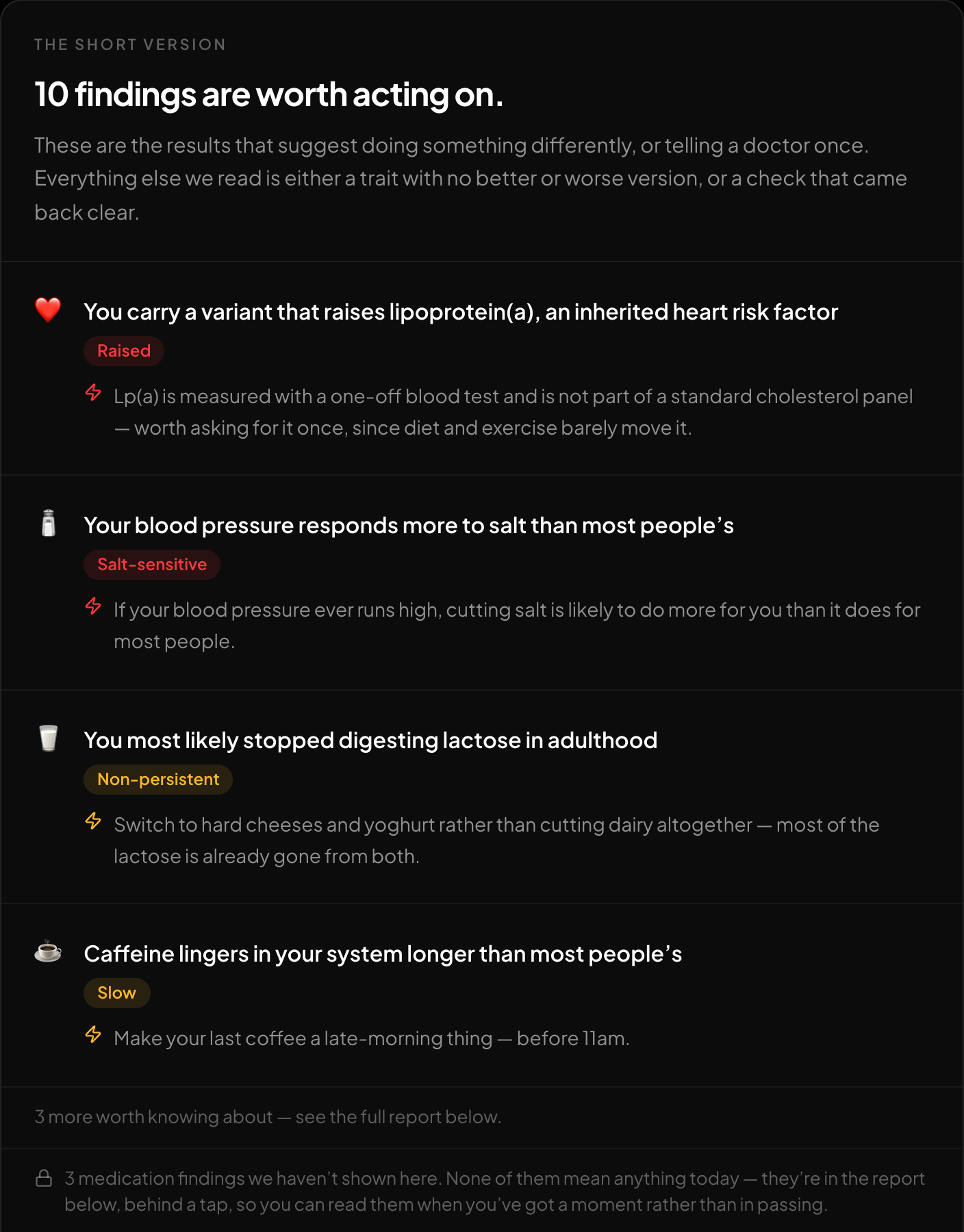
The short version: what is worth acting on, first.
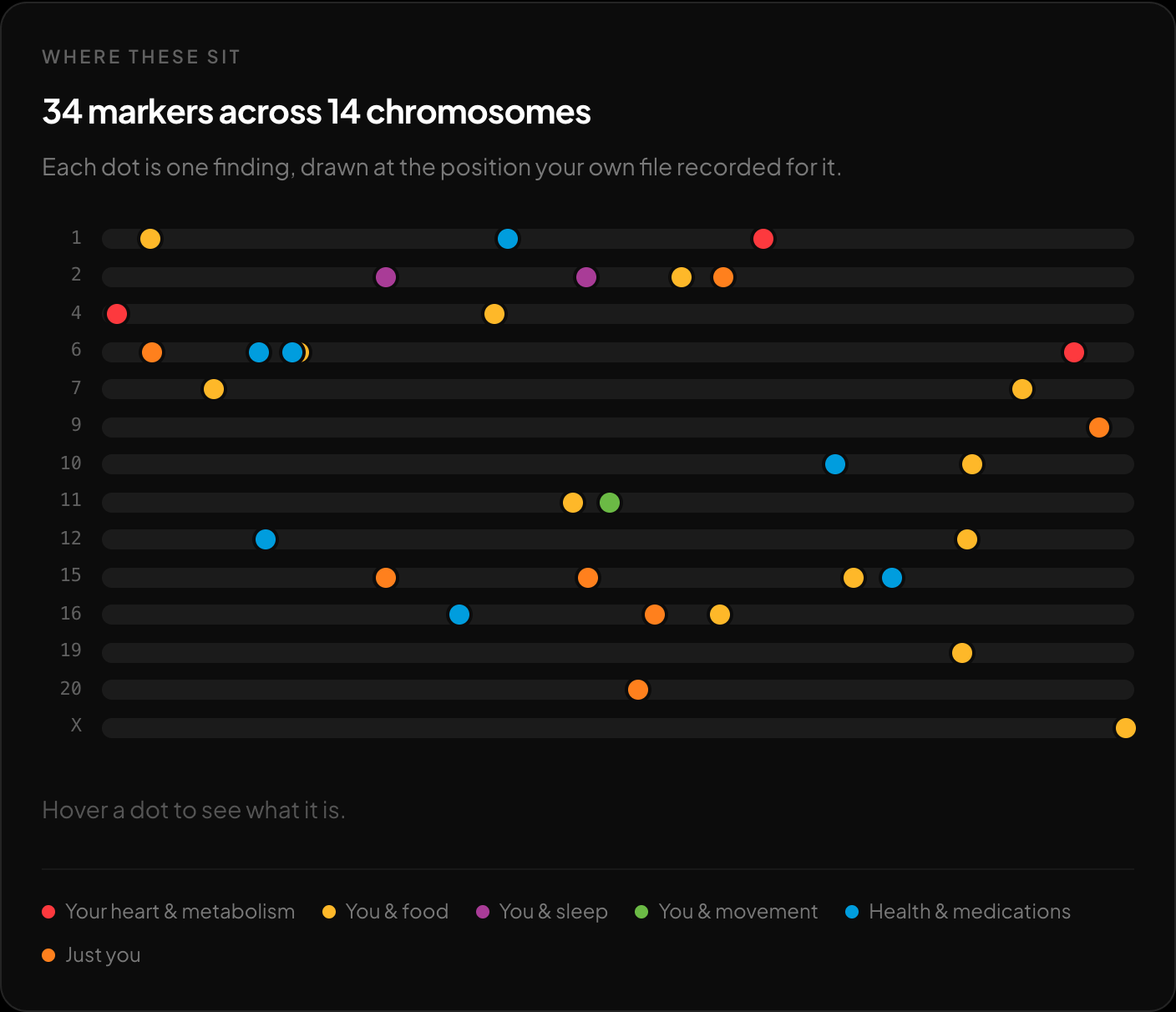
Where each finding sits in your genome.
The sample genome, read in the browser.
Whichever file you have, see what it can honestly tell you, free, in your browser: healthosx.com/dna
New to raw DNA files? Start with the full guide: How to Download & Analyze Your 23andMe Raw Data Free
Common questions
- What is the difference between a 23andMe chip and whole genome sequencing?
- A 23andMe chip reads about 600,000 to 700,000 chosen positions, roughly 0.02% of your genome. Whole genome sequencing reads nearly all of its 3 billion letters, which gives a VCF of about 4 to 5 million variants. A chip is accurate for common variants: traits, ancestry and the main pharmacogenomics genes such as CYP2C19. It misses most rare disease variants and is unreliable on the rare ones it does report. Both files can be read free at healthosx.com/dna. It is free: the file is read in your browser, and your DNA story opens straight away with no account. The full report opens in the HealthOS app after a 6-digit code sent to your email, and your file stays on your device.
- Can imputation turn a chip file into a whole genome?
- No. Imputation fills in untested positions by comparing your chip with reference genomes and guessing the likely letters from the markers around them. It works well for common variants, and many polygenic scores built from chip data rely on it. It cannot recover rare variants you were never tested for.
- Is a chip good enough for pharmacogenomics?
- For several genes, yes: CYP2C19, CYP2C9, VKORC1, SLCO1B1, TPMT and one DPYD variant are called well from a chip. CYP2D6 is not, because its key changes are whole-gene deletions and duplications, and even a whole-genome VCF needs the reads (BAM or CRAM) for it. Confirm any result that would change a prescription with a clinical test.
- Are polygenic scores better from a whole genome?
- Somewhat. A genome gives your actual genotypes where a chip relies on imputed ones. Most published polygenic scores are built from common variants that a chip already tags, though, and for most conditions they shift risk only modestly either way.
No raw DNA file yet?
Get a HealthOS DNA Kit: spit in a tube at home, and your ancestry, lineages and traits arrive in your HealthOS account, with the raw file.
See the DNA kitReferences
- 1.Weedon MN et al. Use of SNP chips to detect rare pathogenic variants. BMJ 2021
- 2.Tandy-Connor S et al. False-positive results released by direct-to-consumer genetic tests. Genet Med 2018
For informational purposes only. For medical advice or diagnosis, consult a professional.
Written by
HealthOS Research