How Much Neanderthal DNA Do You Have? A Free Count From Your Raw DNA File
Count the Neanderthal-matching variants in your 23andMe, AncestryDNA, MyHeritage or whole-genome file and see where you rank against 1000 Genomes, free and on your own device. What the number means, and why it isn’t a percentage.
No DNA test yet?
The HealthOS DNA Kit reads your maternal line, your paternal (Y) line if you have a Y chromosome, your ancestry across 15 regions and the ancient peoples you sit closest to. Spit in a tube at home; the lab is in Germany and the raw file is yours.
See the DNA kitYou can count your Neanderthal variants free from the raw DNA file you already have. At healthosx.com/dna, choose your 23andMe, AncestryDNA, MyHeritage, FamilyTreeDNA, Living DNA, WeGene or whole-genome file. Your browser checks it against 251,234 Neanderthal-matching sites, counts the Neanderthal variants you carry, and ranks you against the people outside Africa in the 1000 Genomes study: "You carry more of them than about 22% of people outside Africa." The count is done on your device, so nothing about it is uploaded.
What the number is
Everyone whose ancestors lived outside Africa carries some DNA from Neanderthals, inherited from interbreeding roughly 50,000 years ago. A study by Browning and colleagues (Cell, 2018) found the stretches of modern genomes that came from them, and the variants inside those stretches. Those variants are the reference list.
For your file, the report shows:
- The count: how many Neanderthal-matching variants you carry, at the sites your file covers.
- Your rank against people outside Africa in 1000 Genomes, overall and within Europe, East Asia, South Asia and the Americas.
- A range around the rank, because a chip reads only a small share of the sites. The report says so instead of printing one confident number.
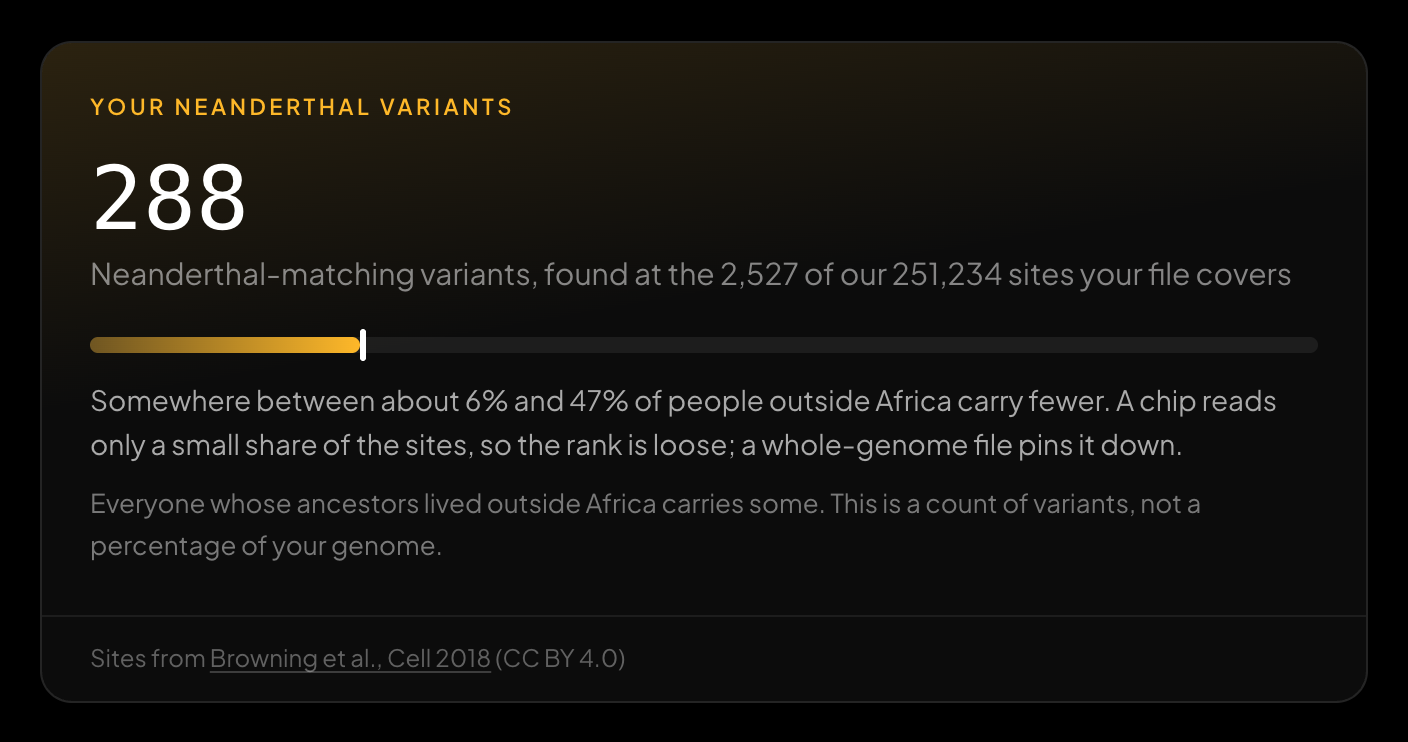
Your Neanderthal variants, counted on your device and ranked against 1000 Genomes.
Why it isn't a percentage
23andMe and others have trained everyone to expect "2.1% Neanderthal". This report won't print that, for a plain reason: a percentage of your genome needs your whole genome compared with an archaic reference genome, and a chip reads a few thousand of these sites out of hundreds of thousands. What a chip can support honestly is a count and a rank.
The rank is also the more interesting statement. The share of Neanderthal DNA barely varies between people outside Africa, roughly 1 to 2% for almost everyone. Where you sit among them does vary, and that is what the percentile tells you.
Chip or whole genome?
| Genotyping chip | Whole genome | |
|---|---|---|
| Sites covered | A few thousand | All 251,234 |
| The count | Yes | Yes |
| The percentile | Yes, with a wide range | Yes, tight |
| A share of your genome | No | No, not from these sites |
Scroll the table sideways for the rest →
Measured on one person who had both: the whole genome put them at the 8th percentile, the chip (2,527 sites) at the 30th, with a range wide enough to include both.
Both work. A whole genome covers all 251,234 sites and pins your rank down. A chip covers a few thousand, enough to rank you once it covers at least 1,500, but with a wider range. To make the two comparable, the report ranks a ratio rather than a raw count: the variants you carry divided by the number expected at the sites your file covers. Every one of the 2,504 reference people has the same ratio computed, so a chip and a genome are placed on the same scale.
The count needs your file on genome build GRCh37, which is what 23andMe, AncestryDNA and MyHeritage deliver. A whole genome on GRCh38 skips it in the browser. The free file checker tells you your build and whether the count will run, without uploading anything.
If much of your ancestry is African
The Neanderthal-matching sites were found by comparing non-African genomes against an African outgroup, because Neanderthal ancestry entered the human line outside Africa. So the study has no African group to measure against, and a person with mostly African ancestry will see a low count. The report says why, rather than handing over a rank that reads like a shortfall.
Where else to get one
| What you get | Price at the time of writing | |
|---|---|---|
| HealthOS /dna | Variant count and percentile against 1000 Genomes, from your raw file | Free |
| 23andMe | Variant count and percentile among its customers, with trait links | Part of its Ancestry Service ($119); needs its own kit |
| Living DNA | Neanderthal and Denisovan scores | Ancestry & Neanderthal kit ($99) |
| DNAGenics | A Neanderthal report from an upload | Essentials Pack (€39) |
| GEDmatch | Segment matches against archaic genomes, a different measure | Free account |
Scroll the table sideways for the rest →
As published on each site on 2026-09-25. Check before buying: prices and features move.
23andMe's report is the best known: it counts variants and ranks you among its own customers, but it needs a 23andMe kit and its Ancestry Service. Living DNA adds a Denisovan score, which this report doesn't have. GEDmatch's archaic matching looks for shared segments with specific archaic genomes, a different measure. The free option here is a count and a rank from any file you already own.
How to get your count
- 1.Download your raw data (23andMe, AncestryDNA, MyHeritage or a whole-genome VCF).
- 2.Choose it at healthosx.com/dna. The count runs in your browser while the file is read.
- 3.Open your full report, which is free and needs a one-time code sent to your email. Your Neanderthal variants are counted on your device from the file and shown beside your ancestry and the ancient people you're closest to.
FAQ
Does more Neanderthal DNA mean anything for my health?
Some Neanderthal variants are linked in studies to traits such as skin, hair and immune responses, but a count across all of them isn't a health measure. Read it as history, not as a risk.
Why is my number different from 23andMe's?
Different sites, a different yardstick. 23andMe counts its own set of variants on its chip and ranks you among its customers. This counts Browning's sites and ranks you against 1000 Genomes. The two ranks can disagree and both be right about what they measure.
Count your Neanderthal variants, free, on your own device: healthosx.com/dna
No raw DNA file yet?
Get a HealthOS DNA Kit: spit in a tube at home, and your ancestry, lineages and traits arrive in your HealthOS account, with the raw file.
See the DNA kitReferences
- 1.Browning SR et al. Analysis of Human Sequence Data Reveals Two Pulses of Archaic Denisovan Admixture. Cell 2018;173:53-61
- 2.Sprime archaic-introgression calls (Mendeley Data, CC BY 4.0)
- 3.23andMe white paper 23-05: Neanderthal Ancestry Inference
For informational purposes only. For medical advice or diagnosis, consult a professional.
Written by
HealthOS Research