Which Ancient People Am I Closest To? Free From Your 23andMe Raw Data
Choose a 23andMe, AncestryDNA, MyHeritage or whole-genome file and see which of 133 ancient groups your DNA sits closest to, how you compare with Ötzi and five other named ancients, and why ties are shown as ties. Free.
No DNA test yet?
The HealthOS DNA Kit reads your maternal line, your paternal (Y) line if you have a Y chromosome, your ancestry across 15 regions and the ancient peoples you sit closest to. Spit in a tube at home; the lab is in Germany and the raw file is yours.
See the DNA kitYou can see which ancient people your DNA is closest to, free, from the raw file you already have. Choose your 23andMe, AncestryDNA, MyHeritage, FamilyTreeDNA, Living DNA, WeGene or whole-genome file at healthosx.com/dna. The ancestry part of the report compares your markers with 133 ancient groups from the Allen Ancient DNA Resource, from Natufian hunter-gatherers and Neolithic Anatolian farmers to Phoenicians and Viking Age Scandinavians, and names the ones your genome sits closest to. It also says how you compare with named individuals such as Ötzi the Iceman.
What the report shows you
- Your closest ancient groups, each with the site, the country and the dates from the archaeological record, such as "Bronze Age Canaanites, Tel Shadud, Israel, 1900 to 1200 BC".
- Ties, shown as ties. For many people the top few groups can't be told apart: Bronze and Iron Age Levantine groups, for example, are genetically almost interchangeable. When groups sit within statistical noise of each other, the report shows them together as "equally close" instead of inventing a first, second and third place.
- A famous ancient. If your genome is more like one of six named individuals than at least half the people in our reference panel, the report says so, and names the paper the genome was published in. For example: "Your genome is more like Ötzi's than 81% of the people in our reference panel."
- The present-day picture around it: proportions across 15 regions, the closest of 298 present-day groups, and your dot on a PCA plot among the reference populations.
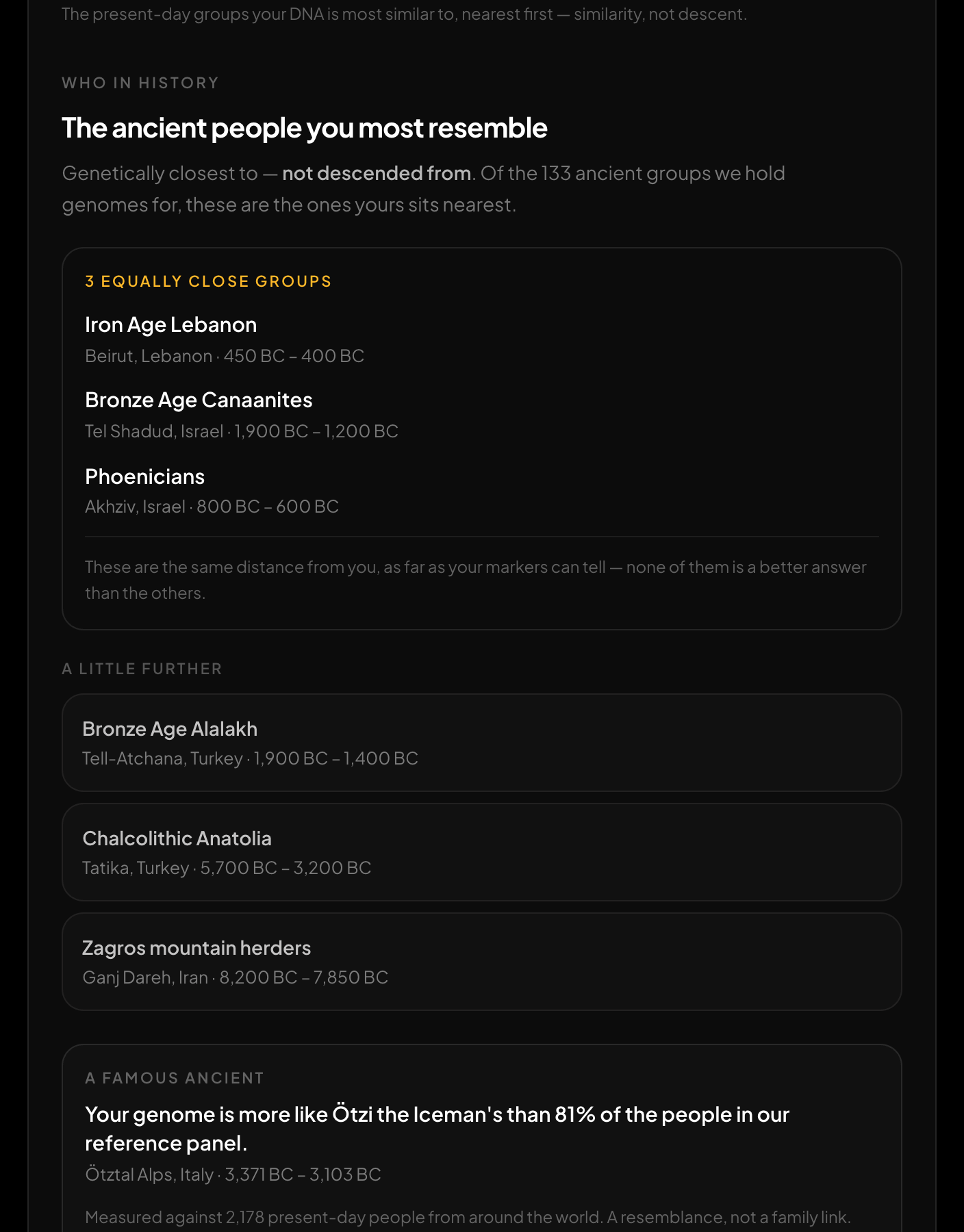
The ancient groups you sit closest to, with ties shown as ties, and a named ancient.
What "closest" means, and what it doesn't
Every result carries the same four words: closest to, not descended from. The ranking measures how similar your genotypes are to a group's at the markers you share with it. It doesn't find your ancestors.
That distinction matters, because present-day people are mixtures of older populations. Most Europeans, for example, carry ancestry from hunter-gatherers, from farmers who came out of Anatolia, and from herders of the Eurasian steppe. Coming out closest to Neolithic Anatolian farmers means your genome resembles theirs more than the other 132 groups do. It doesn't mean your family line runs to Menteşe.
| Group | Site | Dates |
|---|---|---|
| Natufian hunter-gatherers | Raqefet Cave, Israel | 11,300 to 10,800 BC |
| Iberomaurusian foragers | Taforalt Cave, Morocco | 12,700 to 12,300 BC |
| Zagros mountain herders | Ganj Dareh, Iran | 8200 to 7850 BC |
| Neolithic Anatolian farmers | Menteşe, Turkey | 6700 to 3700 BC |
| Bronze Age Canaanites | Tel Shadud, Israel | 1900 to 1200 BC |
| Phoenicians | Akhziv, Israel | 800 to 600 BC |
| Punic Kerkouane | Kerkouene, Tunisia | 600 to 250 BC |
| Medieval Socotra | Wadi Asserho, Yemen | AD 700 to 1200 |
| Medieval Jews of Erfurt | Erfurt, Germany | AD 1300 to 1350 |
Scroll the table sideways for the rest →
Names, sites and dates come from the Allen Ancient DNA Resource (v66) annotation. Only the plain-language name is ours.
Why the ranking is harder than it looks
Ancient genomes are not like the file on your computer. Most were read from a few fragments of degraded DNA, one fragment per position, so each person gives half the information a modern genome does. Groups are small, too: our panel takes up to 20 people from each. A naive ranking would reward whichever group happens to have the most people and the best DNA.
The analysis corrects for both: it judges, person by person, whether a genome was read one fragment per position, and it adjusts every distance for how many people stand behind it. Then it estimates how certain each gap is, which is where the ties come from. When two groups are closer to each other than the uncertainty in your own markers, calling one of them "first" would be pretending.
The six named ancients
Most famous ancients were never sequenced, and a name that isn't on the list below is not in the data. The report never guesses one. Each result is a percentile against a few thousand present-day people from around the world, never a family link, and it only appears when you are more like that person than at least half the panel.
| Who | Where and when | Genome published in |
|---|---|---|
| Ötzi the Iceman | Ötztal Alps, Italy, about 3300 BC | Wang et al., Cell Genomics 2023 |
| Loschbour man | Luxembourg, about 6100 BC | Lazaridis et al., Nature 2014 |
| The Stuttgart woman | Stuttgart, Germany, about 5200 BC | Lazaridis et al., Nature 2014 |
| La Braña man | León, Spain, about 5900 BC | Olalde et al., Nature 2014 |
| Mota man | Mota Cave, Ethiopia, about 2500 BC | Gallego Llorente et al., Science 2015 |
| Sunghir 1 | Sunghir, Russia, about 31,000 BC | Sikora et al., Science 2017 |
Scroll the table sideways for the rest →
An allow-list: each person’s identity is published and uncontested, their genome passes quality control in the Allen Ancient DNA Resource, and the paper is named under the result.
Two exclusions are deliberate. Cheddar Man is not on the list, because the rows in the ancient DNA database cannot be identified as him from their annotation. Ancient Americans such as Kennewick Man and Anzick-1 are left out too: their descendant communities, not a report, get to decide how they are talked about.
Does a chip file work?
Yes. A genotyping chip from 23andMe, AncestryDNA or MyHeritage shares tens of thousands of positions with the ancient genomes, which is enough to rank the groups. The report prints how many markers it used. A whole-genome VCF shares more, which tightens the ranking and separates more of the ties. Not sure your file will read? Check it first, free and in your browser.
Your family lines, too
The same report reads your maternal line and, if you have a Y chromosome, your paternal line, on your device. Each of the world's main lines has its own page with where it is common today, how old it is and the ancient people who carried it: paternal and maternal lineages.
How to run it, free
- 1.Download your raw data: 23andMe, AncestryDNA, MyHeritage or a whole-genome VCF.
- 2.Choose it at healthosx.com/dna. The trait and health story is read in your browser, with nothing asked of you.
- 3.Open your full report, which is free and needs a one-time code sent to your email, and agree to the ancestry analysis. It sends the markers it needs to our server in Germany and keeps them with your result until you delete them. It takes two to three minutes.
FAQ
Is this the same as MyTrueAncestry or Illustrative DNA?
No. Both go much deeper into ancient DNA, with more samples and era-by-era models, and both charge for the full result. How they compare, and where each is the better pick.
Can it tell me my tribe, or which ancient people I descend from?
No. It ranks similarity to groups. For the paternal line and Arab tribal genealogy, see what Y-DNA can and can't say about tribal lineage.
Does it work for Middle Eastern and North African ancestry?
Yes, and it's one of the denser parts of the panel: Natufian, Canaanite, Phoenician, Ebla, Alalakh, Zagros, Taforalt, Punic and medieval Socotra groups, among others. See Middle Eastern ancestry from raw DNA.
Find the ancient people your DNA sits closest to, free, from the file you already have: healthosx.com/dna
No raw DNA file yet?
Get a HealthOS DNA Kit: spit in a tube at home, and your ancestry, lineages and traits arrive in your HealthOS account, with the raw file.
See the DNA kitWritten by
HealthOS Research