Drug Response From a Consumer DNA Chip: What CYP2C19, CYP2D6 and Friends Can and Can’t Tell You
Your 23andMe or AncestryDNA file can flag real medication-gene results for clopidogrel, warfarin, statins and more. Which genes a chip calls well, why CYP2D6 isn’t one of them, and what to do with a result.
A consumer DNA chip can give you real, useful medication-gene results for several well-studied genes: CYP2C19 (clopidogrel, several antidepressants, stomach-acid drugs), CYP2C9 and VKORC1 (warfarin), SLCO1B1 (simvastatin), TPMT (azathioprine), DPYD (5-FU chemotherapy) and two HLA-B drug-reaction markers. It can't reliably call CYP2D6, which handles about a quarter of common drugs, because that gene's key variants are whole-gene deletions and duplications. The free report at healthosx.com/dna reads the genes a chip handles well from a 23andMe or AncestryDNA file, in your browser, and says plainly that CYP2D6 isn't among them. Your DNA story needs no account; the full report opens in the HealthOS app after a 6-digit code sent to your email.
Why medication genes are worth knowing
Pharmacogenomics is among the most actionable things in your DNA. Guidelines from the Clinical Pharmacogenetics Implementation Consortium (CPIC) tell doctors how to adjust specific drugs for specific genotypes, and several drug labels carry genetic information. The value lies in knowing before a prescription, not after a bad reaction.
| Gene | Drugs it affects | From a chip? |
|---|---|---|
| CYP2C19 | Clopidogrel, several antidepressants, stomach-acid drugs | Yes (*2, *17) |
| CYP2C9 + VKORC1 | Warfarin, some painkillers, phenytoin | Yes |
| SLCO1B1 | Simvastatin and other statins | Yes |
| TPMT | Azathioprine, mercaptopurine | Yes |
| DPYD | 5-FU, capecitabine | Partly — one variant of several |
| HLA-B tags | Abacavir, allopurinol | Tag only — confirm with HLA typing |
| UGT1A1 | Irinotecan | Yes |
| BCHE | Succinylcholine (anaesthesia) | Yes |
| CYP2D6 | Codeine, tramadol, tamoxifen, many antidepressants | No — needs copy-number analysis |
Scroll the table sideways for the rest →
Informational only. Never change or stop a medicine on the strength of a raw-data result — tell a doctor or pharmacist, and ask for a clinical test when a decision depends on it.
What a chip calls well
- CYP2C19 (
*2and*17on /dna): poor or intermediate metabolizers activate clopidogrel poorly after a stent, and clear some SSRIs and proton-pump inhibitors differently.*3, which is common in East Asia, isn't read, so treat a "normal" East Asian result with some caution. - CYP2C9 (`2
,3`) and VKORC1 (−1639): together they explain much of the variation in warfarin* dose, and CYP2C9 also affects some anti-inflammatory painkillers and phenytoin. - SLCO1B1 (`5`): raises the risk of muscle pain on simvastatin**, especially at high doses.
- TPMT (`3B
,3C`): low activity means standard azathioprine or mercaptopurine* doses can be dangerous. - DPYD (`2A`): carriers can have severe toxicity from standard 5-FU or capecitabine**. Other DPYD variants exist that a chip may not read.
- The two HLA tag markers:
HLA-B*57:01for abacavir hypersensitivity, andHLA-B*58:01for severe skin reactions to allopurinol. Tag markers stand in for the HLA type and work best in particular ancestries, so these always need a clinical HLA test before a decision. - UGT1A1 `6` and BCHE:** irinotecan toxicity (mainly in East Asian populations) and prolonged paralysis after the anaesthetic drug succinylcholine.
What a chip can't do
- CYP2D6: codeine, tramadol, tamoxifen, many antidepressants and antipsychotics. Copy-number changes (zero to three or more copies) and hybrid genes need sequencing reads or a dedicated assay. Tools that give a confident CYP2D6 call from a chip are guessing.
- Rare variants: a "normal" call means you don't carry the variants that were tested, not that none exist.
- Everything else about you: kidney and liver function, other medicines, age and adherence often matter as much as genes.
What to do with a result
- 1.Don't change or stop any medicine on the basis of a raw-data result.
- 2.Tell your doctor or pharmacist about any non-normal result, ideally before your next prescription.
- 3.Ask for a clinical pharmacogenomic test if a decision depends on it. Many health systems now order them.
- 4.Keep a copy of your results somewhere you'll find them in ten years. Their value lasts.
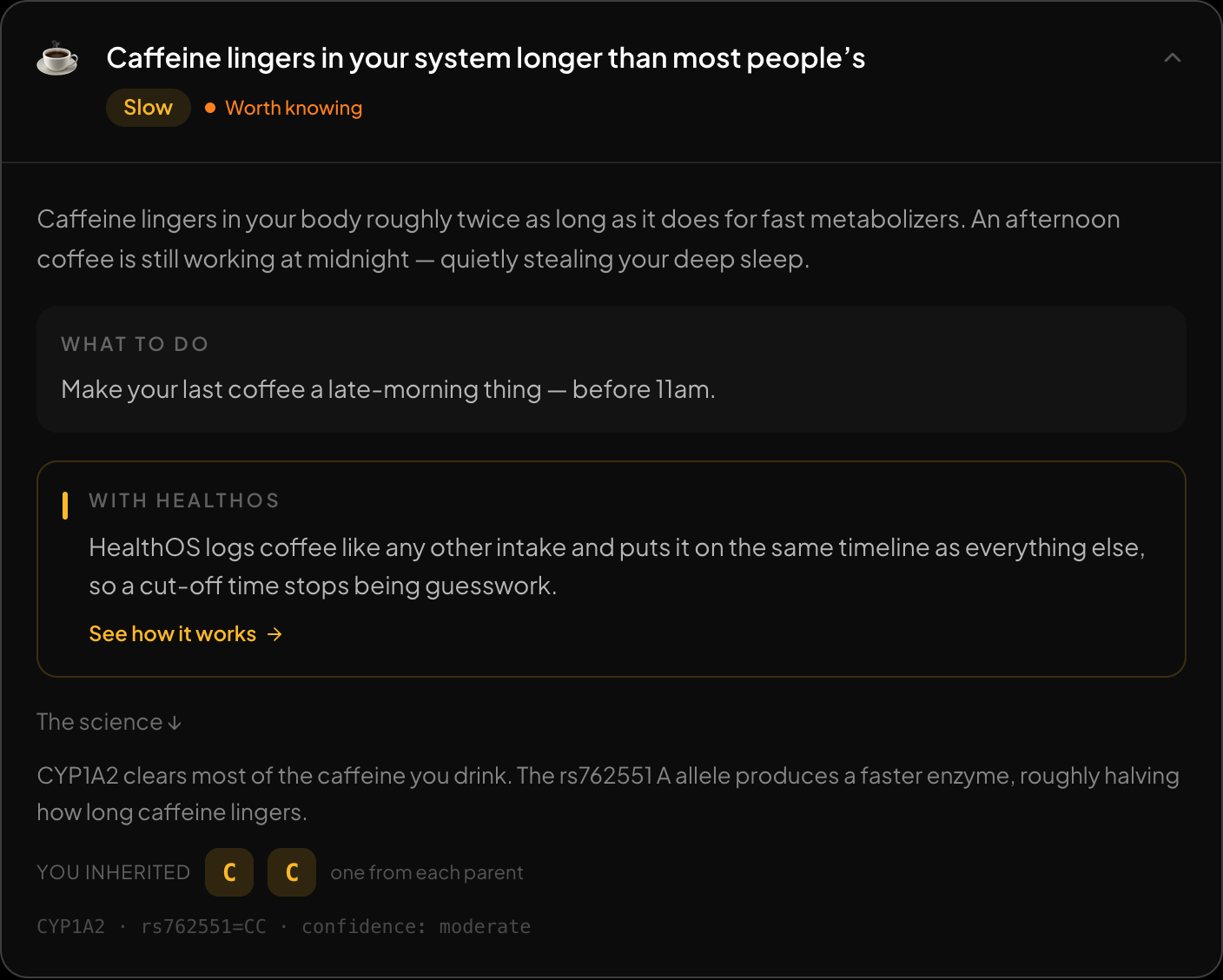
Every finding opens up: what it means, what to do, and the genotype behind it.

The short version: what is worth acting on, first.
How to make a result useful rather than interesting
A medication-gene result is worth something only if the person prescribing knows about it:
- 1.Write it down in plain words, with the gene and the phenotype: "CYP2C19 intermediate metabolizer", not a genotype string.
- 2.Put it somewhere you'll find in ten years — your notes app, a photo, your health record. These results don't change.
- 3.Mention it when a relevant drug comes up, not before. Clopidogrel after a stent, an SSRI, warfarin, a statin, azathioprine, capecitabine: those are the moments.
- 4.Ask for a clinical test when a decision hangs on it. Many health systems order pharmacogenomic panels now, and a lab result belongs in your record in a way a website's report doesn't.
The ones most likely to matter to you
- CYP2C19 and clopidogrel. Poor metabolizers get much less protection after a stent, and alternatives exist. For most people this is the most consequential result on a consumer chip.
- SLCO1B1 and simvastatin. Muscle pain is the main reason people stop statins, and a lower dose or a different statin often solves it.
- DPYD and 5-FU. Rare but severe: testing before fluoropyrimidine chemotherapy is now routine in several countries.
- TPMT and azathioprine. Standard doses can cause dangerous marrow suppression in poor metabolizers.
- The HLA-B tags, for abacavir and allopurinol. A positive tag means asking for proper HLA typing before starting the drug.
FAQ
Can I ask a pharmacist about this?
Yes, and pharmacists are often the most fluent people in a health system on drug-gene interactions. Bring the phenotype, not the raw file.
Does "normal metabolizer" mean I'm fine?
It means you don't carry the variants that were tested. A chip reads a subset, and CYP2C19 *3 — common in East Asia — isn't among them here.
Do my other medicines affect this?
Very much so. Interacting drugs can turn a normal metabolizer into a functionally poor one, which is exactly why this belongs in a conversation with a professional rather than a spreadsheet.
See which medication genes matter for you, free, in your browser: healthosx.com/dna
New to raw DNA files? Start with the full guide: How to Download & Analyze Your 23andMe Raw Data Free
Common questions
- Pharmacogenomics from AncestryDNA raw data free
- Yes. An AncestryDNA raw file is a genotyping chip file, like 23andMe’s, and it carries markers for several pharmacogenomics genes a chip calls well: CYP2C19, CYP2C9, VKORC1, SLCO1B1, TPMT and DPYD. healthosx.com/dna reads the ones your file contains, free. It is free: the file is read in your browser, and your DNA story opens straight away with no account. The full report opens in the HealthOS app after a 6-digit code sent to your email, and your file stays on your device. CYP2D6 cannot be called from a chip. Never change or stop a medicine on a raw-data result; tell your doctor or pharmacist.
- Does a whole-genome VCF give better pharmacogenomics than a chip?
- It covers far more variants in each gene, so a “normal” result is less likely to miss something. CYP2D6 is the exception: its copy-number changes need the sequencing reads (BAM or CRAM), not the VCF.
- How does this compare with Promethease and Allelix?
- Promethease lists every SNPedia entry that matches your file, drug-response entries included, after you upload it and pay per report. Allelix is an open-source toolkit that annotates raw files against databases such as ClinVar and drug-response sources, and you can run it on your own computer. healthosx.com/dna reads a shorter list of CPIC-guided medication genes in plain language, free, in your browser.
No raw DNA file yet?
Get a HealthOS DNA Kit: spit in a tube at home, and your ancestry, lineages and traits arrive in your HealthOS account, with the raw file.
See the DNA kitReferences
- 1.CPIC guidelines (Clinical Pharmacogenetics Implementation Consortium)
- 2.FDA Table of Pharmacogenetic Associations
For informational purposes only. For medical advice or diagnosis, consult a professional.
Written by
HealthOS Research