the-genome.com Alternatives: A €99 DNA Health Report vs a Free Read
the-genome.com analyses an uploaded raw DNA or VCF file for €99 and deletes it afterwards. What you get for the price, and when a free in-browser report covers the same ground.
the-genome.com sells a one-off DNA health report for €99 (at the time of writing). You upload a 23andMe, AncestryDNA, MyHeritage or whole-genome VCF file, and in a couple of minutes you get health risks, drug compatibility across hundreds of medications, nutrition and carrier status. The file is deleted after analysis. For a free alternative that never needs to upload the file, healthosx.com/dna reads it in your browser and includes the medication genes.
What the-genome.com does
- Upload model: server-side analysis, with the file permanently deleted afterwards, according to the site.
- Price: €99 for the report.
- Coverage: health risks, pharmacogenomics (it cites 672 drugs), nutrition and wellness (MTHFR, caffeine, lactose and gluten) and carrier status, drawing on 15 medical sources.
- Files: 23andMe (v3 to v5), AncestryDNA, MyHeritage, Nebula, Dante Labs and standard VCF.
| HealthOS /dna | the-genome.com | |
|---|---|---|
| Price | Free | €99 for the report |
| Where your file goes | Read in your browser, not uploaded | Uploaded, then deleted after analysis |
| Speed | About a minute | Under two minutes |
| Drug coverage | The genes a chip can actually call, and it says CYP2D6 is not one | Cites 672 medications |
| Carrier status | A few validated variants only | Included |
| Ancestry | Included | Not its focus |
| Try before paying | Nothing to pay | No |
Scroll the table sideways for the rest →
Prices and features as published on each site on 2026-09-17; check them before deciding.
Where the-genome.com is the better choice
- You want a single polished report covering drug interactions across a very long medication list.
- You'd rather pay once for a finished document than explore.
Where HealthOS /dna fits better
- It's free, so there's no reason not to see what your file supports first.
- No upload for the report. "Deleted after analysis" is a policy. "Never sent" is a property of how the page works, and you can check it yourself.
- Medication genes in context. A 672-drug list mostly repeats the same few genes: CYP2C19, CYP2C9, VKORC1, SLCO1B1, TPMT, DPYD and CYP2D6. We report the ones a chip can call and say plainly that CYP2D6 isn't one of them. Why that matters.
- Ancestry across 15 regions, and Ask your DNA for follow-ups.

The short version: what is worth acting on, first.
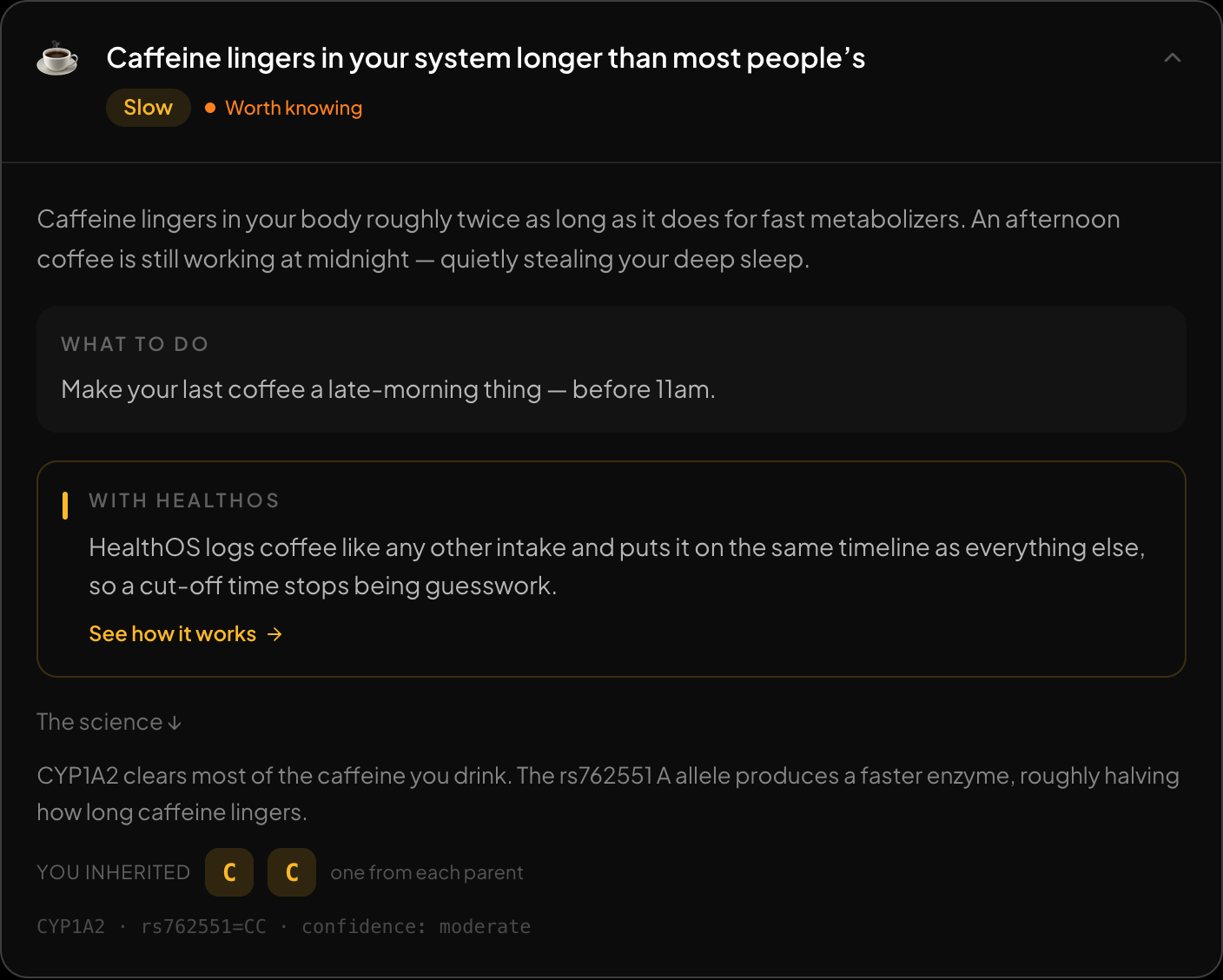
Every finding opens up: what it means, what to do, and the genotype behind it.
HealthOS /dna at a glance
- Price: the report is free. The story needs no account and no email; the full report opens in the HealthOS app after a one-time 6-digit email code. Ask your DNA gives you five free questions, then $1 for five more.
- Privacy: your file is read in your browser and not uploaded for the story or the report. Ancestry sends only the markers it needs and keeps them with your result until you delete them. The chat stores your file only if you choose to (encrypted, deletable).
- What you get: around 50 findings (food, sleep, movement, heart and metabolism, medication genes, traits), ancestry across 15 regions with the closest reference populations, and a chat that answers from your own results.
- Files: 23andMe, AncestryDNA, MyHeritage, FamilyTreeDNA, Living DNA, WeGene and whole-genome VCFs.
What €99 buys, and what it doesn't
A one-off paid report is worth it when it answers a question you actually have. Before paying, it's worth knowing what no report, at any price, can do from a consumer file:
- A 672-drug list is mostly the same few genes. Pharmacogenomic guidance rests on CYP2C19, CYP2C9, VKORC1, SLCO1B1, TPMT, DPYD and CYP2D6. Hundreds of drug names are those genes repeated across drug classes, which is useful presentation rather than extra information. What a chip can and can't call.
- Carrier status from a chip is thin. Chips test a handful of positions per gene, and rare calls from chips are often false positives. Why, and when to get a real carrier screen.
- Nothing here is diagnostic. Any consequential result needs confirming in an accredited lab, whichever tool produced it.
A sensible order
- 1.Read your file free at /dna and see which findings your file actually supports.
- 2.Write down the medication-gene results and tell a doctor or pharmacist once.
- 3.If a specific question is still unanswered — a detailed drug interaction list, say — then pay for the report that answers it.
FAQ
Is a paid report more accurate?
Not inherently. Accuracy comes from how each variant was validated, not from the price. Ask any tool how it checked its effect alleles and strands.
Can I use both?
Yes. They read the same file, and comparing two readings of the same genotype is a reasonable sanity check. Where they disagree, the genotype shown beside each finding tells you which one to trust.
See it free before you pay for it: healthosx.com/dna
New to raw DNA files? Start with the full guide: How to Download & Analyze Your 23andMe Raw Data Free
No raw DNA file yet?
Get a HealthOS DNA Kit: spit in a tube at home, and your ancestry, lineages and traits arrive in your HealthOS account, with the raw file.
See the DNA kitWritten by
HealthOS Research