Carrier Status From Consumer DNA: What It Can Tell You, and Its Limits
A raw DNA file can show a handful of carrier variants, but a chip covers only a sliver of what a real carrier screen tests, and rare calls are often false positives. How to read it, and when to get a proper screen.
A consumer DNA file can show whether you carry a small number of specific, common variants for recessive conditions, but it isn't a carrier screen. A chip tests a few positions per gene, where real carrier screening sequences whole genes, and rare "pathogenic" calls from chips are often false positives. If you're planning a family, especially with a relative, get a clinical carrier screen. For what a raw file can tell you, the free report at healthosx.com/dna reads a few well-validated carrier findings in your browser and says plainly what it can't cover.
What "carrier" means
For a recessive condition, you need two non-working copies of a gene to be affected. With one, you're a carrier: usually completely healthy. It matters when both partners carry a variant in the same gene. Then each child has a 1 in 4 chance of being affected.
Independent for every pregnancy — three unaffected children do not "use up" the risk. It only works this way when both partners carry a variant in the same gene.
Why a chip isn't enough
- Coverage: a gene like CFTR (cystic fibrosis) has more than a thousand known disease-causing variants. A chip tests a handful. "Not detected" means little.
- Accuracy: in a large 2021 BMJ study, most very rare variants called by chips were false positives when checked against sequencing. An earlier study found 40% of variants in consumer raw data that were sent for clinical confirmation were false positives.
- Ancestry: chips are designed around variants common in some populations. Yours may not be well represented.
What a raw file can reasonably tell you
Common, well-validated variants read reliably. On the free /dna report:
- MUTYH: carrier status for MUTYH-associated polyposis
- GBA (N370S): carrier status for Gaucher disease, and a Parkinson's risk factor
- HFE C282Y and H63D: iron overload (haemochromatosis), which is recessive in practice
- G6PD deficiency: X-linked, and common around the Mediterranean, Africa, the Middle East and Asia
- Alpha-1 antitrypsin Z and S
| Consumer chip | Whole genome | Clinical carrier screen | |
|---|---|---|---|
| How much of a gene is read | A handful of positions | Nearly all of it | The whole gene, to diagnostic depth |
| “Not detected” means | Very little | Something, but not everything | A real negative for what was tested |
| Rare-variant accuracy | Often false positives | Good — still confirm | Confirmed |
| Counselling included | No | No | Yes |
| Cost | Already paid for | Hundreds of dollars | Often covered by a health service or insurer |
Scroll the table sideways for the rest →
A whole-genome file can be screened far more broadly against ClinVar, the database of known disease variants. Ask your DNA can run that on a stored whole genome. On a chip file it limits itself to the variants the chip carries, and says so.
When to get a clinical carrier screen
- Before or early in pregnancy. ACOG recommends offering screening for cystic fibrosis, spinal muscular atrophy and haemoglobin disorders to everyone, and expanded panels are widely available.
- If partners are related. Cousin marriage raises the chance that both carry the same variant. Many countries with common consanguineous marriage, including Saudi Arabia, the UAE and others in the Gulf, run premarital screening for sickle cell disease and thalassaemia for this reason.
- If a condition runs in your family or community, such as Tay-Sachs and related conditions in Ashkenazi Jewish communities, or thalassaemia around the Mediterranean.
A clinical screen sequences the genes, confirms results, and comes with genetic counselling. A raw file is a starting point for that conversation, not a substitute.
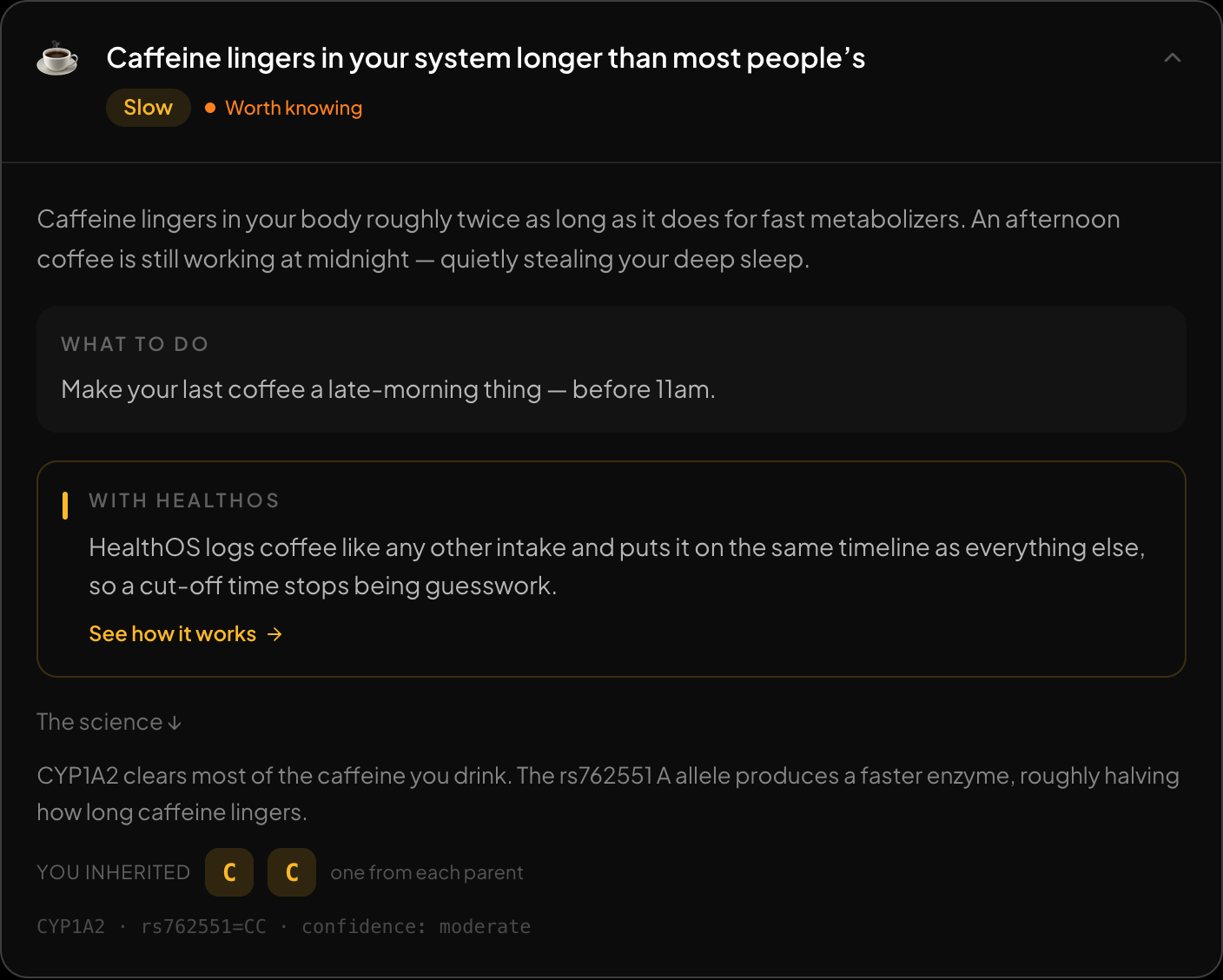
Every finding opens up: what it means, what to do, and the genotype behind it.

The short version: what is worth acting on, first.
What "carrier" means for your family
If you carry a recessive variant, the people it matters to are your partner and your children:
- One carrier parent: each child has a 50% chance of carrying it too, and none of being affected by that variant.
- Two carriers of the same gene: the odds in the chart above apply to every pregnancy independently.
- Siblings: each of your siblings has a 50% chance of carrying the same variant, which is worth telling them.
- X-linked conditions work differently. G6PD deficiency, for example, affects men far more often, and a mother can pass it to a son without being affected herself.
Questions worth asking about any carrier result
- 1.Which variants were tested, and how many exist in that gene? For CFTR the answer is "a handful, out of more than a thousand".
- 2.Was this confirmed? A rare pathogenic call from a chip is a hypothesis until an accredited lab confirms it.
- 3.Does my partner need testing too? For family planning, a variant only matters if both partners carry one in the same gene.
- 4.Is there a screening programme I should use instead? Many countries offer carrier screening free before marriage or pregnancy.
FAQ
I'm a carrier. Am I going to get ill?
For a recessive condition, carrying one copy usually means nothing for your own health. There are exceptions worth knowing: MUTYH carriers may have a modestly raised bowel cancer risk, and GBA carriers a raised Parkinson's risk.
Can I use a raw file instead of a clinical screen before pregnancy?
No. Use it as a prompt to book the real thing, which sequences the genes, confirms what it finds, and comes with counselling.
What does /dna actually report here?
A few well-validated variants — MUTYH, GBA N370S, HFE, G6PD, alpha-1 antitrypsin — and it says plainly that a chip can't support a broad carrier screen. On a stored whole genome, the chat can go wider.
See the carrier findings a raw file can support, free: healthosx.com/dna
New to raw DNA files? Start with the full guide: How to Download & Analyze Your 23andMe Raw Data Free
No raw DNA file yet?
Get a HealthOS DNA Kit: spit in a tube at home, and your ancestry, lineages and traits arrive in your HealthOS account, with the raw file.
See the DNA kitReferences
- 1.Weedon MN et al. Use of SNP chips to detect rare pathogenic variants. BMJ 2021
- 2.ACOG Committee Opinion 691: Carrier screening for genetic conditions
For informational purposes only. For medical advice or diagnosis, consult a professional.
Written by
HealthOS Research