Jewish Ancestry From Raw DNA: What a Raw File Can Show
Can your raw DNA show Ashkenazi, Moroccan, Iraqi or Iranian Jewish ancestry? What population genetics can honestly say, and how to compare your file with Jewish reference groups free.
No DNA test yet?
The HealthOS DNA Kit reads your maternal line, your paternal (Y) line if you have a Y chromosome, your ancestry across 15 regions and the ancient peoples you sit closest to. Spit in a tube at home; the lab is in Germany and the raw file is yours.
See the DNA kitYour raw DNA can show whether your genome is similar to present-day Jewish populations, but it can't tell you whether you're Jewish. You can compare your 23andMe or other raw file free at healthosx.com/dna: the file is read in your browser, and your DNA story needs no account. The optional ancestry analysis ranks the reference populations you're closest to, and those include Ashkenazi, Moroccan, Tunisian, Libyan, Turkish, Iraqi and Iranian Jewish groups, alongside their non-Jewish neighbours.
What genetics can and can't say here
Jewish identity is religious, cultural and communal. Genetics can't confirm or rule it out. What population genetics has shown is that many Jewish communities share ancestry with each other and with Levantine populations, and that each community also carries ancestry from the region where it lived for centuries:
- Ashkenazi Jews show a mix of Levantine-related and Southern European ancestry, and are genetically distinctive because the population went through a bottleneck.
- Sephardi and North African Jewish communities (Moroccan, Tunisian, Libyan) cluster near each other, between the Levant, Southern Europe and North Africa.
- Mizrahi communities (Iraqi, Iranian) sit close to their long-term neighbours in Mesopotamia and Iran, with Levantine-related ancestry.
So a result that says "closest to Moroccan Jewish" means your genotypes most resemble that reference group. It's a strong hint about heritage, not a verdict.
How the comparison works
There are two parts to the ancestry result, and they answer different questions:
- 1.Region proportions across 15 world regions. There is no "Jewish" region here, because Jewish communities are genetically spread across several regions. An Ashkenazi person typically shows mainly Southern European and Levant shares.
- 2.Closest reference populations, a ranked list of the present-day groups you're most similar to. This is where Jewish groups appear. The ranking corrects for reference group size, so a small group isn't penalised against a large neighbour. That matters, because Jewish reference groups are small and genetically close to their neighbours.
Reading your result
- An Ashkenazi Jewish group ranked first is a fairly distinctive signal, because Ashkenazi genomes are distinctive.
- A North African or Middle Eastern Jewish group near the top, alongside Moroccan, Tunisian, Iraqi or Iranian non-Jewish groups, is harder to read. Those communities are genetically close to their neighbours.
- Partial ancestry (one Jewish grandparent) usually shows as a Jewish group appearing lower in the ranking, and shifts in your region proportions, not as a clean "25%".
Health variants worth knowing
Some variants are more common in particular Jewish communities. The free report reads two of them directly: GBA (carrier status linked to Gaucher disease and Parkinson's risk) and LRRK2 G2019S (Parkinson's). Remember that a chip covers only a few carrier variants. For family planning, a proper carrier screen is the right test. Carrier status from consumer DNA, and its limits.
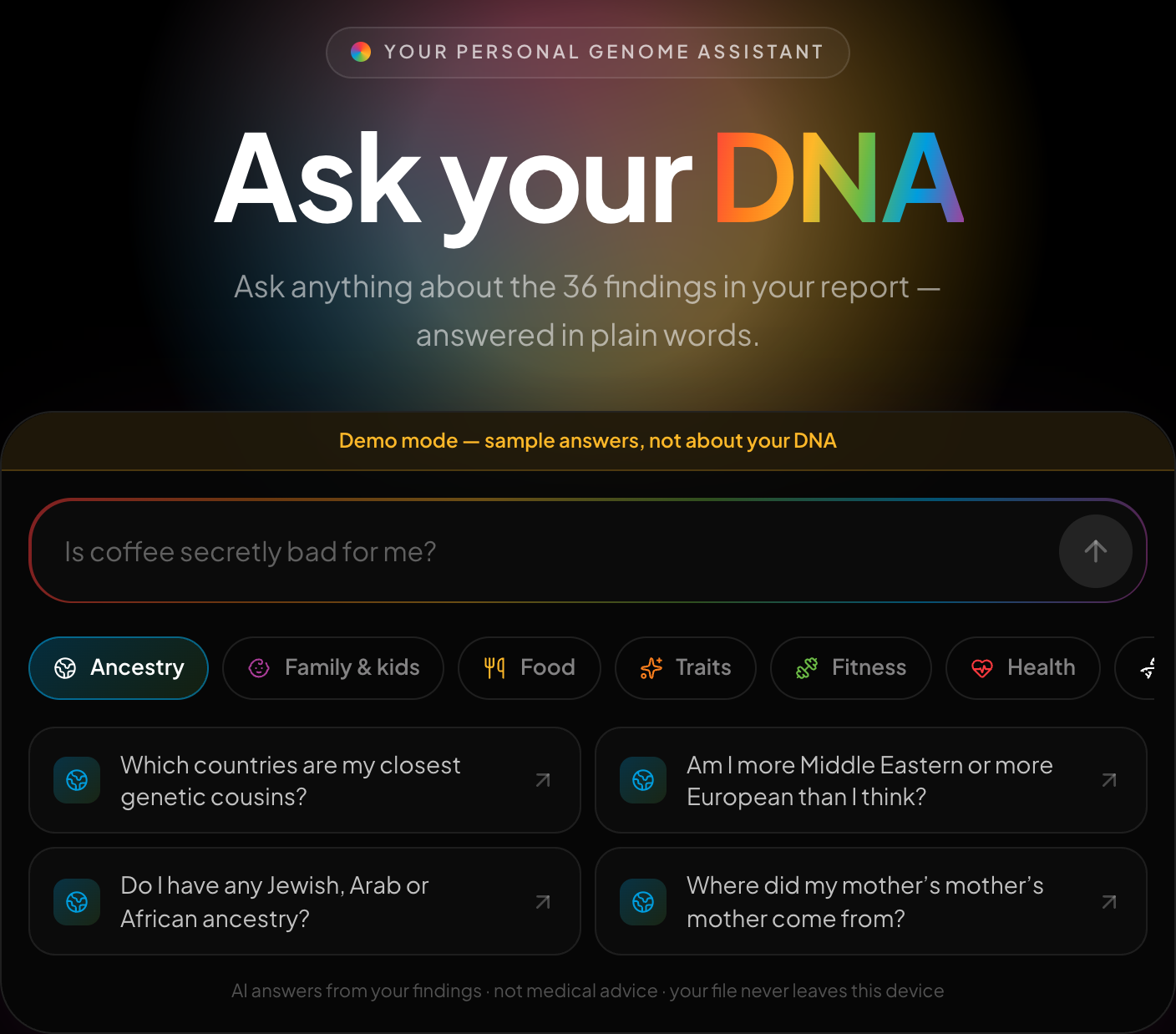
Ask your DNA: five free questions about your own results.
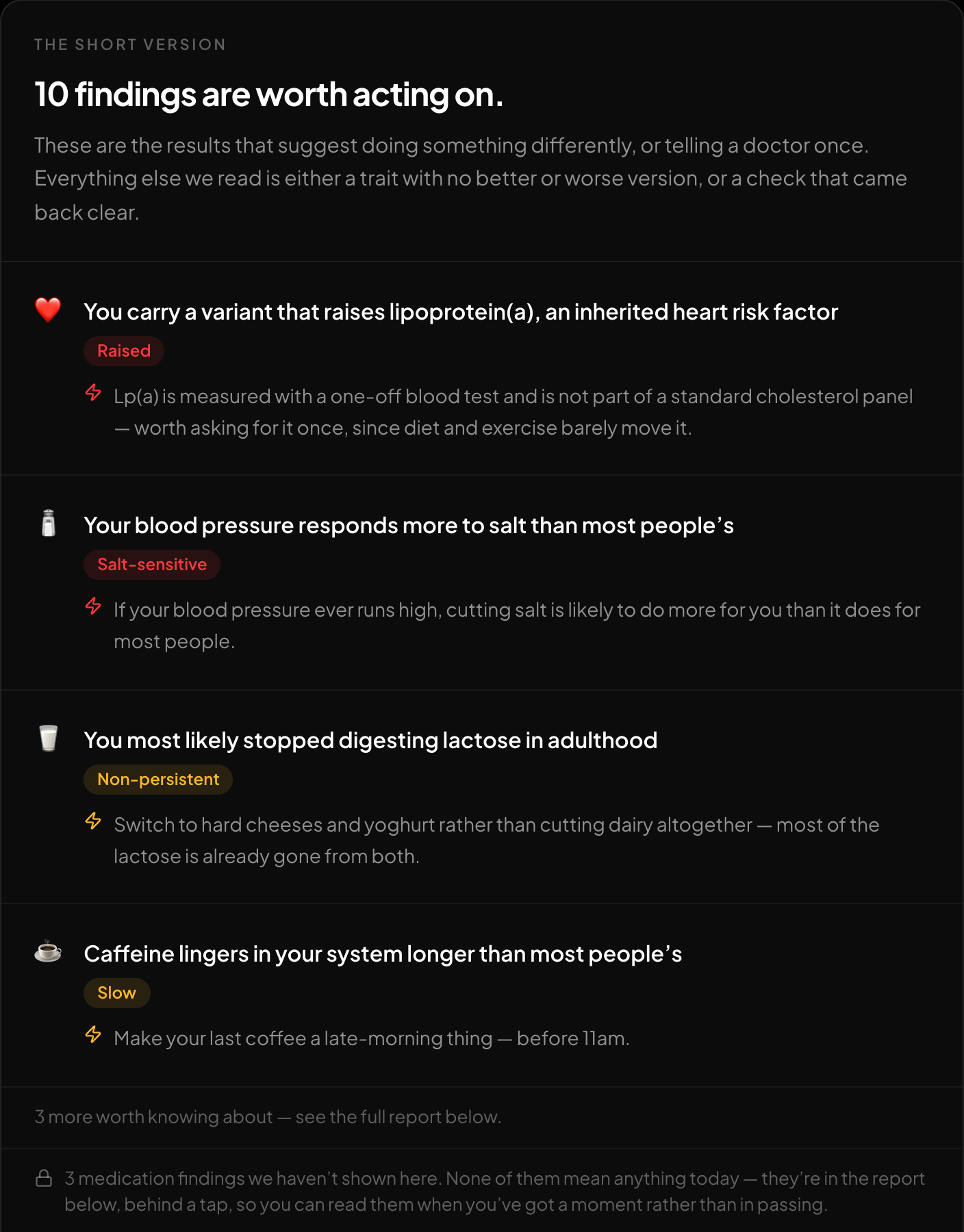
The short version: what is worth acting on, first.
Why these groups are hard to tell apart
Jewish reference groups are small, and each community is genetically close to the population it lived among for centuries. That makes the ranking harder than it looks, and it's worth knowing how the analysis handles it:
- Small groups are not penalised. The distance measure corrects for how many reference individuals a group has, so a group of ten competes fairly with one of eighty. Without that correction, close neighbours with more samples win almost every time.
- Neighbouring populations overlap. An Iraqi Jewish genome and an Iraqi non-Jewish genome are far more similar to each other than either is to, say, a Yoruba genome. A top-ranked group is a hint, not a verdict.
- Ashkenazi genomes are the exception, because a historical bottleneck left them distinctive enough to stand out clearly.
What a result cannot settle
- Religious status. Jewish identity is religious and communal, and no test confers or removes it. Halakhic status in particular is not a genetics question.
- A specific ancestor. Autosomal DNA describes populations, not individuals.
- Partial ancestry with precision. One Jewish grandparent usually shows up as a group appearing lower in the ranking and a shift in your region proportions, rather than a clean 25%.
FAQ
Do the big companies report this?
Some report an Ashkenazi component directly, because it's distinctive. Sephardi and Mizrahi ancestry is usually folded into broader Middle Eastern or Southern European categories.
Are Cohen or Levite lineages testable?
There are Y-chromosome haplotypes historically associated with priestly lineage claims, and they are neither exclusive nor definitive. That's a paternal-line question: see haplogroups from raw data.
What about health variants?
Some are more common in particular communities. The free report reads GBA and LRRK2 directly; for family planning, a clinical carrier screen is the right test.
Compare your file with Jewish and Middle Eastern reference groups, free: healthosx.com/dna
New to raw DNA files? Start with the full guide: How to Download & Analyze Your 23andMe Raw Data Free
Common questions
- Jewish ancestry from 23andMe raw data free
- You can compare your 23andMe raw file with Jewish reference groups free at healthosx.com/dna. The optional ancestry analysis ranks the closest of 298 present-day groups, including Ashkenazi, Moroccan, Tunisian, Libyan, Turkish, Iraqi and Iranian Jewish groups. Your file is read in your browser and your DNA story needs no account. Ancestry runs on HealthOS’s server in Germany only with your consent, and then only a list of markers is sent, not the whole file. A result shows genetic similarity. It cannot tell you whether you are Jewish.
- Can GEDmatch or MyHeritage show Jewish ancestry from my raw data?
- Both accept 23andMe raw files. MyHeritage gives an ethnicity estimate that includes Jewish categories such as Ashkenazi, plus relative matching; some of its features need a one-time unlock fee. GEDmatch offers free admixture calculators and relative matching, and its calculators take some practice to read. Both keep your file, because matching needs it.
- What is an admixture estimate?
- An admixture estimate describes your genome as a mix of reference populations. It depends on which groups the tool chose, so two tools can give the same person different numbers. For Jewish ancestry, the ranking of closest groups is often clearer than region percentages, because Jewish communities are spread across several regions and there is no single Jewish region.
No raw DNA file yet?
Get a HealthOS DNA Kit: spit in a tube at home, and your ancestry, lineages and traits arrive in your HealthOS account, with the raw file.
See the DNA kitWritten by
HealthOS Research