Xcode Life Alternatives: Paid DNA Reports vs a Free Read
Xcode Life sells individual health, nutrition and fitness reports from your raw DNA, from about $20–50 each. When a paid report is worth it, and when a free in-browser read covers what you need.
Xcode Life sells reports built from your uploaded raw DNA, covering nutrition, fitness, skin, allergies, methylation, health and more. At the time of writing, individual reports cost roughly $20 to $50 and bundles more. If you want a free first look before paying for anything, healthosx.com/dna reads the same 23andMe, AncestryDNA or MyHeritage file in your browser, including the medication genes, and your DNA story needs no account.
What Xcode Life does
- Upload model: you upload your raw file, pick reports, and they're generated within hours.
- Pricing: per report, or discounted packs.
- Range: many themed reports (nutrition, fitness, skin, sleep, allergy, methylation, carrier, health), each covering a set of genes.
- Files: the main consumer tests, including 23andMe, AncestryDNA, MyHeritage and FamilyTreeDNA.
| HealthOS /dna | Xcode Life | |
|---|---|---|
| Price | Free | Roughly $20–$50 per report; bundles cost more |
| Where your file goes | Read in your browser | Uploaded |
| Breadth | One report covering food, medication genes, heart and traits | Many themed reports: nutrition, fitness, skin, allergy, methylation |
| Turnaround | About a minute | Within hours |
| Medication genes | Included free | Sold as a report |
| Ancestry | Included | Not its focus |
| Sources shown per finding | Yes, with your genotype | Varies by report |
Scroll the table sideways for the rest →
Prices and features as published on each site on 2026-09-17; check them before deciding.
Where Xcode Life is the better choice
- You want a themed deep-dive, such as a whole report on skin or fitness, with recommendations written around it.
- You like a document you can download and keep.
- You're after categories we don't cover, such as skin or allergy panels.
Where HealthOS /dna fits better
- Free. The whole report costs nothing, so you can see what your file supports before deciding whether a paid report adds anything.
- Private by default. The report runs in your browser. Your file is not uploaded unless you choose ancestry (markers only, kept until you delete them) or choose to store your file for the chat.
- Findings with receipts. Each one shows your genotype and its source, and the report says "not covered" when your file doesn't read a position.
- Ancestry included: 15 regions and the closest reference populations.
- Ask about your results. Ask your DNA answers follow-ups from your own data, with five free questions.
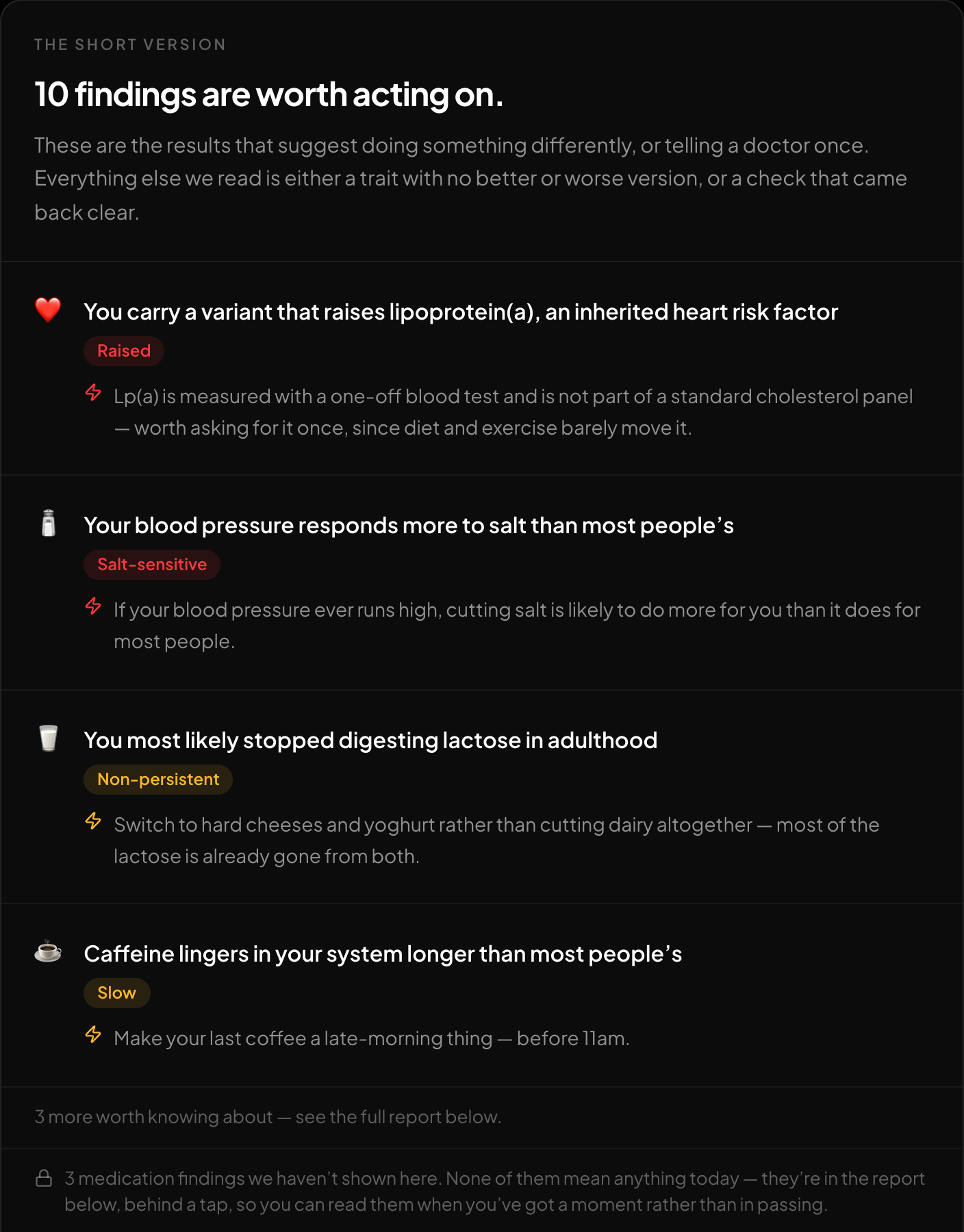
The short version: what is worth acting on, first.
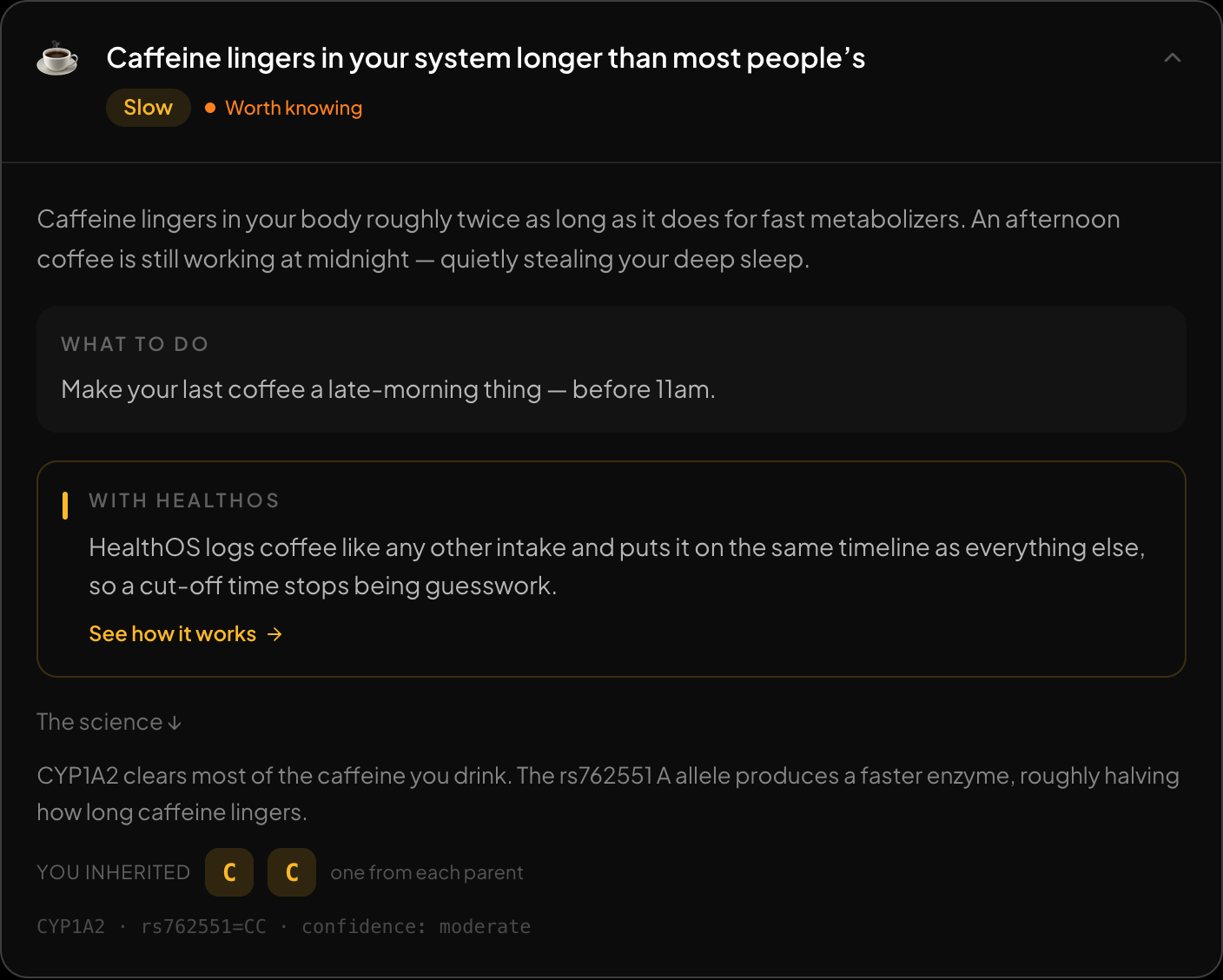
Every finding opens up: what it means, what to do, and the genotype behind it.
A sensible order
- 1.Read your file free at /dna.
- 2.If a theme matters to you and isn't covered, such as skin, compare what a paid report adds gene by gene.
- 3.For anything medical, especially medication genes, confirm with a clinical test. What a chip can and can't say about drug response.
HealthOS /dna at a glance
- Price: the report is free. The story needs no account and no email; the full report opens in the HealthOS app after a one-time 6-digit email code. Ask your DNA gives you five free questions, then $1 for five more.
- Privacy: your file is read in your browser and not uploaded for the story or the report. Ancestry sends only the markers it needs and keeps them with your result until you delete them. The chat stores your file only if you choose to (encrypted, deletable).
- What you get: around 50 findings (food, sleep, movement, heart and metabolism, medication genes, traits), ancestry across 15 regions with the closest reference populations, and a chat that answers from your own results.
- Files: 23andMe, AncestryDNA, MyHeritage, FamilyTreeDNA, Living DNA, WeGene and whole-genome VCFs.
How to decide whether a paid report adds anything
Paid reports are sold by theme, and themes overlap heavily. Before buying, check what the report is built on:
- 1.Which genes does it read? Most nutrition and fitness reports rest on the same few dozen variants — MTHFR, CYP1A2, ACTN3, FTO, VDR, LCT — that a free read already covers.
- 2.What does it recommend? A report that ends in supplement suggestions is making a bigger claim than the underlying evidence usually supports. MTHFR is the clearest example.
- 3.Is anything in it actionable? Medication genes are the most actionable category in consumer genetics, and they're free on /dna.
What neither can do
- Diagnose anything. Confirm any consequential finding in an accredited lab.
- Read CYP2D6 from a chip, which affects codeine, tramadol and several antidepressants. It needs copy-number analysis.
- Rule a variant out. A position a chip didn't read is untested, not absent.
FAQ
Can I use my Xcode Life file on /dna?
You don't need to. Both read the same raw file from your testing company — 23andMe, AncestryDNA, MyHeritage, FamilyTreeDNA, Living DNA or a whole-genome VCF.
Does /dna cover nutrition?
The parts with solid evidence: lactose, caffeine, alcohol flush, folate, vitamin D, omega-3 conversion, celiac genes and G6PD. Not a full "nutrigenomics" plan, because that's mostly built on weaker associations.
Start with the free read: healthosx.com/dna
New to raw DNA files? Start with the full guide: How to Download & Analyze Your 23andMe Raw Data Free
No raw DNA file yet?
Get a HealthOS DNA Kit: spit in a tube at home, and your ancestry, lineages and traits arrive in your HealthOS account, with the raw file.
See the DNA kitWritten by
HealthOS Research