MTHFR From Your Raw DNA: An Honest Guide to an Over-Hyped Gene
MTHFR C677T (rs1801133) is in every raw DNA file and all over the internet. What CC, CT and TT really mean, why major medical bodies advise against testing it, and the one thing worth doing.
Free gene check
Check it in your own file
Drop your raw DNA file here and see which row of this guide is yours. It is read in your browser and never uploaded.
Choose or drop your raw DNA file
.txt · .csv · .zip · .vcf · .vcf.gz
MTHFR C677T is read from rs1801133 in your raw DNA. On the plus strand that 23andMe and AncestryDNA use, GG is the typical form (677CC), AG is one copy (677CT), and AA is two copies (677TT). One copy is extremely common and has little practical effect. Two copies modestly lowers enzyme activity, which matters mainly when folate intake is low. Despite what much of the internet says, it isn't a cause of chronic illness, and major medical bodies advise against testing it for most purposes. The free report at healthosx.com/dna reads it calmly, as one finding among about 50.
What MTHFR does
The MTHFR enzyme converts folate into the form your body uses to recycle homocysteine into methionine, a step in what's called the methylation cycle. The C677T variant makes the enzyme less stable:
- 677CT: about 65% of typical activity
- 677TT: about 30% of typical activity
Approximate, relative to 677CC. Low activity matters mainly when folate intake is low.
| In your file | Usually written | How common | What it means |
|---|---|---|---|
| GG | 677CC | About half of people of European ancestry | Typical enzyme activity. Nothing to do. |
| AG | 677CT | Roughly 40% | One copy. Common, and of little practical consequence. |
| AA | 677TT | About 10%, and 20%+ in some populations | Lower activity. Keep folate intake solid; a homocysteine test tells you more than the genotype. |
Scroll the table sideways for the rest →
Plus-strand letters. A1298C (rs1801131) is the other commonly discussed variant; its effect on its own is smaller still.
How common it is
Very common. Roughly 40% of people of European ancestry carry one copy, and about 10% carry two. In some populations, parts of Italy and Mexico for example, TT is 20% or more. A variant that common, with the population still thriving, is rarely a disaster.
What the evidence actually shows
- TT raises homocysteine, mostly in people with low folate intake. With enough folate the difference largely disappears.
- Heart disease and stroke: the link is small and inconsistent, and lowering homocysteine with B vitamins didn't reduce heart attacks in large trials.
- Blood clots and pregnancy loss: the American College of Medical Genetics and the American College of Obstetricians and Gynecologists both advise against MTHFR testing for these, because it doesn't change care.
- Neural tube defects: TT slightly raises the risk when folate is low, which is exactly what folic acid before pregnancy prevents.
The claims to ignore
"MTHFR causes" fatigue, anxiety, autism, chronic fatigue, histamine problems, and "detox" failure: none of these is established. Much of that content is written by people selling supplements or protocols.
What's actually worth doing
- Eat enough folate: leafy greens, legumes, fortified grains.
- If you could become pregnant, take folic acid as recommended. The CDC is explicit that people with MTHFR variants process folic acid and should take it. Methylfolate is a reasonable alternative if you prefer it, but don't skip folate because of a forum post.
- If you want a number, a blood homocysteine test tells you far more than the genotype does.
- A1298C (rs1801131) is the other commonly discussed MTHFR variant. Its effect alone is smaller still.
What /dna shows
The report reads rs1801133 and describes it plainly. One copy is shown as neutral, and only TT is flagged as worth a look, with the practical step above. It's placed next to findings with stronger evidence, like lipoprotein(a) and the medication genes, so it gets the weight it deserves and no more.

Every finding opens up: what it means, what to do, and the genotype behind it.
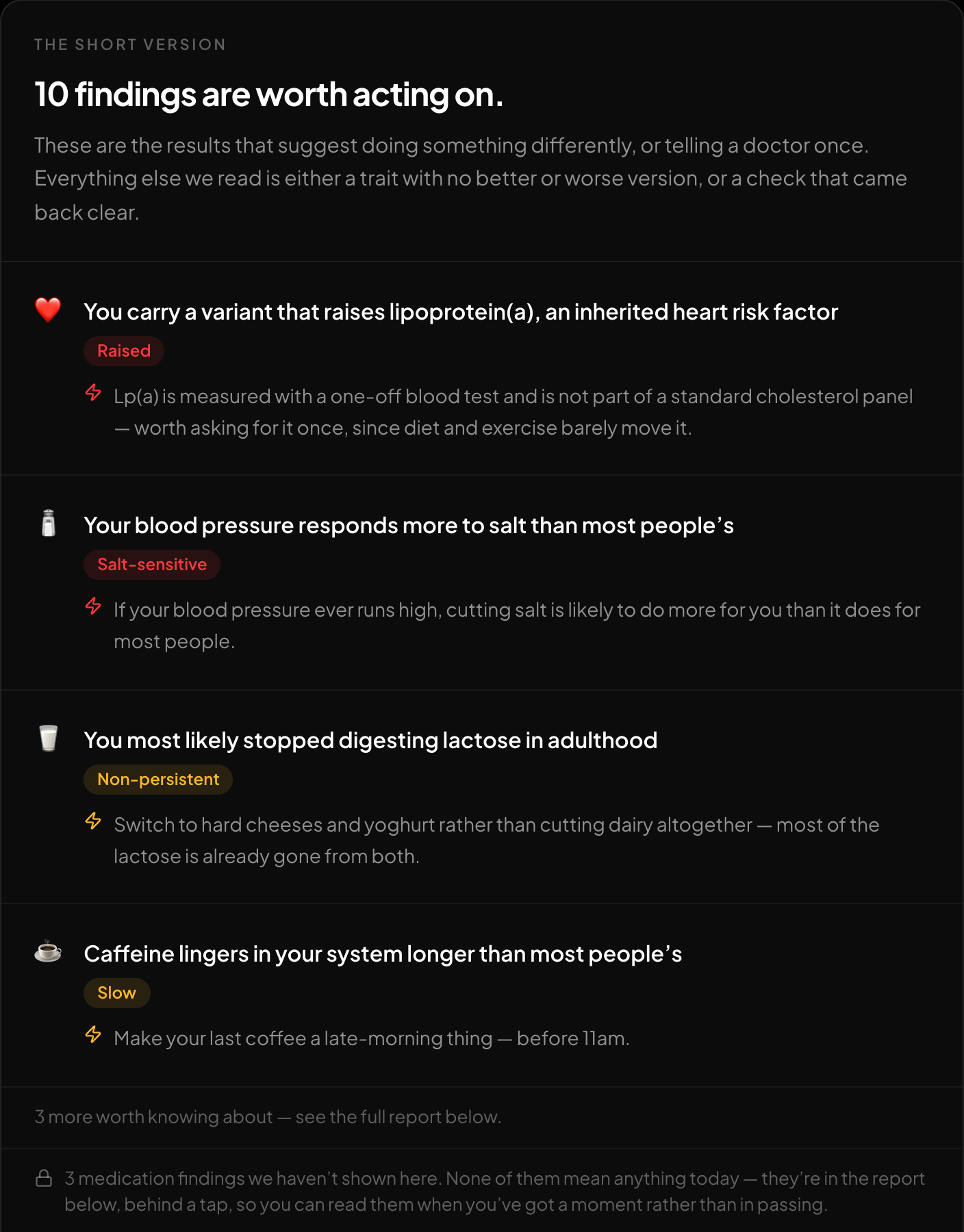
The short version: what is worth acting on, first.
Where the MTHFR story came from
The variant is real, and the early research was reasonable: C677T lowers enzyme activity, low activity raises homocysteine, and high homocysteine was associated with cardiovascular disease. The chain looked strong enough to act on.
Two things then happened. Trials that lowered homocysteine with B vitamins did not reduce heart attacks or strokes, which broke the middle of the chain. And by then a large industry of supplement sellers and protocol writers had built on the early version of the story. That's why the internet's MTHFR is a decade out of date and far more dramatic than the evidence.
What to do if you've been told you have "the MTHFR mutation"
- 1.Find out which variant and how many copies. "MTHFR positive" usually means one copy of C677T, which is common and of little practical consequence.
- 2.Measure homocysteine if you want to know whether anything is actually happening. It costs little and answers the question the genotype only hints at.
- 3.Get folate from food, and take folic acid as recommended if you could become pregnant.
- 4.Be sceptical of protocols that bundle a dozen supplements around one variant — especially sustained high-dose B6, which can cause nerve problems.
FAQ
Should I take methylfolate instead of folic acid?
Either is reasonable. The CDC is explicit that people with MTHFR variants process folic acid, and folic acid is what the neural-tube-defect evidence was built on. Methylfolate is a fine alternative if you prefer it; the mistake is skipping folate altogether.
Does MTHFR cause miscarriage or clots?
Medical bodies advise against testing it for either, because the result doesn't change care. Recurrent pregnancy loss or a clot deserves a proper workup rather than a genotype.
Is 677TT worth knowing at all?
Mildly. It's a nudge to keep folate intake solid and, if you're curious, to check homocysteine once. It is not a diagnosis, and it is not why you're tired.
See MTHFR in proportion, with the rest of your file: healthosx.com/dna
New to raw DNA files? Start with the full guide: How to Download & Analyze Your 23andMe Raw Data Free
Common questions
- How do I read MTHFR from my AncestryDNA raw data?
- Find rs1801133, the C677T variant. On the plus strand AncestryDNA and 23andMe use, GG is the typical form (677CC), AG is one copy (677CT) and AA is two (677TT). One copy is very common and has little practical effect; two copies modestly lower enzyme activity, which matters mainly when folate intake is low. The other common variant is A1298C (rs1801131). healthosx.com/dna reads it free in your browser.
- Should I get tested for MTHFR?
- For most purposes, no. The American College of Medical Genetics and the American College of Obstetricians and Gynecologists advise against MTHFR testing for blood clots and pregnancy loss, because it does not change care. A blood homocysteine test tells you more than the genotype does.
- Should people with MTHFR variants avoid folic acid?
- No. The CDC says people with MTHFR variants process folic acid and should take it if they could become pregnant. Methylfolate is a reasonable alternative, but don’t skip folate.
No raw DNA file yet?
Get a HealthOS DNA Kit: spit in a tube at home, and your ancestry, lineages and traits arrive in your HealthOS account, with the raw file.
See the DNA kitReferences
- 1.Hickey SE et al. ACMG Practice Guideline: lack of evidence for MTHFR polymorphism testing. Genet Med 2013
- 2.CDC: MTHFR gene variants and folic acid
- 3.Frosst P et al. A candidate genetic risk factor for vascular disease: a common mutation in methylenetetrahydrofolate reductase. Nat Genet 1995
For informational purposes only. For medical advice or diagnosis, consult a professional.
Written by
HealthOS Research