Genomelink Alternatives: Free Trait Reports From Raw DNA
Genomelink gives free trait reports from an uploaded file and sells a subscription for hundreds more. Where it is the better choice, and where a free, in-browser read with medication genes fits better.
Genomelink is one of the best-known free DNA upload sites: upload a 23andMe, AncestryDNA or MyHeritage file and you get a set of trait reports free, with a paid upgrade (a monthly subscription or a one-time purchase at the time of writing) for hundreds more. If you'd rather not upload your file, or you want medication genes and health findings free, healthosx.com/dna reads the same file in your browser, and your DNA story needs no account.
What Genomelink does
- Upload model: your file is uploaded to your Genomelink account.
- Free: a set of trait reports, basic ancestry and DNA matching with other users.
- Paid: a subscription (around $14 a month at the time of writing) or a one-time option unlocks 300+ traits and new ones each week.
- Focus: personality, nutrition, fitness and wellness traits, largely from genome-wide association studies.
| HealthOS /dna | Genomelink | |
|---|---|---|
| Price | Free report | Free trait set; about $14/month or a one-off upgrade for 300+ traits |
| Where your file goes | Read in your browser | Uploaded to your account |
| Account required | Not for the story; the full report needs an email code | Yes |
| Number of traits | About 50, chosen for evidence rather than count | 300+ on the paid plan |
| Medication genes | Free | Not its focus |
| DNA matching | No — needs a database of other people | Yes |
| Ancestry | 15 regions with named reference groups | Included |
Scroll the table sideways for the rest →
Prices and features as published on each site on 2026-09-17; check them before deciding.
Where Genomelink is the better choice
- You want lots of traits and enjoy reading them as a series.
- You want DNA matching in another database.
- You're happy to keep your file in an account for ongoing reports.
Where HealthOS /dna fits better
- No upload for the report. Your browser reads the file. Nothing needs an account.
- Medication genes are free: CYP2C19, CYP2C9, VKORC1, SLCO1B1, TPMT, DPYD and HLA markers. These are the findings most worth telling a doctor about.
- Health findings you can act on: lipoprotein(a), iron overload, alpha-1 antitrypsin, G6PD and celiac genes.
- Stricter evidence bar. Many trait reports rest on associations that shift a trait only slightly. We publish a finding only when the effect allele is validated and the source is recorded, and we'd rather show around 50 solid findings than 300 faint ones.
- Ancestry with named reference groups: 15 regions, including a detailed Middle East, plus your closest present-day populations.
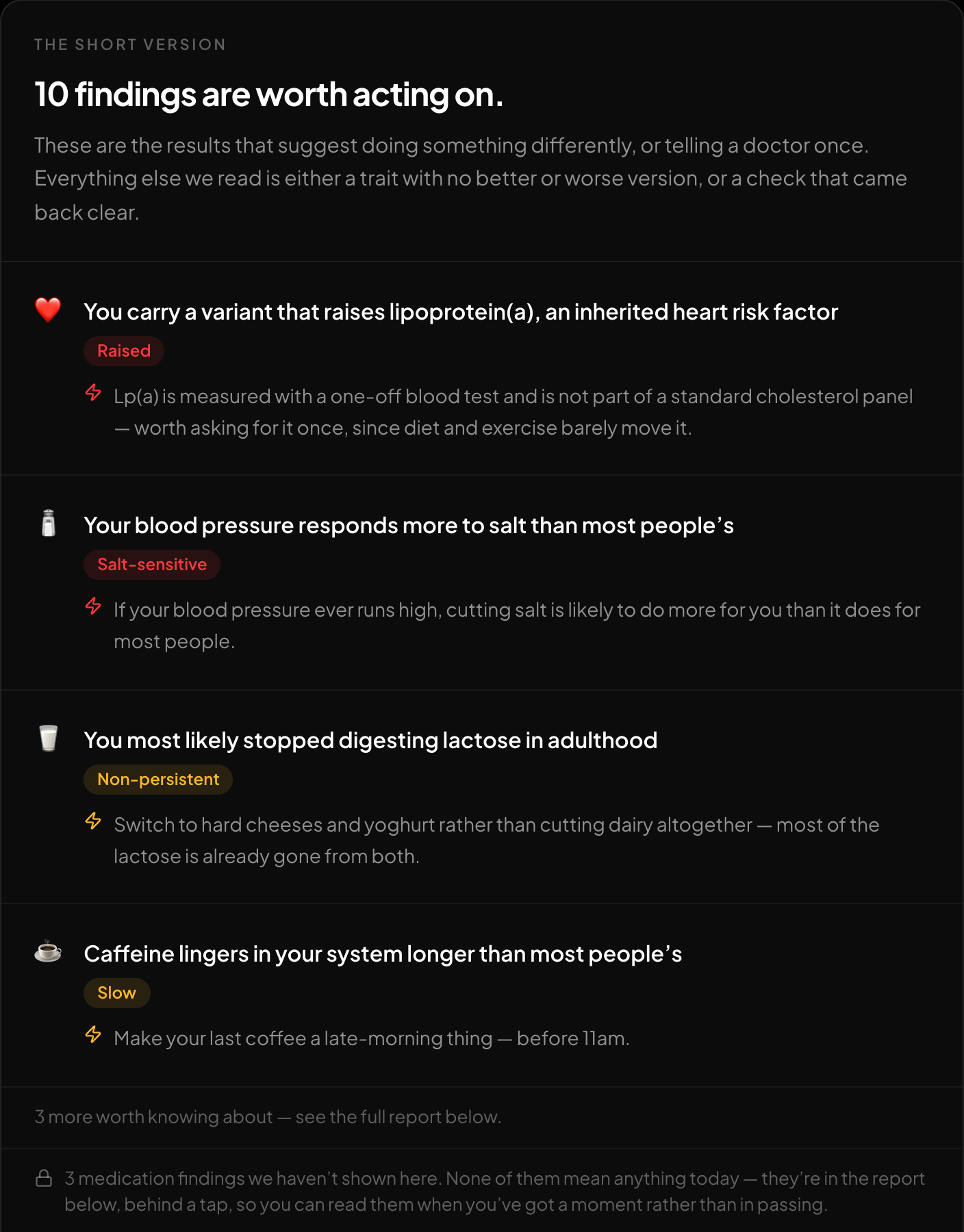
The short version: what is worth acting on, first.
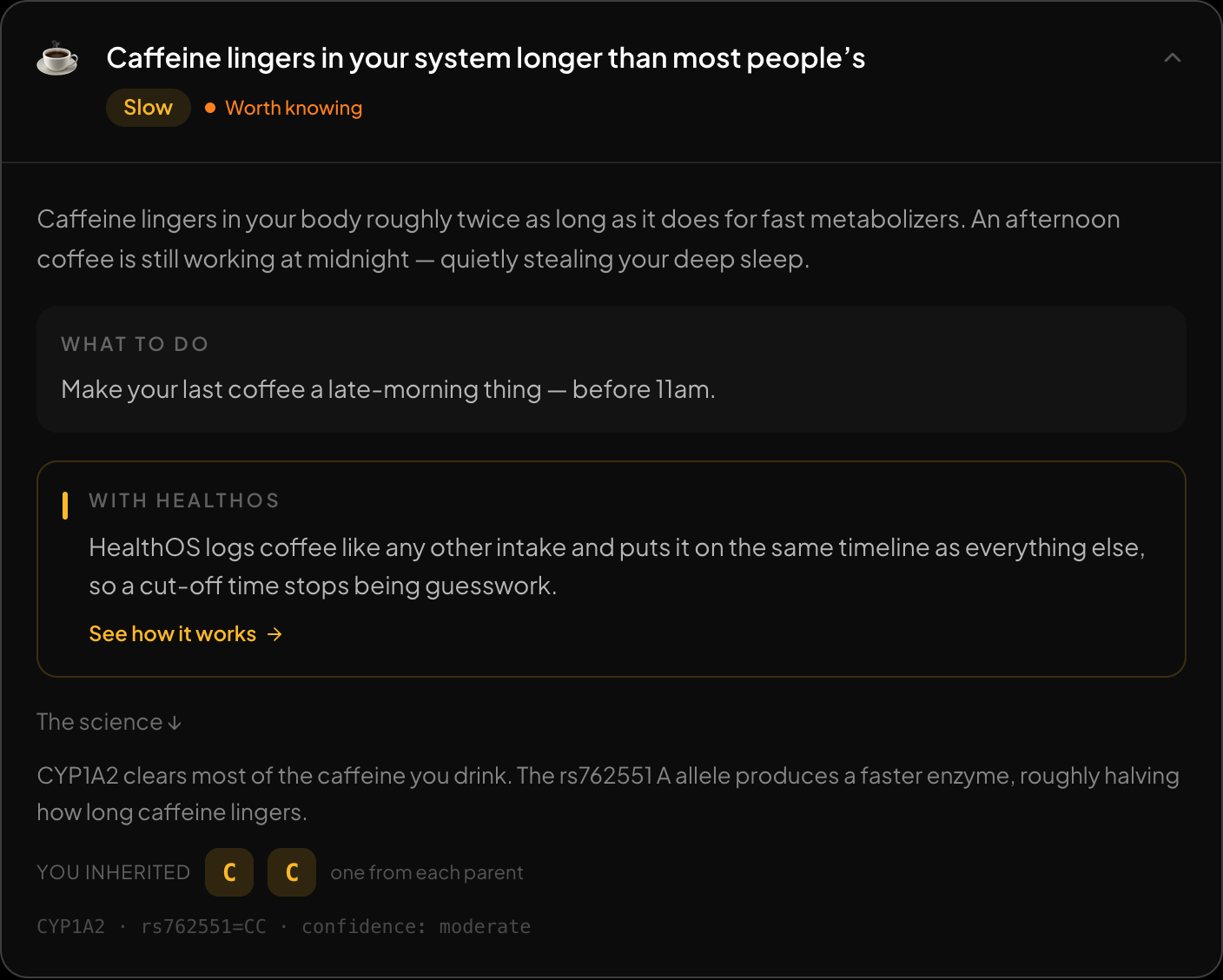
Every finding opens up: what it means, what to do, and the genotype behind it.
HealthOS /dna at a glance
- Price: the report is free. The story needs no account and no email; the full report opens in the HealthOS app after a one-time 6-digit email code. Ask your DNA gives you five free questions, then $1 for five more.
- Privacy: your file is read in your browser and not uploaded for the story or the report. Ancestry sends only the markers it needs and keeps them with your result until you delete them. The chat stores your file only if you choose to (encrypted, deletable).
- What you get: around 50 findings (food, sleep, movement, heart and metabolism, medication genes, traits), ancestry across 15 regions with the closest reference populations, and a chat that answers from your own results.
- Files: 23andMe, AncestryDNA, MyHeritage, FamilyTreeDNA, Living DNA, WeGene and whole-genome VCFs.
Other options
- Relatives: GEDmatch and MyHeritage for matching. GEDmatch alternatives.
- Maximum depth: Promethease or SelfDecode. Compared here.
The trait-count question
Genomelink's pitch is breadth: hundreds of traits, with new ones arriving weekly. That's genuinely enjoyable, and it's also where consumer genetics is weakest. Most trait reports beyond the well-studied set rest on associations that move a trait slightly, measured in one population and sometimes not replicated.
Our report stops where the evidence does, which is why it runs to about 50 findings rather than 300. Each one shows the genotype behind it and links to its source, so you can judge it yourself. Neither approach is wrong — they answer different appetites.
What to do if you've already uploaded
If your file is already in a Genomelink account and you'd rather it weren't, you can usually delete the data from the account settings, and you always keep the original file from your testing company. Then read that original locally if you prefer: nothing is uploaded for the /dna report.
FAQ
Do I need an account to read my file?
Not to read it. On /dna your file is read in your browser, and your DNA story needs no account and no email. The full report opens in the HealthOS app after a 6-digit code sent to your email, and the optional chat uses the same email to hold your five free questions and your saved conversation.
Can Genomelink find relatives?
It has DNA matching among its own users. So do GEDmatch, MyHeritage and FamilyTreeDNA. GEDmatch alternatives.
Which is better for ancestry?
They answer different questions. If you want a breakdown with the reference groups named and the Middle East split into five regions, that's ours.
Read your file without uploading it: healthosx.com/dna
New to raw DNA files? Start with the full guide: How to Download & Analyze Your 23andMe Raw Data Free
No raw DNA file yet?
Get a HealthOS DNA Kit: spit in a tube at home, and your ancestry, lineages and traits arrive in your HealthOS account, with the raw file.
See the DNA kitWritten by
HealthOS Research