What Your Y-DNA Haplogroup, Clade, Subclade, and Haplotype Mean
Sharing an upstream Y-DNA clade does not by itself show a recent paternal relationship. A recent signal can come from a SNP-confirmed terminal or private branch, close Y-STR matching, or both, plus documentary evidence.
In Y-DNA testing generally, a haplogroup is your deep paternal branch, a clade is any branch, and a subclade is a smaller branch inside a haplogroup. Your haplotype is your own set of Y-STR marker values. FTDNA-style reports often use these labels, and examples here follow that format unless every label is guaranteed in the current report. Sharing an upstream clade with a different surname does not by itself show a recent paternal relationship. A recent signal can come from a SNP-confirmed terminal or private branch, close Y-STR matching, or both, plus documentary evidence.
The four Y-DNA labels, from broad to narrow
Think of the Y chromosome as a document copied by hand from father to son. Most of it gets copied without change, but occasionally a typo enters. Two kinds of typo matter for Y-DNA testing.
- SNP mutations define branches. A single base changes and every direct male descendant inherits it. Branches are called haplogroups, clades, and subclades depending on how deep they sit.
- STR mutations are changes in short repeating stretches. These change faster and are more variable. A man's Y-STR values at the tested markers are his haplotype.
A haplogroup is an ancient trunk. A clade is any branch, including a haplogroup and everything below it. A subclade is a branch below a major haplogroup, defined by newer SNP mutations. A haplotype is not a branch label; it is the raw set of STR numbers used to estimate how closely two men match.
| Term | What it actually is | Time depth |
|---|---|---|
| Haplogroup | A deep branch defined by one or more shared SNP mutations | Varies by branch and is often thousands of years |
| Clade | Any branch on the Y tree, big or small | Depends on the branch |
| Subclade | A branch nested inside a haplogroup, defined by downstream SNPs | Varies by branch; check the named SNP branch |
| Haplotype | Your personal set of Y-STR repeat values at tested markers | Genealogical, but raw values are not a clock |
Scroll the table sideways for the rest →
Time depths are illustrative and not a relationship test by themselves.
The tree logic is simple in one direction: every man in a subclade also belongs to the parent haplogroup, but the reverse is false. That asymmetry is why an upstream shared label is weak evidence for family relationship.
A shared upstream clade tells you about ancient population history, not family. A recent signal needs a SNP-confirmed terminal or private branch, close Y-STR matching, or both, plus documentary evidence.
Does sharing an upstream clade with a different surname mean we're related?
No. It means you share a paternal ancestor, but usually from before surnames stabilised. That may be 2,000, 4,000, or more years ago, when the shared DNA just means you both descend from the same prehistoric population. It is ancestry, not family.
Different surnames are common inside old branches because surnames are only a few hundred years old in many cultures. Men carrying different surnames can descend from the same ancient paternal line through village names, patronymics, adoptions, name changes, or non-paternity events. A shared upstream clade is not a contradiction to a different surname, but it is not proof of a recent common ancestor either.
What would you actually see in a FTDNA-style report? You might share a predicted haplogroup such as R-M269 or E-V13 with men from several countries and many surnames. Those men are not your close relatives. They are your ancient cousins.
What has to be true before you call someone a paternal relative
Move from broad to narrow in this order.
- 1.You share a terminal or private subclade: a recent SNP-confirmed branch, ideally one whose age is checked for that named SNP branch.
- 2.You have a close STR match. Y-STR genetic-distance cutoffs are heuristic and depend on marker panel, lab, and time depth. They are not fixed relationship rules. FTDNA's TiP tool turns a match into a probability over generations.
- 3.Shared surname or shared origin helps, but it is not required. Many genuine paternal relatives carry different surnames.
The simple rule: upstream clade alone is not enough. A SNP-confirmed terminal or private branch alone is only a maybe, but add a close STR match and you have a real signal.
When the simple answer breaks
The rule upstream clade alone is weak evidence for family works because most shared branch labels sit too far back. But some tested terminal subclades are young. A very young or private terminal SNP shared by men with different surnames can itself be a genealogical signal, prompting investigation of adoption, name change, or non-paternity. If two men share a private or recently named subclade and have different surnames, that can point to an adoption, a name change, or a non-paternity event within genealogical time. The surname then becomes the thing to explain, not the DNA.
Also, close STR matches do not prove a specific relationship. They narrow the window to a recent common paternal ancestor, but they cannot tell you whether that ancestor was a grandfather, great-grandfather, or a 6th cousin. Documentary records and paper genealogy have to do that part.
No Y-DNA result replaces the family tree. It trims the tree down to men who are actually worth comparing records with.
The obvious follow-up: why is my haplogroup predicted and not confirmed?
If you only ordered Y-STR markers, a testing company predicts your haplogroup from the STR pattern. That prediction can be old and broad. It is not the same as a confirmed terminal subclade from SNP testing, such as Big Y. A predicted R-M198 result and a confirmed downstream branch are different levels of evidence. When someone says you share a haplogroup, ask whether that label is predicted or SNP-confirmed, and how many years old that branch is.
The practical move is to use the broad label for population history, and reserve the terminal or private subclade plus STR genetic distance for surname-level questions.
Choosing a file. The report is read on your own device.
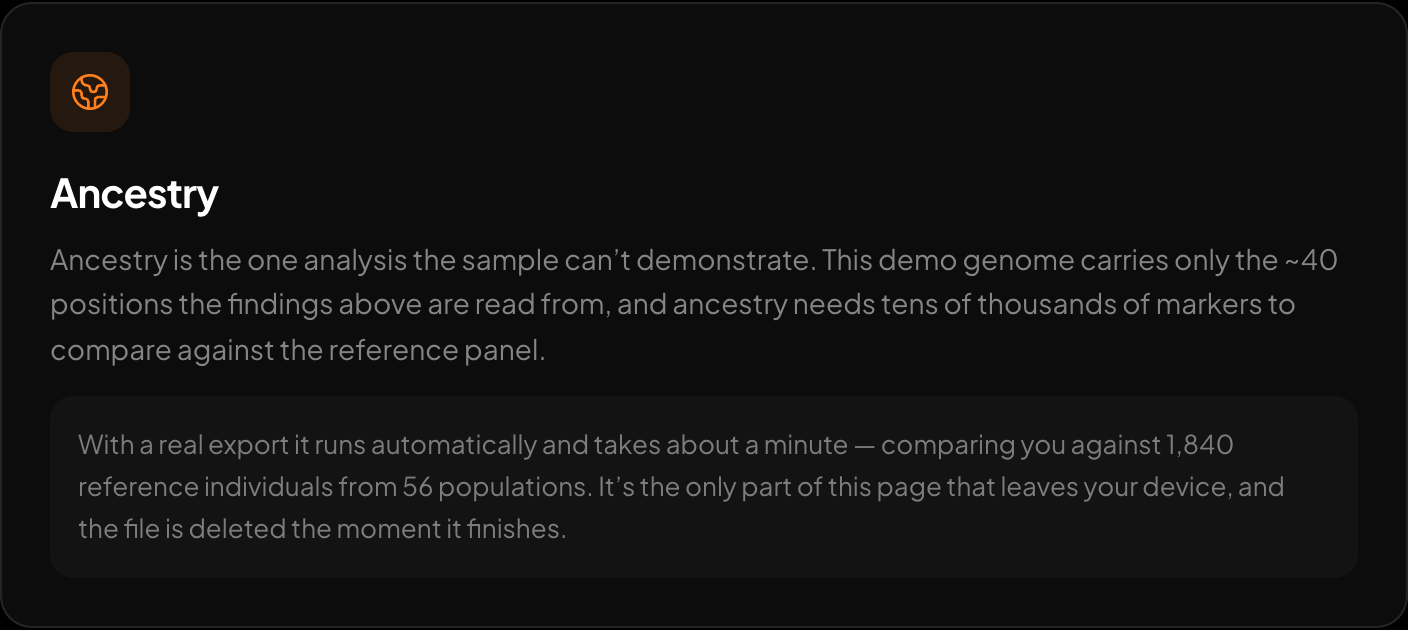
Ancestry against 1,840 reference genomes.
The free HealthOS report at https://healthosx.com/dna reads raw files from 23andMe, AncestryDNA, MyHeritage, FamilyTreeDNA, Living DNA, WeGene, and whole-genome VCFs. Trait and health processing runs in the browser. Optional ancestry sends only the required markers to a server, and those submitted markers are deleted afterwards unless the person chooses to store the file. VCFs without rsIDs get ancestry only. The free report does not include Y-DNA haplogroups or APOE. Haplogroup questions are only available through Ask your DNA when the file is stored with consent, which includes 5 free questions. It reports selected trait and health findings only, and it does not include relative matching, sequencing, or polygenic risk scores. Use it for the autosomal side of your DNA, and use your Y-DNA results for the paternal line.
New to raw DNA files? Start with the full guide: How to Download & Analyze Your 23andMe Raw Data Free
Written by
HealthOS Research