What LRRK2 Means in My 23andMe Raw Data
LRRK2 in 23andMe raw data usually means the G2019S variant at rs34637584. It is a Parkinson's-linked risk marker, not a diagnosis, and most carriers never develop Parkinson's.
If your 23andMe raw data shows an A allele at rs34637584, the free HealthOS DNA report may flag LRRK2 as a Parkinson's-linked risk marker. It is not a diagnosis. You carry the G2019S variant in LRRK2, a well-studied LRRK2 variant linked to Parkinson's, and most people with it never develop the disease.
An LRRK2 flag is a risk marker, not a diagnosis. Most G2019S carriers never develop Parkinson's.
What does LRRK2 mean in my 23andMe raw data?
LRRK2 is a gene that codes for a large protein called leucine-rich repeat kinase 2. When a raw data file flags LRRK2, it usually means one thing: the file has a call at rs34637584 with at least one A allele. That specific change is called G2019S. It is the most studied LRRK2 variant and the main one consumer DNA chips can actually detect.
The word risk marker matters here. This is not a polygenic risk score and not a diagnosis. It is a single variant with a well-studied but incomplete link to Parkinson's disease.
The mechanism that makes one A allele matter
LRRK2 makes a kinase, an enzyme that adds phosphate groups to other proteins. The G2019S change makes that kinase slightly overactive. Over decades, that overactivity is thought to stress dopamine-producing neurons. Parkinson's appears when enough of those neurons in the substantia nigra fail.
The key word is decades. G2019S does not switch on Parkinson's. It lowers the threshold for the slow cellular damage that can eventually lead to the disease. That is why age is such a big part of the risk estimate.
What you actually see in a raw file
In 23andMe raw data, search for rs34637584. The risk allele is A. A typical file will show one of three calls:
| Genotype | Alleles | What it means |
|---|---|---|
| No risk allele | G/G | Most people have this. No G2019S variant detected. |
| One risk allele | A/G | G2019S carrier. The report flags LRRK2. Elevated risk, not a diagnosis. |
| Two risk alleles | A/A | Two copies of G2019S. Very rare. Risk may be higher, but still not deterministic. |
Scroll the table sideways for the rest →
How rs34637584 (G2019S) genotypes map to the report. The risk allele is A.
- G/G means no G2019S variant at this marker. The report should not flag LRRK2 on this basis.
- A/G means one risk allele. This is the genotype that triggers the LRRK2 flag.
- A/A means two risk alleles. This is rare, and the risk may be higher, but it is still not a guarantee of Parkinson's.
The same marker can be flagged in raw files from AncestryDNA, MyHeritage, FamilyTreeDNA, Living DNA and WeGene, if their chip included rs34637584. Whole-genome VCFs from Nebula, Dante Labs and Sequencing.com can also carry it. If a chip omitted the marker, a missing flag is not the same as a normal result. You just did not get tested for it.
Does a flagged LRRK2 mean you will get Parkinson's?
No. Most carriers never develop Parkinson's. Estimates of cumulative risk by roughly age 80 vary, but they usually land between 25% and 40%. That means out of 100 people with G2019S, roughly 25 to 40 develop Parkinson's by around age 80, and 60 to 75 do not. It is a cumulative risk estimate, not a fixed lifetime guarantee.
The risk is strongly age-dependent. It is small before 50 and rises after 60. Family history also matters. A G2019S carrier with a first-degree relative who had Parkinson's is generally at the higher end of risk estimates.
The mistake people make in the other direction is just as important. A normal LRRK2 result does not clear you of Parkinson's risk. Most Parkinson's cases are not caused by LRRK2. If you have no risk allele, your overall background risk is still there.
When it is worth asking a doctor
A flagged LRRK2 is worth a clinical conversation in a few situations, not because the finding is an emergency but because context changes what it means.
- You have a parent or sibling with Parkinson's, especially if your ancestry is Ashkenazi Jewish or North African, where G2019S is more common.
- You notice new or worsening resting tremor, stiffness, loss of smell, or REM sleep behaviour disorder.
- You want a neurologist's view on monitoring, not because symptoms are present but because the variant is present.
No single test result can tell you to change your life. The useful next step is knowing whether the surrounding risk factors make this variant louder or quieter.
See it in your own file
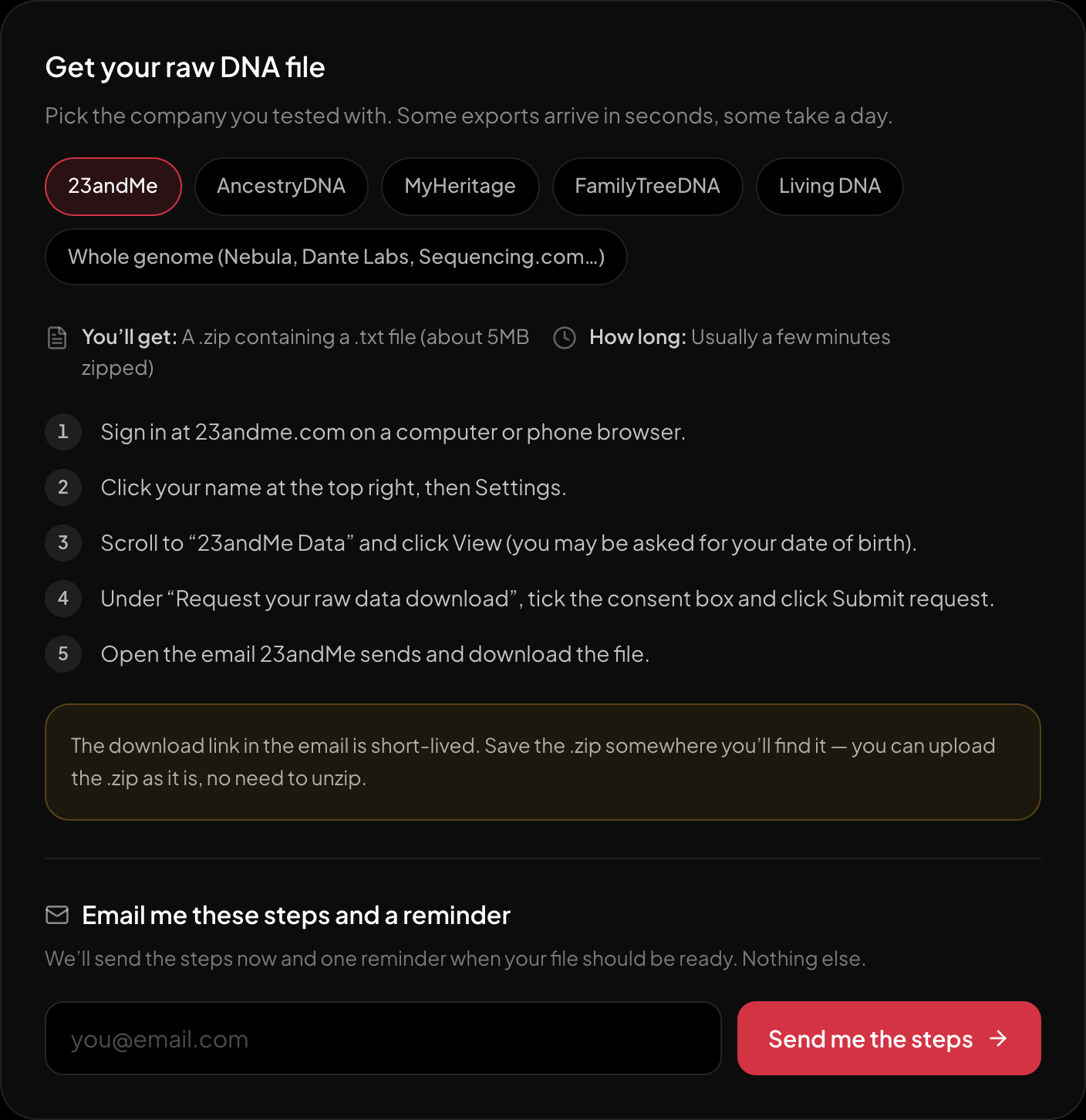
The download steps for 23andMe, on the page itself.
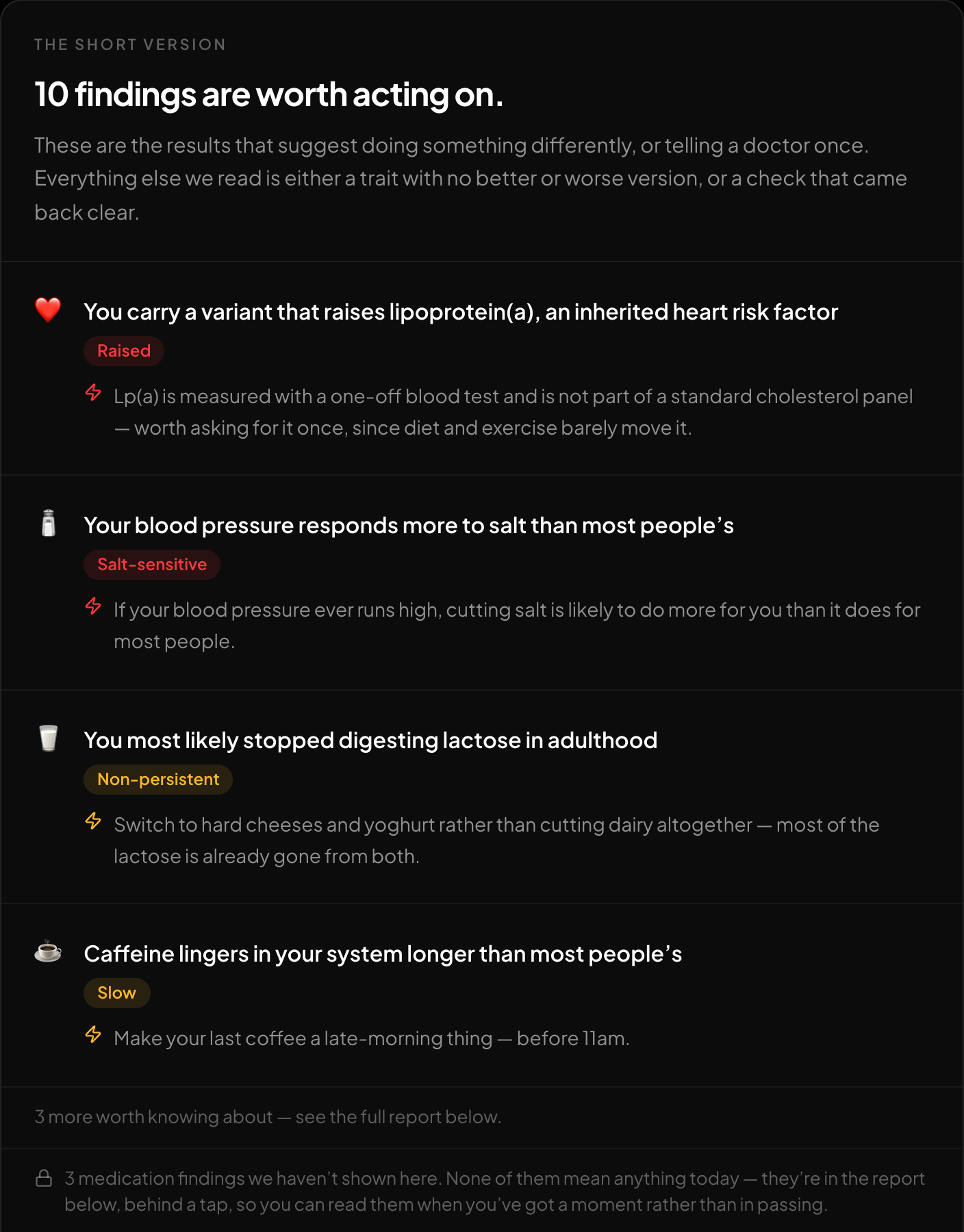
The short version: what is worth acting on, first.
If you want to see this in your own numbers, the free HealthOS DNA tool reads a raw 23andMe, AncestryDNA, MyHeritage or whole-genome VCF file in the browser. Your DNA story needs no account; LRRK2 is among the gene findings in the full report, which opens in the HealthOS app after a 6-digit code sent to your email.
New to raw DNA files? Start with the full guide: How to Download & Analyze Your 23andMe Raw Data Free
Written by
HealthOS Research