What ACTN3 rs1815739 Means in Your 23andMe Raw Data
CC means full alpha-actinin-3, CT reduced, TT none. Here is how to read rs1815739 in your 23andMe raw data and what it does not tell you.
In your 23andMe raw data, rs1815739 is the DNA marker for ACTN3, the gene that encodes alpha-actinin-3. CC means your muscle cells make the full protein, CT means reduced protein, and TT means none. Population studies have reported small, mixed associations: CC has been linked with slightly more fast-twitch power potential in some groups, TT with a possible endurance-leaning pattern, and CT with an intermediate pattern, but the effect is small and not deterministic.
Illustrative frequency only. Not a named population or a clinical frequency. Your ancestry-specific frequency may differ.
What does ACTN3 rs1815739 mean in my 23andMe raw data?
When you search your 23andMe raw data for rs1815739, the result is two letters. Those letters are your genotype at one position on chromosome 11. The C version carries the instructions for making alpha-actinin-3. The T version has a premature stop signal at protein position 577, often written R577X, which stops the protein from being built. You inherit one copy from each parent, and that gives you three possible results.
The protein itself lives mostly in fast-twitch, or type II, muscle fibres. Those fibres produce rapid, forceful contractions. Alpha-actinin-3 anchors actin filaments inside the muscle cell and may help with the speed and power of those contractions. People with TT still have a close relative, alpha-actinin-2, so their muscles do not fall apart. They just run without the extra fast-twitch support.
Your genotype says whether one fast-twitch muscle protein is present, reduced, or absent. It does not say which sport you should play.
What the alpha-actinin-3 protein actually does
Alpha-actinin-3 sits in the Z-disc, the structure that anchors actin filaments in muscle sarcomeres. In fast-twitch type II fibres, it helps transmit force during rapid contractions. Without it, fast-twitch fibres may take on slightly slower, more oxidative properties in some studies, but the associations are small and mixed. Some studies have suggested reduced peak power in narrow measures, while others find little difference. A possible endurance-leaning trend exists, but it is not a consistent or direct effect. It is not that TT gives you endurance directly.
How to read your CC, CT, or TT result
23andMe usually reports this marker as C or T in its raw data file. Some other files or strand representations can use different letters, such as A or G, depending on strand and genome build. If you are looking at a file from another source, check the file's strand and build information or use a tool that handles strand. Search by rsID rather than by expected letters or chromosome position, because positions can differ by genome build and file format.
- CC: Two working copies. You make full alpha-actinin-3 in fast-twitch fibres. This profile has been associated with elite sprint and power groups in some studies, but that is a population pattern, not a personal verdict.
- CT: One working and one non-working copy. You make less alpha-actinin-3. CT people often show an intermediate pattern, but training and other factors usually matter more.
- TT: Two non-working copies. You make no alpha-actinin-3. This profile has been associated with some endurance-focused groups in population studies, but it does not cap your strength gains.
| Genotype | Alpha-actinin-3 | Population pattern | What it means |
|---|---|---|---|
| CC | Full protein | Power and speed | More fast-twitch support. Not a guarantee. |
| CT | Reduced protein | Intermediate | Training history usually matters more. |
| TT | No protein | Endurance-leaning | No fast-twitch ACTN3. Some population studies show an endurance-leaning pattern, not a personal expectation. |
Scroll the table sideways for the rest →
How to read your own genotype in a 23andMe file. Raw file columns vary.
What this does not say about your athletic fate
The common mistake is treating CC or TT as a destiny. ACTN3 is one small part of muscle biology. Thousands of other genetic variants, your training history, movement skill, tendon stiffness, heart function, sleep, food and environment all shape performance. Elite endurance athletes with CC exist, and elite power athletes with TT exist.
What the marker can do is add a little context. If you already notice that short maximal efforts feel natural, or that you recover better from long steady work, your ACTN3 result may match that pattern. If it does not match, that is normal too.
Can you train against your genotype?
Yes. Both strength and endurance are highly trainable in all three genotypes. If you have TT, heavy resistance training still increases muscle size and force. If you have CC, aerobic training still improves VO2max and endurance performance. The practical advice is to train for the outcome you care about, not the outcome your raw data seems to whisper.
See it in your own raw data
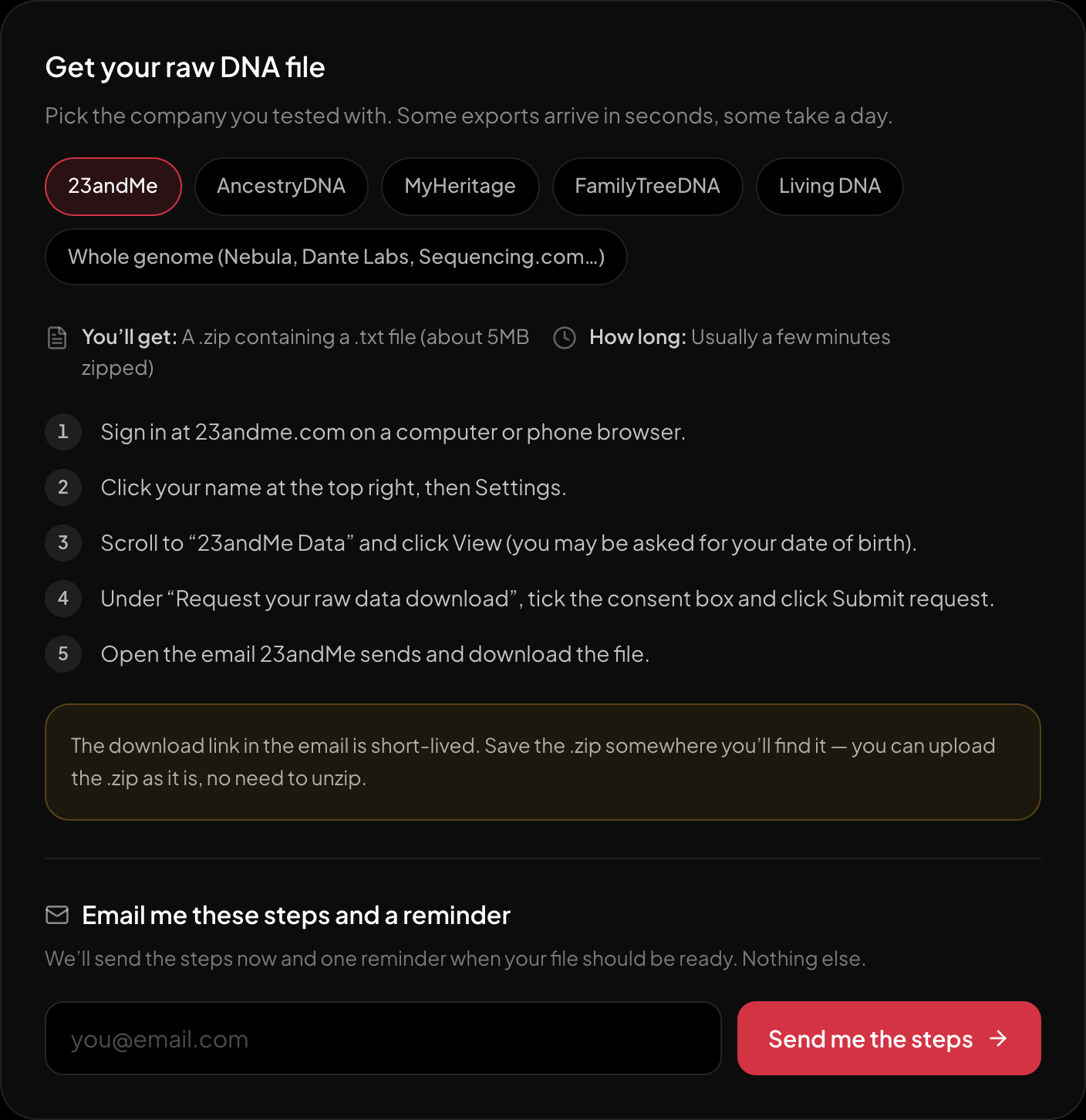
The download steps for 23andMe, on the page itself.

The short version: what is worth acting on, first.
If you have a 23andMe file, the free trait and health report at HealthOS is processed in your browser on your device and includes ACTN3. The DNA story needs no account; the full report opens after a 6-digit email code. It also checks genes tied to caffeine, lactose, some medication-metabolism markers, iron storage, blood group, and skin or hair traits. The free trait and health report does not include ancestry, APOE, haplogroups, relative matching, sequencing, or polygenic risk scores. Optional ancestry features, if used, require server processing. Use it when a genetic result like this one is in play.
New to raw DNA files? Start with the full guide: How to Download & Analyze Your 23andMe Raw Data Free
Written by
HealthOS Research