Will Statins Cause Me Muscle Pain Based on My DNA
SLCO1B1 rs4149056 in a 23andMe or AncestryDNA raw file can tell you about statin muscle pain risk, but it is not the whole answer.
Your SLCO1B1 rs4149056 result in a 23andMe or AncestryDNA raw file is a real signal, not a crystal ball. Two C alleles mean the highest risk of statin-related muscle pain, mainly with simvastatin. One C allele is in between, and T/T means this gene adds no raised risk but does not rule muscle pain out.
| Genotype | SLCO1B1 function | What it means for statin muscle pain |
|---|---|---|
| T/T | Normal | No added risk from this gene |
| C/T | Intermediate | Some added risk, mainly simvastatin |
| C/C | Low | Highest risk, especially simvastatin |
Scroll the table sideways for the rest →
For 23andMe, AncestryDNA and similar raw files. The C allele is the reduced-function version.
Will statins cause me muscle pain based on my DNA?
Not on its own. The result tells you about one liver transporter. A C/C result makes the risk higher, but it does not say you will get muscle pain. A T/T result is reassuring for this gene but does not clear you.
The marker is rs4149056, and 23andMe and AncestryDNA raw files include it. You will see it as C/C, C/T or T/T. The C allele makes a liver transporter called OATP1B1 work less efficiently.
The C allele is common. In people of European ancestry, roughly 1 in 4 to 1 in 3 carries at least one C allele, and about 1 in 50 carries two. The frequency varies by ancestry, so what looks rare in one group is not in another.
What SLCO1B1 rs4149056 is doing in your body
SLCO1B1 carries instructions for OATP1B1, a protein on the surface of liver cells. Its job is to pull statin molecules out of the blood and into the liver, where they are broken down. When you have one or two C alleles, fewer working transporters sit on the liver surface. Less statin gets cleared into the liver, so more stays circulating in the blood. Muscle cells then see a higher statin concentration for longer.
Muscle pain is not one thing. The DNA marker is strongest for myopathy, the rarer form with muscle damage and raised creatine kinase, or CK, on a blood test. It is weaker for the ordinary aches people report on statins. Many people with a C/C genotype will still take a statin without a problem, and many people with T/T will still get some muscle ache.
The result matters most for simvastatin, less for atorvastatin
Simvastatin is the drug where this gene has the clearest effect. It depends heavily on OATP1B1 for liver uptake. A C/C carrier taking higher-dose simvastatin has the largest known increase in risk. Atorvastatin is also influenced by SLCO1B1, but the effect is smaller. Rosuvastatin and pravastatin have other clearance routes, so the same C allele is less predictive of muscle pain with those drugs. Evidence thins out for the less transporter-dependent statins. If someone's raw file is being used to make a decision, simvastatin is the one where it most deserves attention.
Illustrative ranking of the evidence, not a measured effect size.
This is why the same raw file can matter a lot for simvastatin 80 mg and matter very little for pravastatin 20 mg. The gene is not a blanket statin risk score. It is a transporter result that interacts with the choice and dose of drug.
What your raw file can and cannot tell you
Your raw file can tell you: - Whether you carry the reduced-function SLCO1B1 variant. - Which statin deserves more caution, mainly simvastatin.
It cannot tell you: - Whether you will definitely get muscle pain. - Whether a different statin will be pain-free. - Whether your current ache is caused by the statin. - What other causes, such as low vitamin D, thyroid status, or interacting drugs, are doing.
Does T/T mean I can stop worrying?
No. T/T means normal SLCO1B1 function. The gene does not add risk, but statin-related muscle pain still happens in people with T/T. Age, kidney function, thyroid status, vitamin D, other drugs, and the nocebo effect all influence whether a statin will cause pain. In controlled trials, muscle complaints appear in the placebo arm too, which is why a normal genotype is not a clean bill of health.
A C/C result is a reason to adjust the statin choice or dose, not a reason to refuse statin treatment on its own.
The mistake people make with this result
The most common mistake is treating C/C as a ban on all statins. It is not. It is a strong reason to avoid or reduce simvastatin and to choose a different statin, but the benefit of lowering LDL often outweighs the muscle risk. The second mistake is treating T/T as proof that a statin cannot cause pain. That is also false.
Choosing a file. The report is read on your own device.
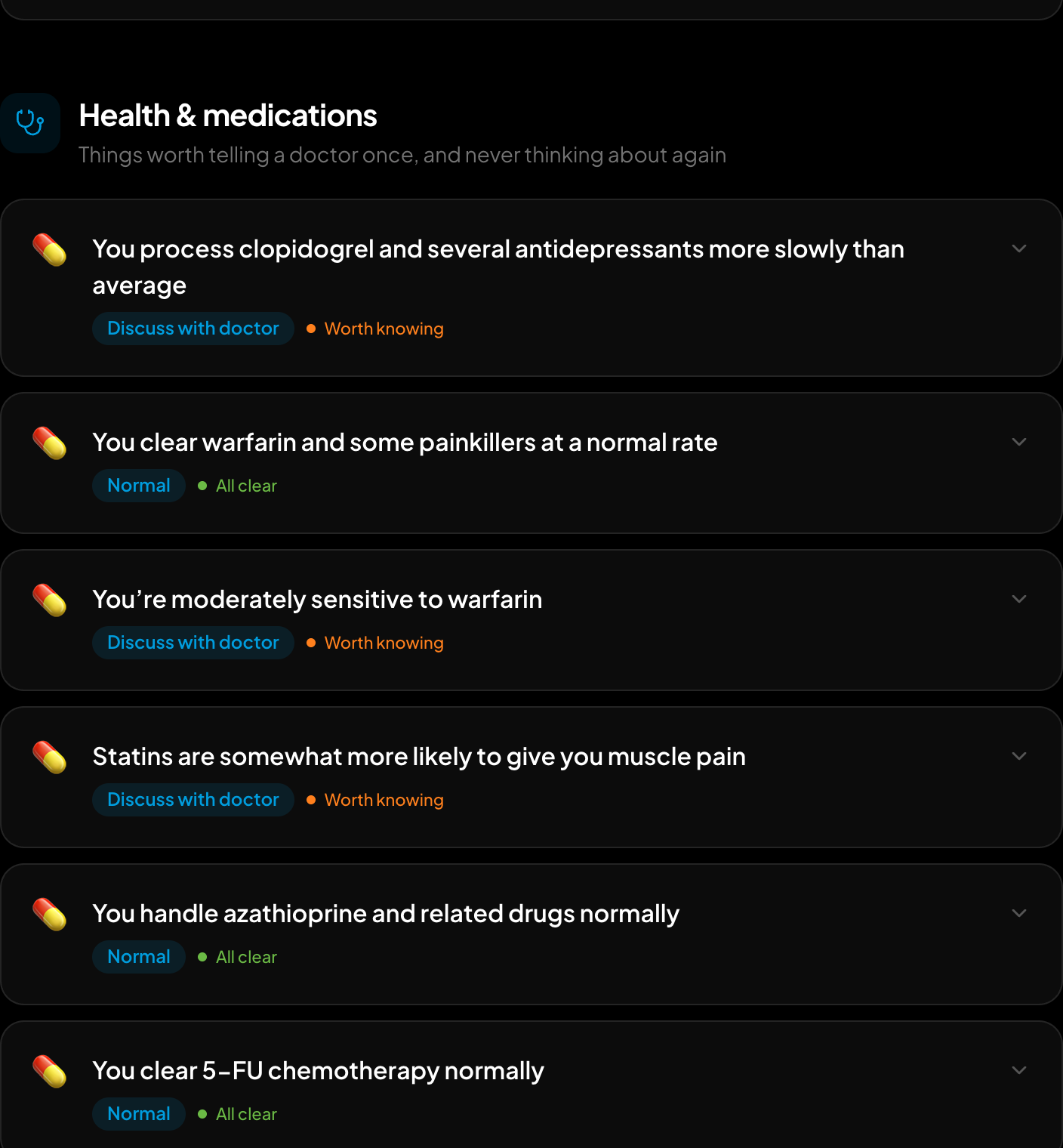
Medication genes, kept behind a tap rather than sprung on you.
See your own genotype in the free DNA tool at HealthOS. It reads a 23andMe, AncestryDNA, MyHeritage or whole-genome VCF file in the browser, and the DNA story needs no account. If the file has rsIDs, it reports SLCO1B1 alongside other medication and trait results. A VCF without rsIDs gets ancestry only.
New to raw DNA files? Start with the full guide: How to Download & Analyze Your 23andMe Raw Data Free
Written by
HealthOS Research