What the OR2M7 Region in Your 23andMe Raw Data Says About Asparagus Pee
If your 23andMe raw file includes rs4481887, a marker near OR2M7 associated with asparagus pee odor detection, you can check your likely sensitivity.
Yes. Your 23andMe raw data can tell you about asparagus pee, but only if the file includes the right marker and you know what to look for. If your 23andMe raw file includes rs4481887 in the OR2M7 region, the version you carry has been associated with whether you can detect the sulfur compounds that make asparagus urine smell. This is a harmless sensory trait, not a health finding.
Can my 23andMe raw data tell me if I can smell asparagus in my pee?
If you open your raw file and search for rs4481887, you may find a line with a chromosome, a position, and two alleles. If the marker is not in your file, your chip version did not test it. That line is the part 23andMe typed. It does not say 'you can smell asparagus pee' because the raw file only stores the letters, not the interpretation. A free DNA tool that reads the same marker can label it.
The genotype you see will usually be A/A, A/G or G/G. The direction of effect depends on the file orientation, so the tool should be allowed to orient the marker. In one common orientation, the A allele is associated with noticing the odor, but not every chip reports it in that orientation. Treat this as a probability, not a guarantee. Some A/A people still do not notice the smell, and some G/G people do.
| Genotype | What it usually means | Not a guarantee |
|---|---|---|
| A/A | Two smell-associated copies. Most likely notices the odor; effect size is modest. | Some A/A people still report not noticing it. |
| A/G | One copy. Often still notices the odor, sometimes weaker. | Effect size is modest; some carriers miss it. |
| G/G | No smell-associated copies. Most likely does not notice it. | Some G/G people do report the smell. |
Scroll the table sideways for the rest →
Interpretation for one common orientation. Effect size is modest: each smell-associated copy raises the odds but does not determine the trait. Raw files never contain the label itself.
Why asparagus makes urine smell at all
Asparagus contains asparagusic acid, a sulfur-containing molecule that is not itself smelly. When your body breaks it down, the metabolites end up in urine as volatile sulfur compounds, mainly methanethiol, dimethyl sulfide and dimethyl disulfide. These evaporate from urine at room temperature and can reach your nose quickly after you urinate.
The strength likely depends on how much asparagus you ate, how much water you drank, and how concentrated your urine is.
The smell is not a sign that your kidneys are failing or that asparagus is cleaning you. It is the normal breakdown of a sulfur-rich food.
What the OR2M7 region actually does
OR2M7 is an olfactory receptor gene. The rs4481887 marker sits near OR2M7 and is associated with odor detection in genome-wide studies. The exact functional mechanism is not fully established, so the receptor binding step should be considered inferred rather than proven.
People without the responsive version are not losing smell generally. They can smell coffee, grass and garlic fine. They just have a specific anosmia for asparagus urine odor.
The gene is about your nose, not your kidneys. Non-smellers can still produce the same sulfur compounds.
The common mistake
The raw file is not a label. A lot of people search their 23andMe file, see rs4481887 with two letters, and walk away thinking the file told them something it did not. The label has to come from matching that marker to the association.
Another mistake is assuming that if you cannot smell asparagus pee, your body does not make it. The known genetic effect is mainly about detection. Whether people also differ in how much of the smell compounds they excrete is still argued about, but the best-replicated signal is sensory.
How to check it free
You do not need to read the raw file yourself. The HealthOS DNA tool at https://healthosx.com/dna reads 23andMe, AncestryDNA, MyHeritage and several other raw files in the browser. The file is parsed locally in your browser, not uploaded to a server. The trait story appears immediately with no account and no server upload. Look for the OR2M7 line and it will say whether your genotype is linked to being able to smell asparagus in your pee.
If you already have your 23andMe file: - Download the raw .txt or .zip from 23andMe. - Go to https://healthosx.com/dna. - Choose your file. - Search the report for asparagus. - The full report is also free after a one-time email code.
What this result cannot tell you
The OR2M7 result is not a health finding. It does not tell you about kidney function, detox ability, liver enzymes, or whether asparagus is good or bad for you. If your urine has a strong or unusual smell without asparagus, that is a different question and worth discussing with a clinician.
For this marker, the practical takeaway is simple: if your genotype says likely non-smeller, you have a specific sensory blind spot. If it says likely smeller, your genotype is associated with detecting that particular sulfur odor. Either way, dinner is unchanged.
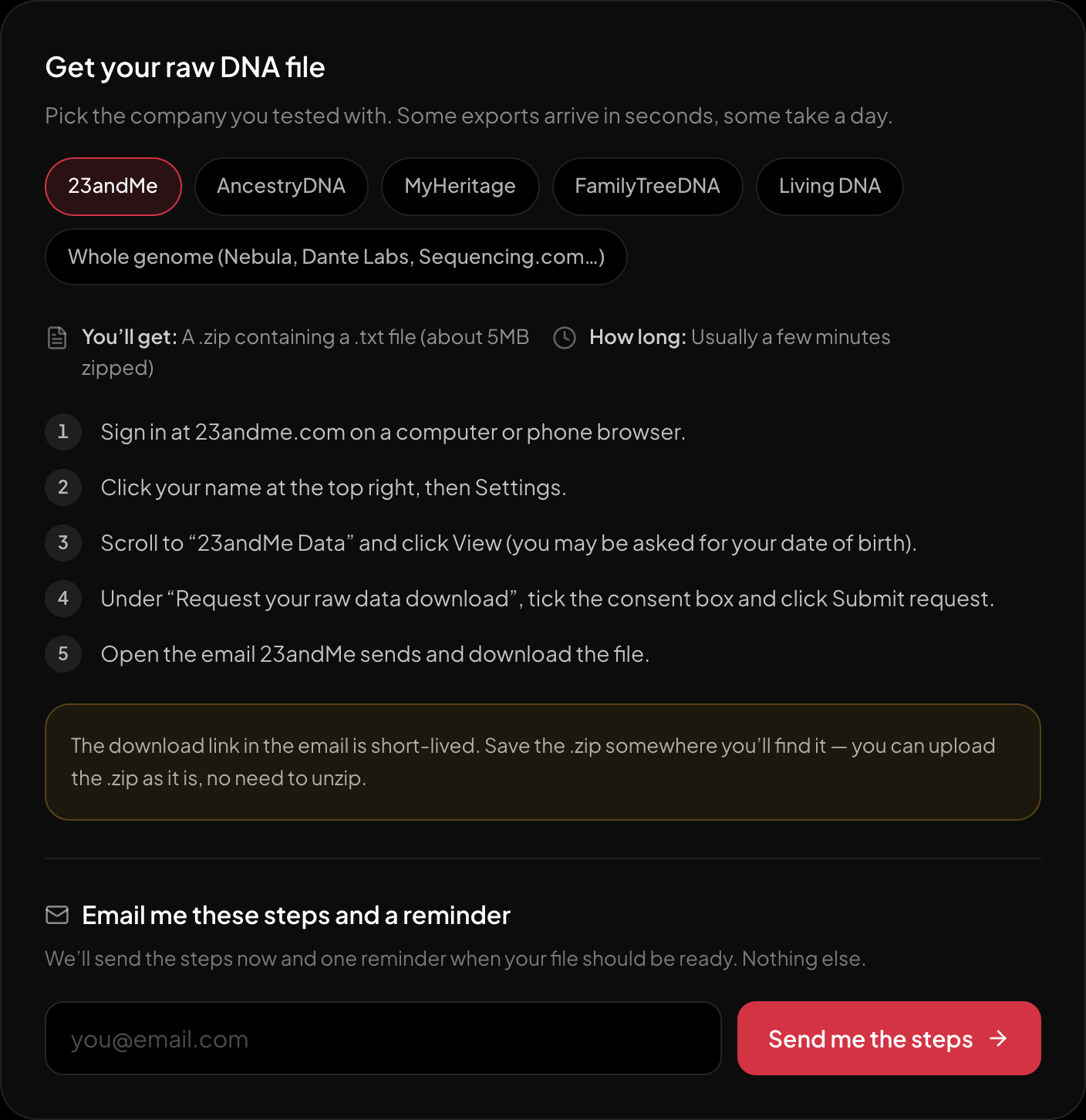
The download steps for 23andMe, on the page itself.
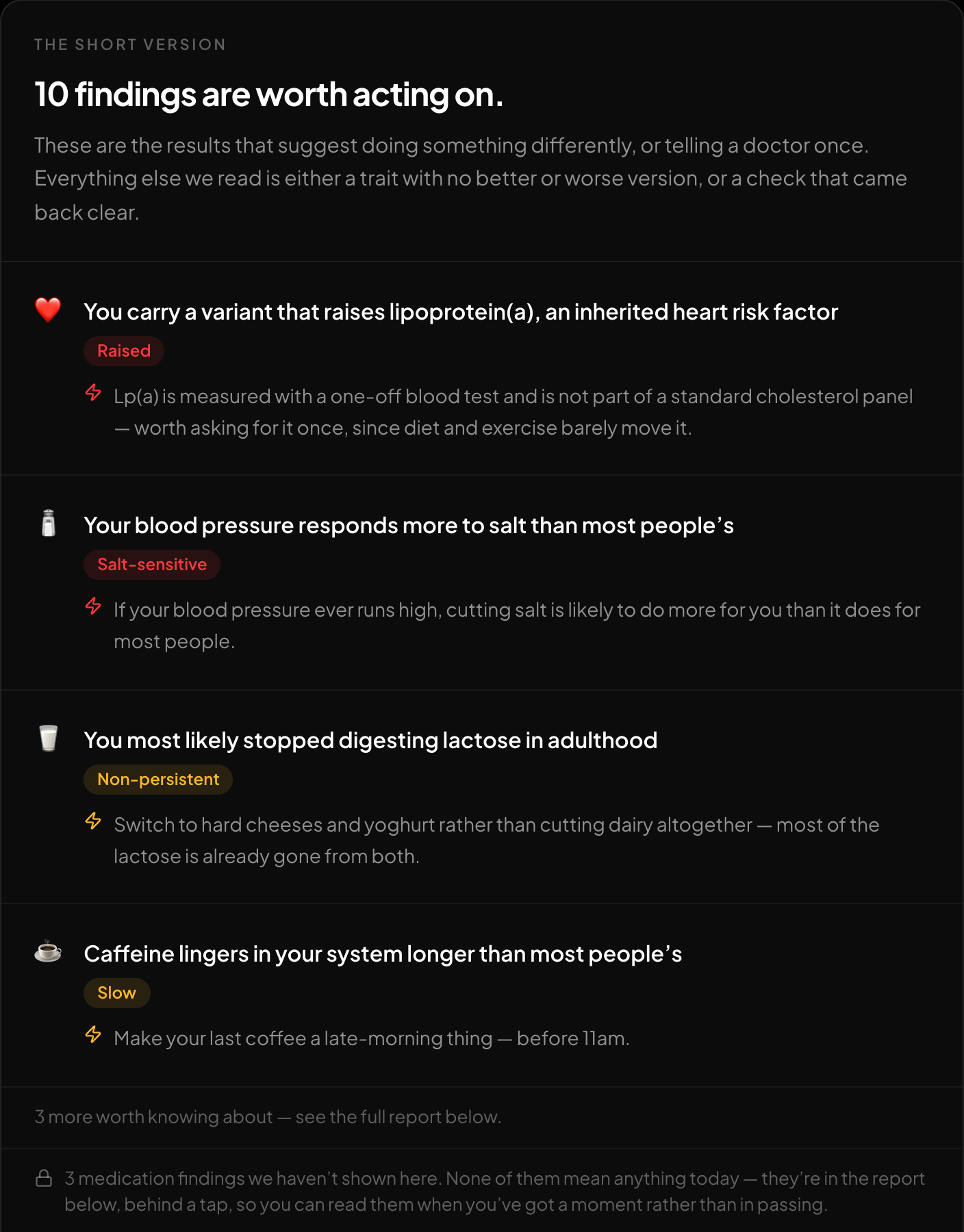
The short version: what is worth acting on, first.
Need your own numbers? The HealthOS DNA tool is at https://healthosx.com/dna.
New to raw DNA files? Start with the full guide: How to Download & Analyze Your 23andMe Raw Data Free
Written by
HealthOS Research