What Do DP GQ and AD Mean in Your Whole Genome VCF File
DP, GQ, and AD in a Nebula VCF tell you how many reads covered a site, how confidently the genotype was called, and how reads split between alleles.
DP, GQ, and AD are the three FORMAT fields that tell you whether a specific genotype call in a Nebula Genomics whole-genome VCF is solid or shaky. DP is read depth at that position, GQ is a Phred-scaled confidence score for the called genotype, and AD is the read count supporting each allele. A high GQ with balanced AD at a decent DP usually means the call is reliable; none of the three proves the variant is clinically important.
What do DP, GQ, and AD mean in my Nebula Genomics VCF file?
In the FORMAT column of a VCF record, these fields describe one sample's evidence at one genomic position.
DPis total read depth. It counts reads covering the variant position after the pipeline's filters, although the exact convention varies.GQis genotype quality. It is Phred-scaled, so GQ 20 means 1 in 100 chance the genotype is wrong, GQ 30 means 1 in 1000, GQ 40 means 1 in 10000.ADis allelic depth. It gives comma-separated read counts for the reference and alternate alleles, in the order listed in the REF and ALT columns.
For a heterozygous A/G call, the FORMAT might look like GT:DP:AD:GQ = 0/1:28:14,14:99. That says 28 reads covered the site, 14 supported the reference A, 14 supported the alternate G, and the caller assigned the maximum confidence of 99. For a multi-allelic site like ALT=A,G, AD=12,8,5 means 12 reads for the reference, 8 for the first alternate, 5 for the second.
A genotype call is only as good as the read counts behind it: DP says how many reads looked, GQ says how confidently the caller picked, AD says how the reads split.
DP is a headcount, not a verdict
DP is the simplest field, but people over-read it. It does not say the reads are good reads; it says how many reads passed the pipeline's filters and covered the position. A high DP with many duplicate reads, or reads mapped to the wrong repetitive region, can still produce a wrong call.
In a 30x whole-genome file from Nebula Genomics, you will often see DP in the 20-40 range at straightforward positions. Some regions fall lower because they are hard to sequence or map. A DP of 6 does not automatically mean the call is false, but there is less evidence, and GQ usually drops with it. A DP of 80 does not automatically mean the call is true; it can mean you are looking at a duplicated region.
A practical filter for whole-genome calls is GQ at least 20 and DP at least 10, with GQ 30 and DP 20 as a stricter comfort zone. These are rules of thumb, not validated clinical cutoffs; different pipelines and variant types need different care.
GQ is a bet against an error, not a percentage
GQ is calculated from genotype likelihoods. The VCF often reports the maximum possible value as 99, but the underlying math is -10 * log10(p_error). If the caller estimates a 1 in 1000 chance the genotype is wrong, GQ is 30. If it estimates 1 in 10, GQ is 10. GQ 0 means the caller had no real confidence.
The common mistake is treating GQ as confidence in the variant being real. It is confidence that the chosen genotype matches the aligned reads. If the reads are misaligned, or the site is in a low-complexity region, the caller can be very confident about a wrong answer. GQ tells you about the call, not about the universe.
AD shows the evidence for each allele, not just the winner
AD is the field that catches cases where the call is technically high quality but biologically suspicious. A true heterozygous single-nucleotide variant should split roughly 50/50, with sampling noise. At 20x depth, a 12/8 split is still reasonable for a true heterozygote. A 19/1 split is not good evidence for a heterozygote; that is 5% alternate reads, and a skew that severe usually reflects sequencing error, allelic dropout, or another technical artifact, and only rarely a biological event.
For a solid heterozygous call, you expect AD values near half the DP. For a solid homozygous call, nearly all reads support one allele, so AD=25,1 with GT=0/0 makes sense if the one alternate read is noise. If the genotype is called 0/1 but AD is heavily skewed, the caller may be forcing a heterozygous call where a homozygous call with a single error is more plausible. Some pipelines apply allele balance filters; others leave that judgment to you.
What should make you distrust a call?
- GQ below 10: there is at least a 1 in 10 chance the genotype is wrong.
- DP below 10: each allele judgement rests on a handful of reads.
- AD showing a severe skew on a heterozygous call: treat it as an artifact until other evidence says otherwise.
- The variant sits in a repeat, segmental duplication, or low-complexity region: mapping errors are more likely.
- The variant is an insertion or deletion, especially a long one: short-read sequencing calls these less reliably than single-nucleotide changes.
An indel with DP=15, GQ=99, and balanced AD can still be wrong if the alignment placed the gap differently in half the reads. Indels need more care than SNPs.
What do these fields not guarantee?
They do not guarantee the variant exists in your germline. They do not rule out sample mix-up, contamination, or a somatic mutation in blood. They do not tell you whether a variant is pathogenic, benign, or actionable. A high-quality call for a pathogenic BRCA1 variant is strong evidence you carry that change, but clinical significance, penetrance, and classification are separate layers that these three fields say nothing about.
They also do not tell you whether the variant was missed elsewhere. A VCF only contains calls the caller made. Low coverage or bad mapping can cause a true variant to be absent from the file entirely, and no DP, GQ, or AD will be there to warn you.
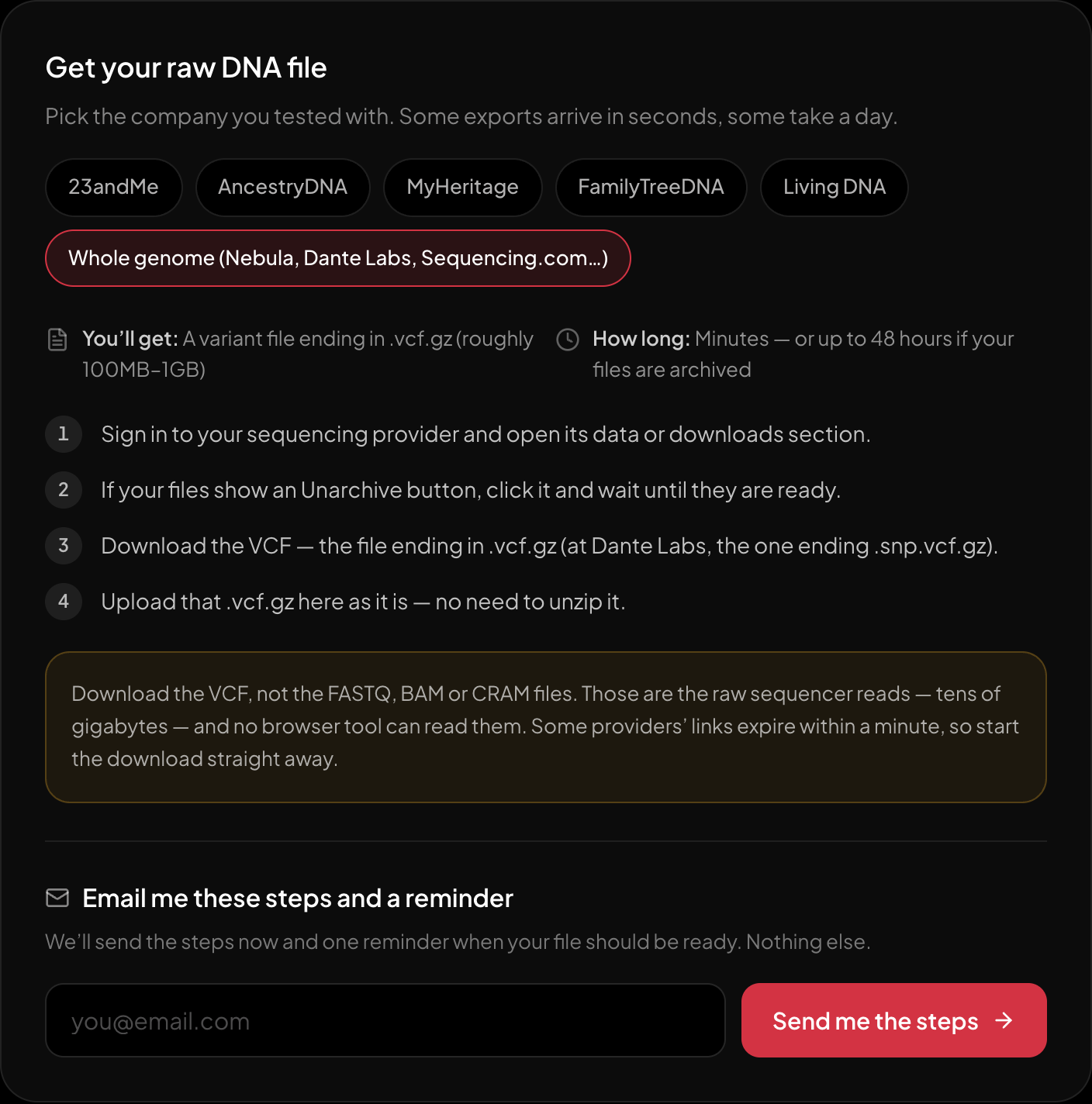
The download steps for whole-genome sequencing, on the page itself.

The short version: what is worth acting on, first.
Upload your Nebula Genomics VCF or other raw file at https://healthosx.com/dna. The tool parses the file in the browser, screens whole-genome VCFs against ClinVar for pathogenic or likely pathogenic variants, and reports its named panels. It does not scan every high-quality call against all known health findings. Files without rsID annotations cannot produce HealthOS health findings.
New to raw DNA files? Start with the full guide: How to Download & Analyze Your 23andMe Raw Data Free
Written by
HealthOS Research