What Are MyHeritage Genetic Groups and Why Am I Assigned to One With No Known Ancestry?
MyHeritage Genetic Groups are cluster labels built from shared DNA matches, not ethnicity percentages, and they can appear with no known ancestry because paper trails end before DNA does.
MyHeritage Genetic Groups are cluster labels built from shared DNA matches, not an ethnicity estimate. You can be assigned to one with no known ancestry because the signal comes from DNA segments that outlive paper records. A group can reflect a real population your tree cannot see, an undocumented ancestor, or a low-confidence match.
What MyHeritage Genetic Groups are actually measuring
MyHeritage takes your raw DNA file, compares it with other customers, and finds people who share runs of identical DNA with you and with one another. Then it looks at what those people report in their trees: birthplaces, surnames, migration paths, cultural communities. When a set of matches clusters around a place or a tightly connected community, MyHeritage labels that cluster as a Genetic Group.
The ethnicity estimate works differently. It compares your genome with reference panels and tries to assign fractions to broad populations. Genetic Groups are built from your actual matches. That is why a group can appear even when the ethnicity estimate gives the same region 0%. The two are measuring different things.
Why am I assigned to one with no known ancestry?
No known ancestry does not mean no ancestry. Most family trees stop around five to seven generations. In many places, records for ordinary people become sparse before 1800 and largely disappear before 1700. A DNA segment can survive from an ancestor who lived before any document names them. The paper trail ended. The DNA did not.
The common reasons:
- The paper trail stopped before the ancestor lived.
- The population was endogamous. Ashkenazi Jewish, French Canadian, Acadian, Roma, Finnish, island and mountain communities have many distant cousins sharing the same segments. A group can reflect that population, not one recent line.
- The tree has an undocumented line: adoption, a non-paternity event, a surname change, an assimilated ancestor.
- The group is a low-confidence cluster. Small shared segments can align with a group by chance, and MyHeritage may still show it.
A Genetic Group is not a list of your ancestors. It is a signal that part of your DNA resembles people with a shared history. Paper records often stop before that history becomes visible.
What this looks like in real data
On MyHeritage, a Genetic Group appears as a named community under your results, often with a map location and a confidence level. You might see “Italians in Trabia, Sicily” or “Pennsylvania Dutch Country Settlers” while your known tree has nothing there. The group can sit beside an ethnicity estimate that gives that region 0%. That mismatch is normal because the group is driven by matching segments, not by reference panels.
If you have endogamous ancestry, expect extra groups. One Ashkenazi great-grandparent can produce several Ashkenazi groups, not because you have several separate lines, but because the community is deeply interconnected.
| Cause | What it means | How to check |
|---|---|---|
| Paper trail ends | An ancestor lived before records survive | Check whether known lines stop around the same period |
| Endogamous population | Many distant cousins share the same segments | Look for multiple groups from the same community |
| Undocumented line | Adoption, surname change, misattributed parent | Test older relatives if possible |
| Low-confidence noise | Small segments can match by chance | Check confidence label and shared DNA amounts |
Scroll the table sideways for the rest →
Common causes and what to look at
What to check before trusting the group
- Look at the confidence label. A high-confidence group is stronger. A low-confidence group can be a statistical echo.
- Look at how many matches support the group and how much DNA you share. One or two weak matches are not a strong claim.
- Test a parent or grandparent if possible. A genuine group usually appears in one parent at higher confidence.
- Do not treat a group as an exact birthplace. It names a genetic community, not the village of one ancestor.
The common mistake is to treat a Genetic Group as proof that an ancestor lived in that exact place. It is not. It means your segment pool overlaps with people whose ancestors formed that community.
Get an independent ancestry breakdown from your raw MyHeritage file
MyHeritage lets you download your raw genotype data as a .csv file. That same file can be read independently. The free DNA tool linked at the end of this page parses MyHeritage .csv files in the browser and reports traits, medication response, carrier-relevant findings, and an optional ancestry breakdown.
The ancestry part uses a different reference panel from MyHeritage. It fits your markers into 157 present-day populations across 15 world regions. The Middle East and North Africa are split into Levant, Arabia, Anatolia/Iran, the Caucasus, and North Africa, rather than one broad West Asian bucket. It also ranks your closest modern populations among 298 groups and compares you with 133 ancient groups as similarity, never descent. Because ancestry needs a large reference panel, it runs on the server and only with explicit consent. It sends the markers it needs, not the whole file.
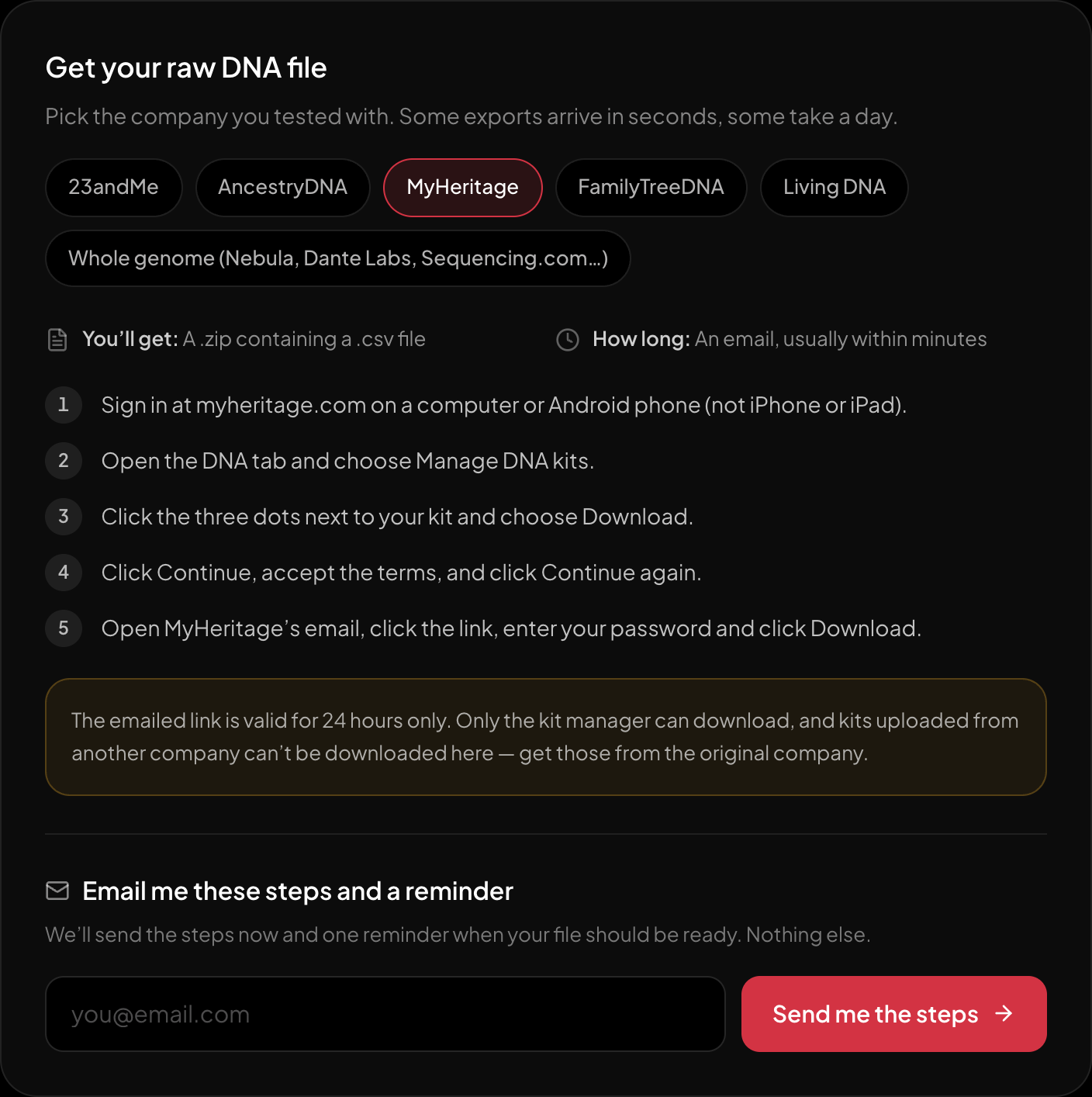
The download steps for MyHeritage, on the page itself.
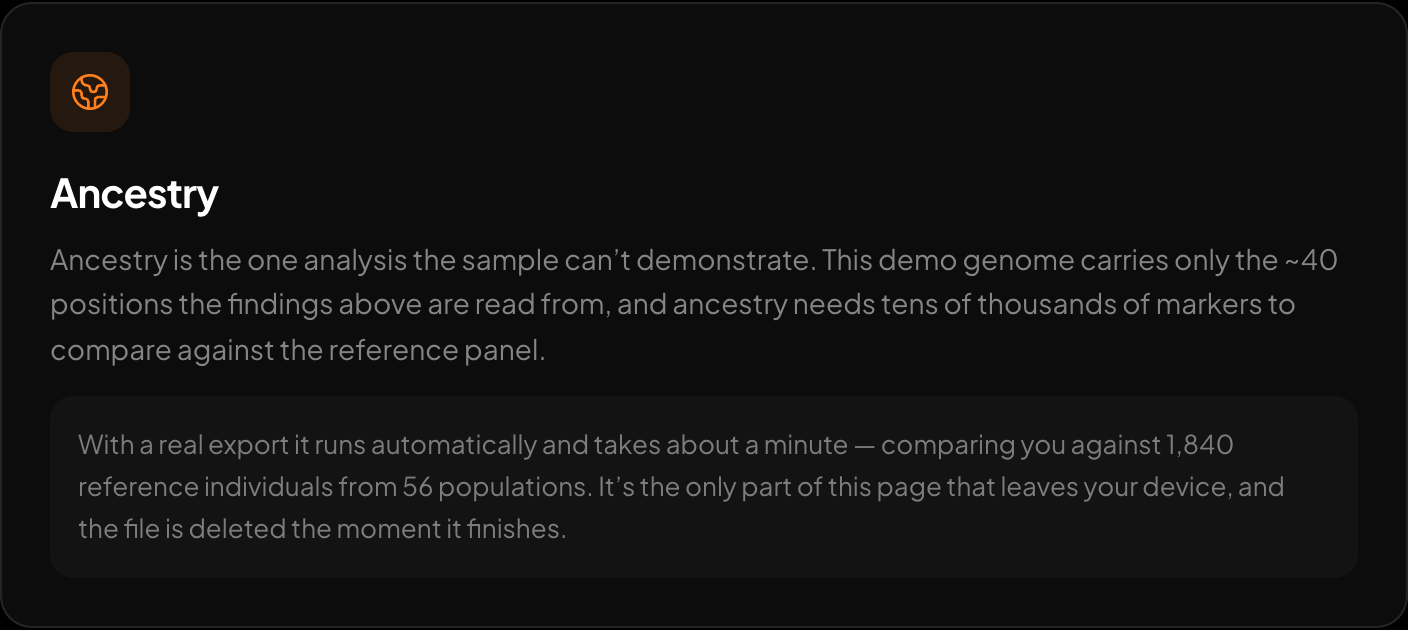
Ancestry across 15 regions and 157 reference populations.
When a MyHeritage group does not match your tree, the useful next step is not to edit your tree to force it in. Run the same raw file through a different panel and see whether the signal holds. If anything genetic or inherited is in play, run your file through https://healthosx.com/dna.
New to raw DNA files? Start with the full guide: How to Download & Analyze Your 23andMe Raw Data Free
Written by
HealthOS Research