What ASIP rs4911414 Means in Your 23andMe Raw Data
If your 23andMe raw data shows G at rs4911414, you carry a pigmentation-linked ASIP variant. It nudges freckles and sun sensitivity, not melanoma.
If your 23andMe raw data shows one or two copies of the G allele at rs4911414, you carry a pigmentation-linked variant in the ASIP region. It makes freckling and sun-sensitive skin more likely. It is one small genetic signal, not a mole or melanoma score on its own.
How to find ASIP rs4911414 in your raw data
Open the file in a text editor or the tool you use. In a 23andMe file you will see a line like this:
rs4911414 20 [position on your build] AG
The last column is your genotype. For this marker, most 23andMe files call the two alleles as A and G, so you will normally see AA, AG, or GG.
AA: no G copy at this marker.AG: one G copy.GG: two G copies.--: the chip did not call the marker, so there is no result to read.
| Genotype | Looks like | What it means at this marker |
|---|---|---|
| AA | Two A alleles | No G copy. Baseline freckle tendency at this locus. |
| AG | One A and one G | One G copy. Small shift toward freckling and sun sensitivity. |
| GG | Two G alleles | Two G copies. Strongest freckle tendency at this single marker. |
| -- | No call | The chip missed the marker. No result, not a risk. |
Scroll the table sideways for the rest →
Illustrative for files that call the alleles as A and G. The column that matters is how many G copies you carry.
If your file shows A/G with a slash, that is the same as AG. The count of G alleles is the part that matters.
What the ASIP region does
ASIP stands for agouti signaling protein. The protein acts against MC1R, the receptor that tells a melanocyte to make eumelanin, the brown-black pigment that protects skin from UV damage. When ASIP action is stronger, less eumelanin gets made and the balance shifts toward pheomelanin, the red-yellow pigment that is less protective. Freckles are localized UV-induced melanin spots, not clusters of pheomelanin.
rs4911414 is not a coding change in ASIP itself. It sits in the wider ASIP region and acts as a marker for nearby regulatory variation. Carrying the G allele does not mean the ASIP protein is broken. It means your version of this region leans toward the pigmentation pattern seen in people with more freckling and quicker sunburn.
The diagram below shows an association pattern, not a direct causal path.
What does ASIP rs4911414 mean in my 23andMe raw data?
For a single marker in a 23andMe-style file, the practical meaning is modest.
- One G copy nudges your baseline freckle tendency upward.
- Two G copies nudge it further.
- No G copy means you have the common pattern at this marker, which does not make freckles impossible.
The reason it is not bigger than that is simple. Freckles and sun sensitivity are polygenic. ASIP is one of many genes. MC1R matters a lot. HERC2 and OCA2 matter for eye and skin tone. SLC24A5 and SLC45A2 matter for skin pigmentation. If several of those push the same direction, the combined effect can be obvious. If rs4911414 is the only pigmentation variant leaning one way, you may see no clear difference.
Sun exposure is still the trigger. No genotype creates freckles in the dark. If you had little childhood or adult UV exposure, your ASIP genotype may never show as visible freckling.
What it does not tell you
The mistake people make is reading rs4911414 as a melanoma score. It is not that.
ASIP variants do show up in genome-wide studies of melanoma risk, but the effect of one marker is small and population-level. A single G at rs4911414 is a weak nudge, not a personal risk category. Your actual melanoma risk depends much more on family history, number of moles, skin type across many genes, and lifetime UV exposure. A person with AA at this marker but several strong MC1R red-hair variants and a history of sunburns can have more melanoma-relevant risk than someone with GG at rs4911414 and no other risk factors.
The evidence is strongest in European-ancestry populations. In people from other ancestral backgrounds, the same variant may be rarer, may have a different effect, or may not be well studied. That is not a gap in the raw data. It is a limit of the association work.
The follow-up question: should I do anything different?
If you have one or two G copies, treat it as a reminder, not a finding.
- Use sunscreen on exposed skin when UV is high.
- Watch any moles that are new or changing.
- If you have many atypical moles or a family history of melanoma, ask a doctor about a skin exam.
If you have AA, none of that becomes irrelevant. Skin cancer risk exists across all genotypes. The ASIP marker is not a get-out-of-sun-protection card.
The next step with your own file
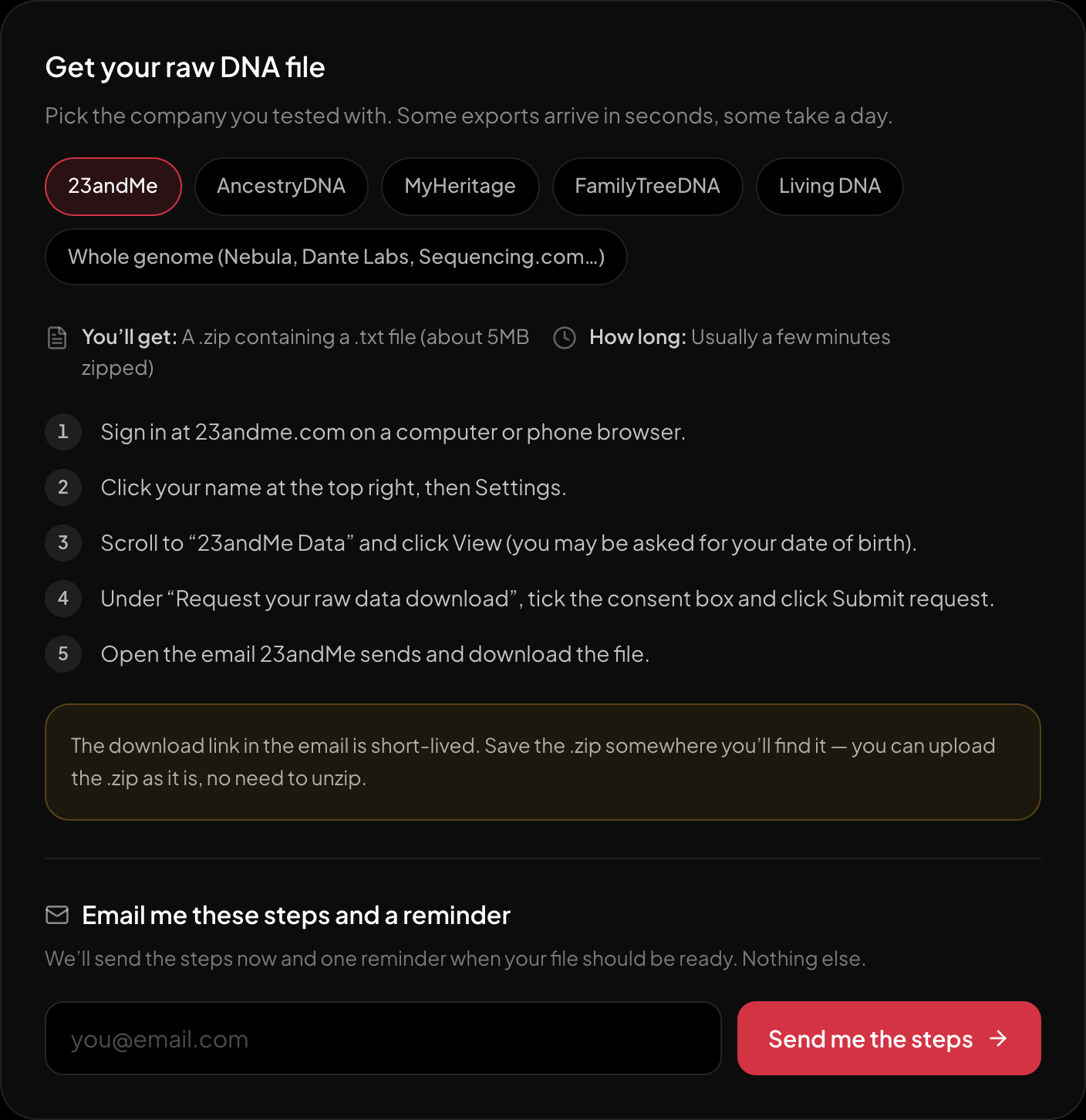
The download steps for 23andMe, on the page itself.
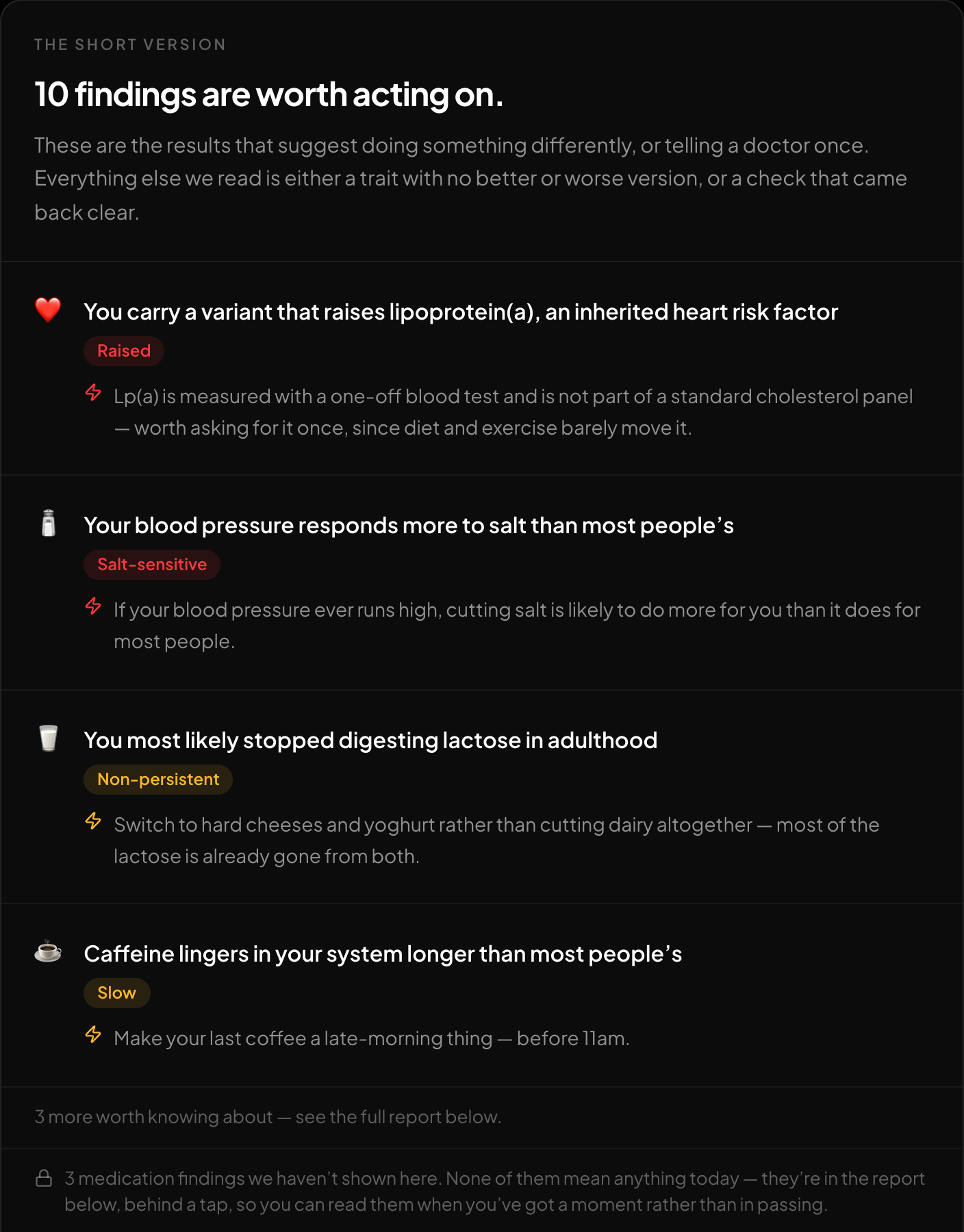
The short version: what is worth acting on, first.
The ASIP region is one of the pigmentation traits you can see next to your other DNA results. The free DNA tool at https://healthosx.com/dna reads a raw 23andMe, AncestryDNA, MyHeritage or annotated whole-genome VCF file in the browser and reports the ASIP region as 'whether you freckle, and what that means for moles.' Whole-genome VCFs without rsID annotations cannot produce health findings. If the VCF has rsID annotations, it can be read. It also checks the other pigmentation genes, medication response and carrier-relevant markers, so you can see whether this variant sits inside a larger pattern or is an isolated small hit.
New to raw DNA files? Start with the full guide: How to Download & Analyze Your 23andMe Raw Data Free
Written by
HealthOS Research