What MEIS1 rs2300478 Means in Your 23andMe Raw Data
rs2300478 in your 23andMe raw data is the MEIS1 restless legs marker. The risk letter is G. G/G raises odds the most, but it is not a diagnosis.
In your 23andMe raw data, rs2300478 is a single-letter change in the MEIS1 gene. The risk letter is G. G/G is the highest genetic-risk genotype for restless legs syndrome, G/T is intermediate, and T/T is the common lower-risk genotype. It is a risk marker, not a diagnosis.
What does MEIS1 rs2300478 mean in my 23andMe raw data?
Open the raw file and search for rs2300478. A 23andMe export is a tab-separated text file, so the line will show the rsID, chromosome 2, a base-pair position, and your two letters.
- T/T: two non-risk letters. Most common in European reference panels.
- G/T: one copy of the risk letter. The odds of restless legs syndrome rise by a modest amount.
- G/G: two copies of the risk letter. The strongest effect from this marker, but still not a verdict.
In European reference panels the split is roughly 55% T/T, 38% G/T and 7% G/G. The G version is common enough that carrying it is unremarkable by itself.
The G at rs2300478 raises the odds of restless legs. It does not turn the odds into a verdict.
Why a single letter in MEIS1 matters
MEIS1 codes for a transcription factor, a protein that switches other genes on and off. During development it helps pattern parts of the nervous system, and in adults it stays active in brain regions involved in movement and in iron biology.
rs2300478 sits in an intron, so it does not change the amino acid sequence of the MEIS1 protein. The working model is that the G version changes how strongly the gene is expressed in certain cells. Some expression studies find lower MEIS1 transcript with the risk allele, but the exact cell type and the full set of target genes are still being argued about.
Restless legs syndrome has two recurrent biological themes: low brain iron in motor circuits and altered dopamine signalling. MEIS1 is one of the plausible links between those themes, which is why this marker appears in genome-wide studies.
How much risk does each genotype add?
The number most studies converge on is an odds ratio. Each copy of the G allele adds roughly 50 to 80 percent to the odds of restless legs syndrome in European-ancestry analyses. In practical terms, G/T is a small shift and G/G is a larger but still incomplete shift.
Restless legs syndrome affects about 5 to 10 percent of adults. The risk genotype nudges your probability upward, but it does not put you in a separate category. Most people with G/G never receive an RLS diagnosis, and many people with T/T do.
Does this mean I have restless legs syndrome?
No. RLS is a clinical diagnosis. The core features are an urge to move the legs, worse at rest or in the evening, relieved by movement, and not explained by another condition such as iron deficiency anaemia or neuropathy.
The obvious follow-up question is what to do with a G/G result. If you have those symptoms, the useful next step is a proper assessment and blood tests, especially ferritin, because low iron can mimic or worsen RLS. If you have no symptoms, there is no preventive treatment and no need to act on the genotype. It belongs in the background, not on a problem list.
What if my file shows a different pair of letters?
23andMe reports on the plus strand, where the common letters are G and T. Some third-party tools or older files may show the same variant as C/A or another pair because of strand flipping. If your call is not G/T, check the orientation before reading anything into it. The rsID is what matters, not the letter colour.
The common mistake is treating a risk allele as a settled outcome. rs2300478 is a weak genetic signal with a real mechanism behind it, but it is one small part of a common condition.
Where the evidence thins out
Most of the clean risk estimates come from European-ancestry studies. In other populations the same letter may not be the best tag for the causal variant, so be cautious about applying the exact odds ratio elsewhere.
The marker is also one of several restless legs loci. BTBD9, MAP2K5/LBXCOR1 and PTPRD all show up in genome-wide analyses. A high-risk result at MEIS1 does not tell you the rest of your polygenic background, and family history usually adds more practical information than a single SNP.
Animal models show that reducing MEIS1 can cause hyperactivity and altered movement, which fits the direction of the human data. The gap is in the middle: the exact target genes and the cell types where this matters in humans are still not fully mapped.
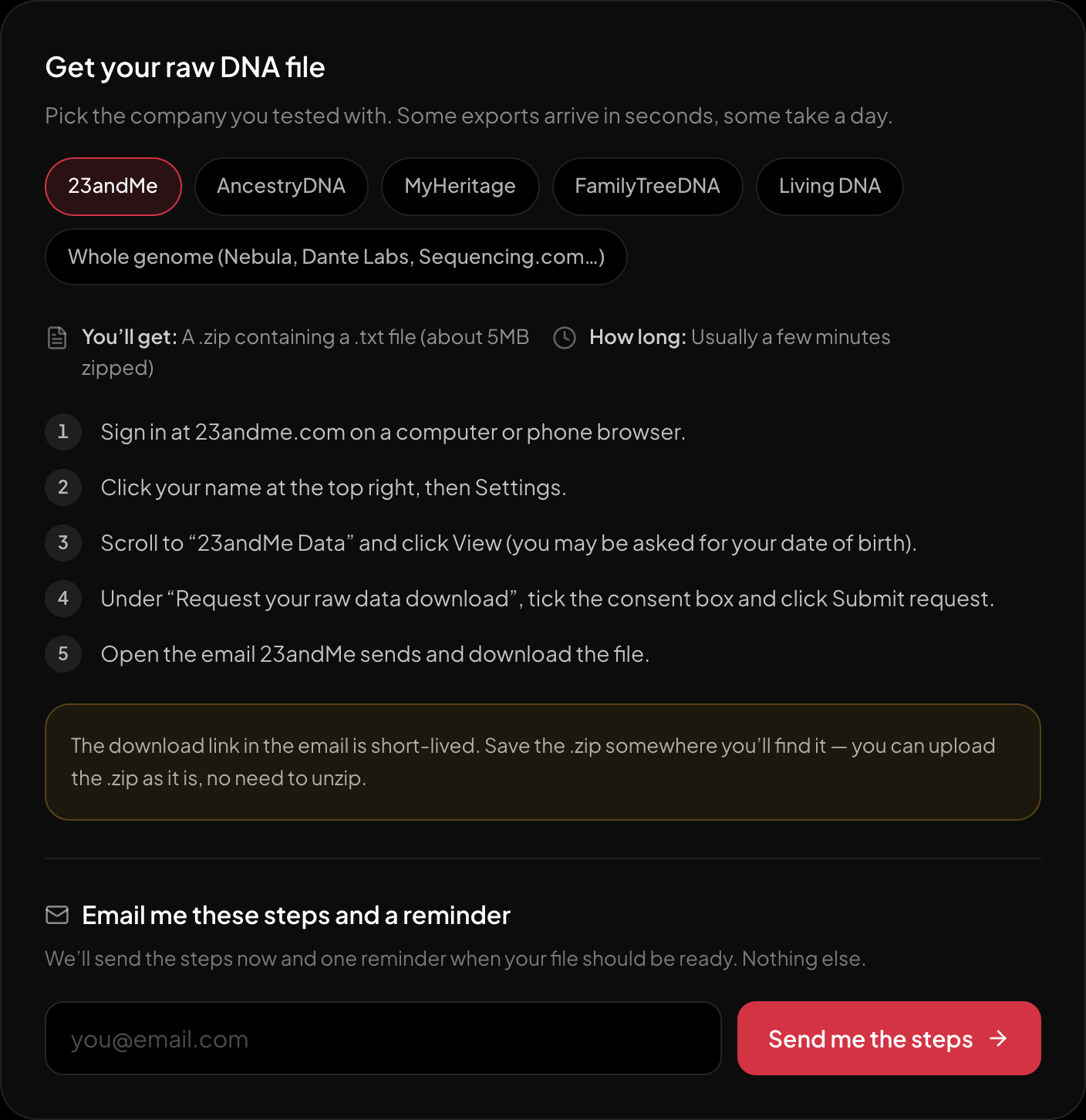
The download steps for 23andMe, on the page itself.

The short version: what is worth acting on, first.
If you want to see how your own file calls rs2300478, upload it at https://healthosx.com/dna. The tool reads 23andMe, AncestryDNA, MyHeritage and whole-genome VCF files in the browser, and reports the MEIS1 call as part of its trait findings, with no account needed for the initial story.
New to raw DNA files? Start with the full guide: How to Download & Analyze Your 23andMe Raw Data Free
Written by
HealthOS Research