How Far Back Is 2% Anatolia and the Caucasus Ancestry
A 2% Anatolia and the Caucasus result on AncestryDNA points roughly five to six generations back under a single-ancestor model, but the percentage alone cannot name the ancestor.
# How Far Back Is 2% Anatolia and the Caucasus Ancestry
On AncestryDNA, a 2% result for Anatolia & the Caucasus is a small estimate, not a confirmed ancestor. Under a clean single-ancestor model, it points roughly five to six generations back, around a third or fourth great-grandparent, with a wide confidence range. The percentage alone cannot tell you who, where, or whether it was one person.
2% Anatolia and the Caucasus is a clue, not a family member. It says a small part of your DNA resembles the reference panel for that region, not that you found a named ancestor.
How far back is 2% Anatolia and the Caucasus ancestry on AncestryDNA?
The arithmetic is simple. You inherit half from each parent, so a parent is 50%, grandparent 25%, great-grandparent 12.5%, 2nd great-grandparent 6.25%, 3rd great-grandparent 3.125%, 4th great-grandparent 1.5625%. A 2% number lands between 3.125% and 1.5625%. That is five to six generations back if all of it came from one single ancestor.
| Generations back | Relationship | Expected DNA share |
|---|---|---|
| 4 | 2nd great-grandparent | 6.25% |
| 5 | 3rd great-grandparent | 3.125% |
| 6 | 4th great-grandparent | 1.5625% |
| 7 | 5th great-grandparent | 0.78% |
Scroll the table sideways for the rest →
Expected autosomal contribution. Real single-ancestor expectations under random inheritance.
For illustration only, an ethnicity estimate of 2% would be roughly 140 cM if it behaved like a single DNA block; this conversion is illustrative only and is not a literal DNA-match segment from an ethnicity estimate. In match terms, a full third great-grandparent shares on average about 212 cM and a fourth great-grandparent about 106 cM. Again, that places 2% between the two, only as a rough comparison.
But a real family tree rarely follows that clean model. You may have several ancestors from the region. Each may have passed small segments that added up to 2%. Or one third great-grandparent passed less than the expected 3.125%. Or a fourth great-grandparent passed more than the expected 1.5625%.
What the percentage actually measures
AncestryDNA does not read an address or a surname from your DNA. It compares your genotype at hundreds of thousands of markers to reference panels from living people whose families have deep roots in a region. For Anatolia and the Caucasus, the reference panel includes people from present-day Turkey, Armenia, Georgia, Azerbaijan and nearby parts of the Caucasus. The algorithm chops your genome into small windows and assigns each window to the reference population it most resembles.
A small percentage like 2% can come from a real segment or from common deep ancestry shared across neighboring regions. Anatolia, the Caucasus, Iran, the Levant and Greece have been connected for thousands of years. The reference panels overlap more than the clean category names suggest. That is why the same 2% can disappear, grow, or become 1% Levant or 1% Iran after an update.
What does it look like in your AncestryDNA results?
You will usually see the region listed with a percentage and a range. A result might show Anatolia and the Caucasus 2% with a range of 0 to 5%. The range matters more than the single number. If zero is inside the range, the 2% is not solid enough to anchor a family story.
You may also see no DNA matches from the region. That is normal at this level. A third or fourth great-grandparent is far enough back that you and those distant relatives may share no detectable DNA. Or the paper trail may be missing because records from the region are sparse for the relevant period.
The common mistake: reading 2% as a named ancestor
The mistake is to convert a small ethnicity percentage into a claim like my great-great-grandfather was Armenian. The percentage cannot do that. It cannot name the village, the religion, the language or the migration route. It can only suggest that a small portion of your DNA resembles a modern reference group.
Another mistake is to treat 2% as fixed. AncestryDNA updates its reference panel over time. Small percentages are more likely to shift than large ones because they sit closer to the boundary between signal and noise.
How to actually find the ancestor behind 2%
Use the ethnicity estimate as a lead, not a conclusion.
- Build a tree out to third and fourth great-grandparents on every line. Look for missing people, especially in the generation near five to six generations back.
- Check your shared matches. If you have a DNA match with ancestry from the region, use shared matches to group them into a cluster.
- Test an older generation if possible. A parent or grandparent is likely to show a larger percentage if the ancestor is real, because they are one or two generations closer, but inheritance is probabilistic.
- Search the paper records that exist for Ottoman, Armenian, Greek, Georgian, Kurdish, Assyrian or neighboring communities, but expect gaps.
- Treat small percentages as a hypothesis until a record or a close match confirms it.
What 2% does and does not tell you
It tells you that a small fraction of your genome looks Anatolian or Caucasian under the current panel. It does not tell you that you inherited exactly 2% from one person, that the ancestor lived five generations ago, or that they identified with a modern nationality.
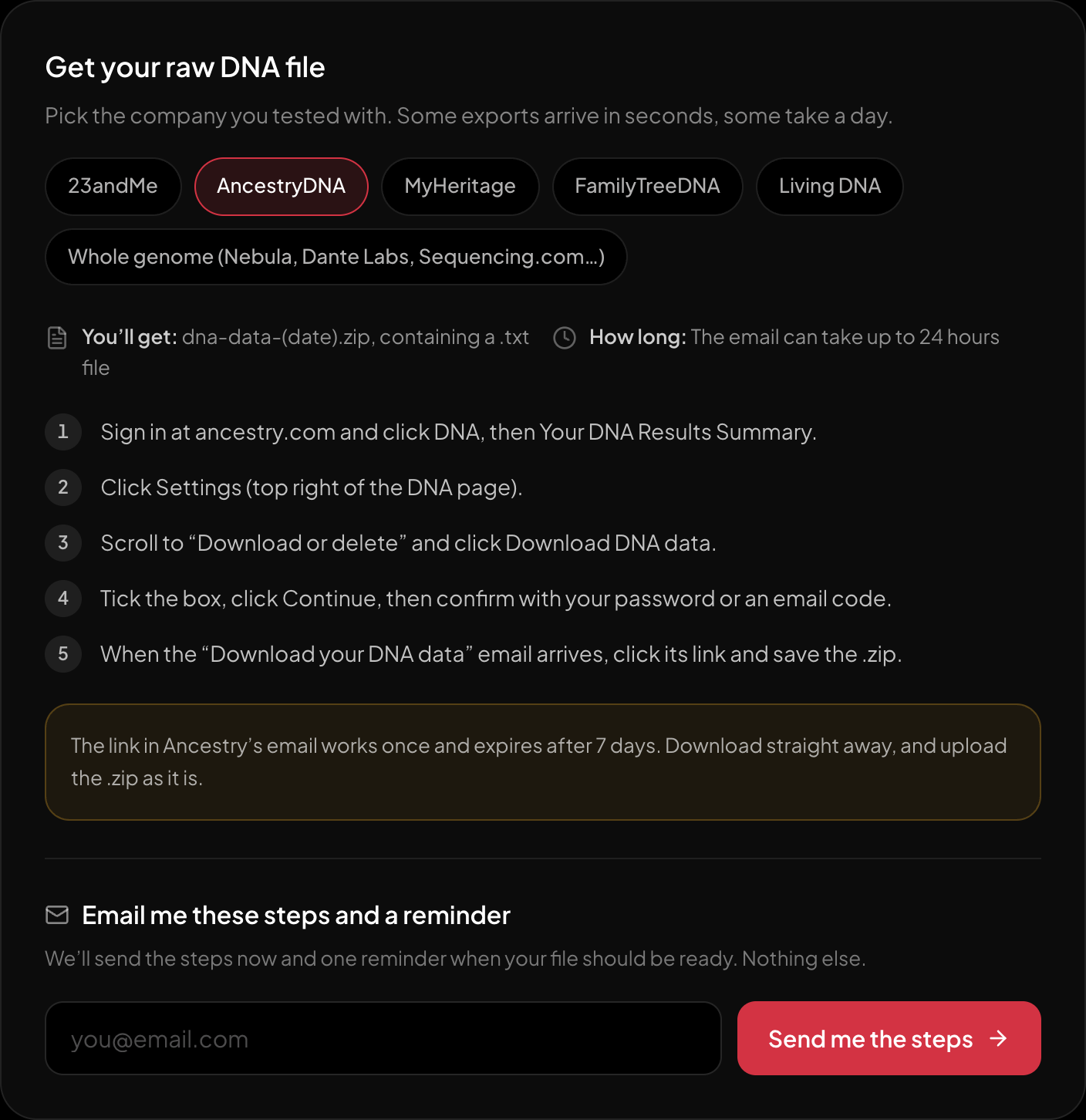
The download steps for AncestryDNA, on the page itself.
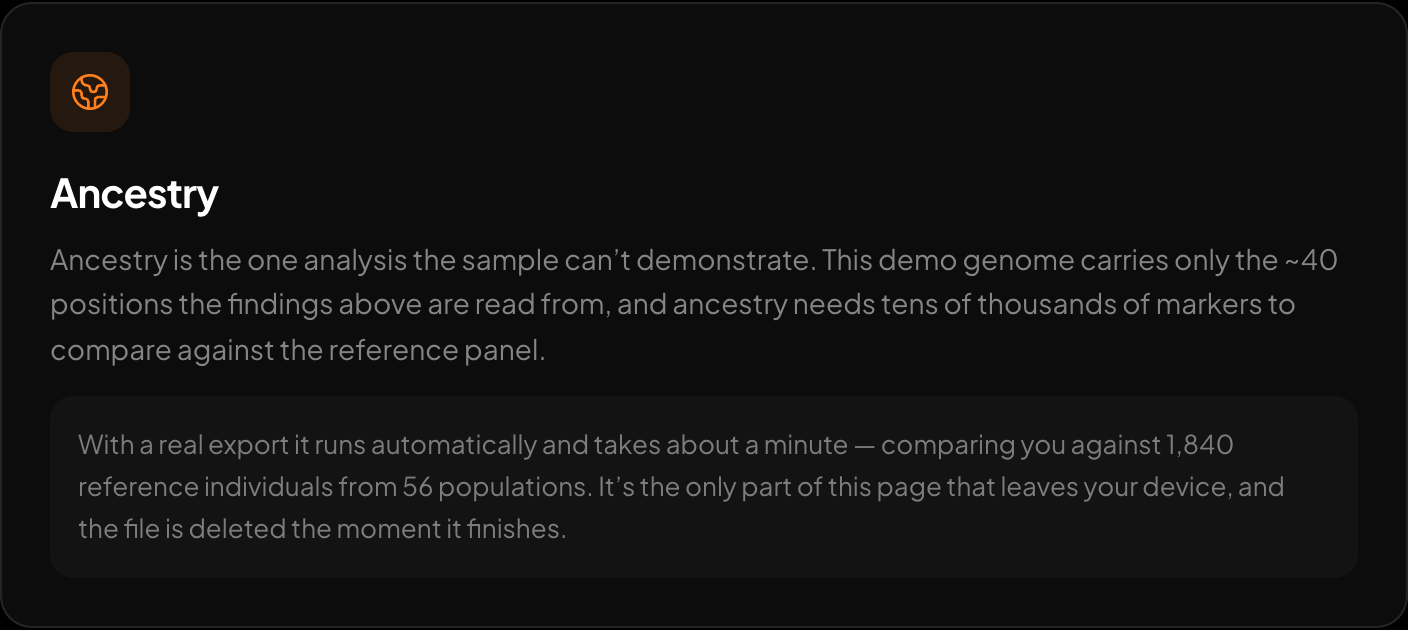
Ancestry across 15 regions and 157 reference populations.
If you want more resolution than a single 2% estimate, the free DNA tool reads a raw AncestryDNA, 23andMe, MyHeritage or whole-genome VCF file. Its ancestry panel separates Anatolia/Iran, the Caucasus, Levant and North Africa into distinct regions, shows your closest modern and ancient populations, and gives the ranges rather than one clean number.
New to raw DNA files? Start with the full guide: How to Download & Analyze Your 23andMe Raw Data Free
Written by
HealthOS Research