Is 1.5x or 2x Whole-Genome Sequencing Enough for Reliable Health or Haplogroup Analysis
A 1.5x or 2x nuclear whole-genome file is too shallow for heterozygous disease calls. mtDNA and Y haplogroups may be assignable only when the relevant mitochondrial genome or Y-defining sites have adequate coverage.
No. A 1.5x or 2x nuclear whole-genome file is not reliable for medical heterozygous calls or for ruling out a heterozygous disease variant. mtDNA and Y haplogroups may be assignable only when the relevant mitochondrial genome or Y-defining sites have adequate coverage.
Is 1.5x WGS read depth enough for reliable medical heterozygosity or haplogroup analysis?
For reliable medical heterozygosity, no. For mtDNA or Y haplogroup assignment, only when the relevant mitochondrial genome or Y-defining sites have adequate coverage. The same file can be useful for population genetics and misleading for rare disease variants, because the two tasks need different amounts of evidence.
A heterozygous site has one reference base and one alternate base on the two copies of a chromosome. If you sequence to an average depth of 1.5x or 2x, most sites get zero, one or two reads. A site with a single read will look either reference or alternate. A true heterozygous site will only show both alleles when at least two reads land on it and one happens to carry each allele. The values in the figure are an illustrative Poisson/binomial upper bound assuming unbiased sampling, no errors, no mapping bias, and a caller willing to call heterozygous from two reads. Under those idealized assumptions, at 1.5x depth that happens for roughly 28% of true heterozygous sites, and at 2x depth roughly 40%. Real usable sensitivity is lower. The rest look homozygous or uninformative. That is not a small loss. It is a systematic failure for exactly the rare variants you are trying to find.
Why low coverage breaks a heterozygous call
The problem is not just missing data. It is that low coverage creates the wrong data.
- A heterozygous variant can be called homozygous reference because only the reference allele was sampled.
- A heterozygous variant can be called homozygous alternate if two copies of the alternate allele happened to land and the reference was missed.
- A single alternate read can be a true variant or a sequencing error. At 1.5x depth, a caller cannot tell the difference well, so many harmless errors become visible in a VCF as low-quality alternate calls.
That means a pathogenic variant may be absent from the file because no read covered it, or present as a single low-quality alternate that a filter drops. Homozygous variants are less affected because there is no second allele to miss, but medical action still needs confirmation. Neither outcome is a genotype you can act on medically. Positive pathogenic or likely pathogenic findings from 1.5x or 2x WGS need orthogonal clinical confirmation before action.
| Use | 1.5-2x WGS | 30x WGS | Dense array |
|---|---|---|---|
| Broad ancestry | Partial | Yes | Yes |
| Major mtDNA haplogroup | Partial | Yes | Partial |
| Broad Y haplogroup | Partial | Yes | Partial |
| Heterozygous disease variant | Not reliable for medical use | High-quality, not absolute | Known markers only |
| Rare subclade or novel variant | Not sufficient | High-quality, not absolute | Not sufficient |
Scroll the table sideways for the rest →
For typical consumer or research 1.5-2x WGS. mtDNA and Y calls depend on coverage of the relevant mitochondrial genome or Y-defining sites. Positive findings need confirmation; negative findings are not evidence of absence. 30x WGS is high-quality but not absolute; dense arrays cover known markers only.
What low-pass data looks like in a VCF reader
If you open a 1.5x or 2x VCF, you will see large numbers of missing genotypes shown as ./.. Many called sites will have DP values of 0, 1 or 2. Genotype quality GQ will be low across much of the file. A variant at a disease gene may be missing from the filtered file, not because you are wild-type, but because the site never got enough reads.
Practical QC checks include DP, GQ, allele balance, missingness, mitochondrial coverage, and Y-site coverage. A ./. or low-depth site is not evidence of absence.
In a browser-based reader, this shows up as blank or absent results for specific markers. Ancestry and haplogroup reports can still look reasonable because they use many markers together. Medical variant reports look patchy because they depend on one specific base.
What it can still do: ancestry and haplogroups
Broad ancestry can be usable at 1.5x or 2x, but it is less certain than at high coverage. It depends on marker overlap, the reference panel, and how the tool handles missing data. At HealthOS, ancestry uses the AADR Human Origins panel, runs on the server only with explicit consent, and sends only the markers it needs. A raw VCF without rsIDs can work for ancestry only when its positions are matched on GRCh37 coordinates. Health findings require named positions.
Mitochondrial DNA is present in many copies per cell, so a whole-genome library often gives higher effective coverage on the mitochondrial genome. Major mtDNA haplogroups may be assignable only when mitochondrial coverage is adequate. The Y chromosome is single copy in males, so any individual Y marker may be missing. A major Y branch may be assignable only when the Y-defining sites are covered. Resolution depends on whether defining SNPs are covered. Terminal or rare subclades, heteroplasmy, and poorly covered markers are not reliable.
A 1.5x or 2x whole-genome file is a population map, not a rare-variant detector.
Can I still use a free VCF reader to screen for disease variants?
You can, but you have to read the output differently. A VCF reader will screen whatever variants are actually called in the file. If a ClinVar pathogenic variant is called as heterozygous with enough support, treat it as a positive finding needing confirmation. A clear panel in a low-pass file means only that no such variant was called. It does not mean the site was truly wild-type.
This is the common mistake people make with low-pass WGS. They treat missing calls as reassuring. In a 30x clinical genome, a clear result is high quality, but it is not absolute. In a 1.5x or 2x file, a clear result for a rare heterozygous variant often means the data could not see it.
The follow-up is not always another whole genome. For a specific medical question, a dense genotyping array, a targeted panel, or higher-coverage sequencing of the relevant region is the right tool. For broad ancestry or a rough haplogroup answer, the low-pass file you already have can be usable.
The practical bottom line
A 1.5x or 2x nuclear WGS file is not reliable for heterozygous disease variants or for ruling them out. It can support broad ancestry, and it may support major mtDNA or Y haplogroup assignment when the relevant mitochondrial genome or Y-defining sites have adequate coverage. Positive findings need confirmation. Negative findings are not evidence of absence. A 30x clinical genome or a dense array aimed at known disease markers is better for medical questions, but even those are not absolute for every possible variant.
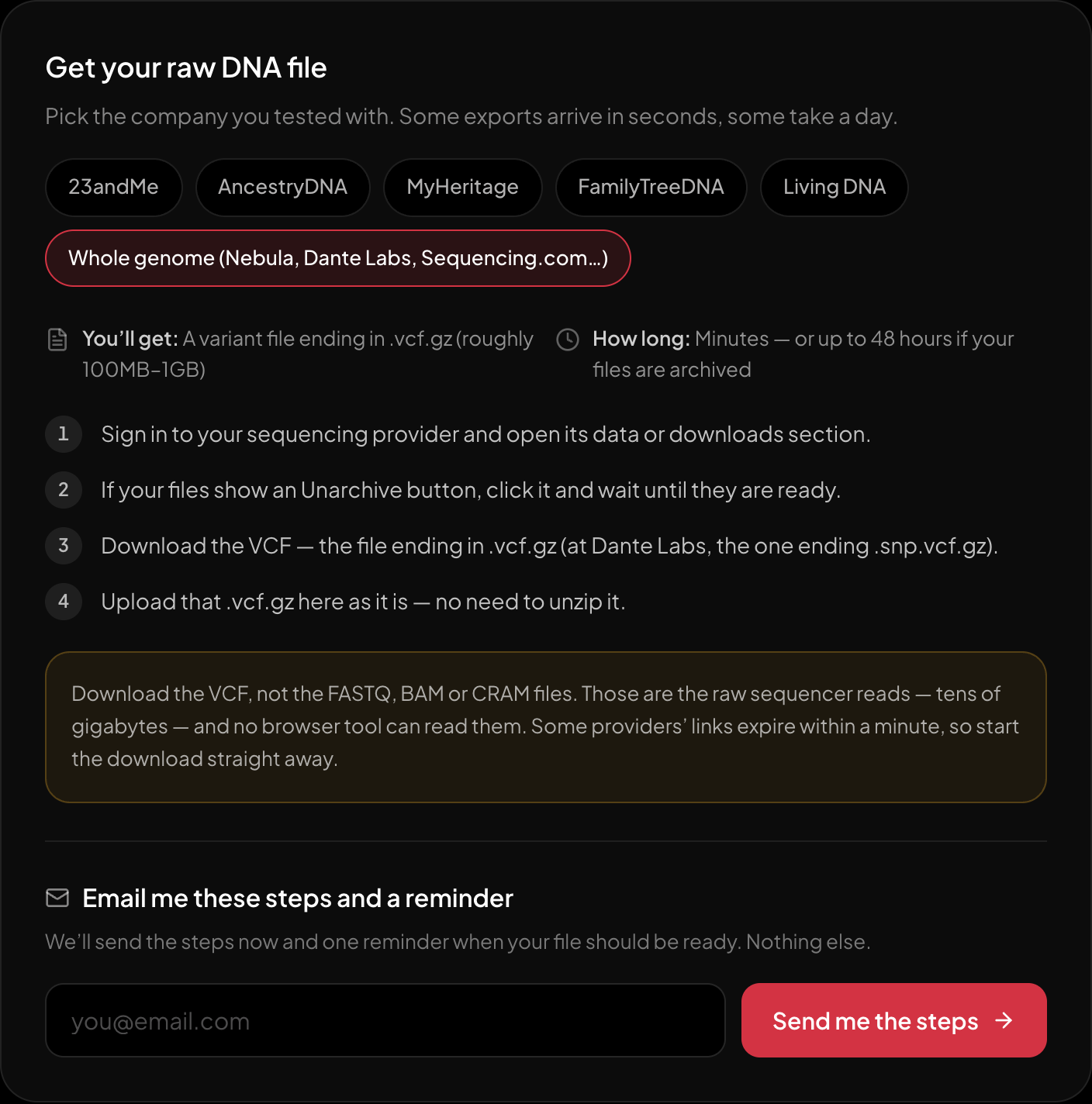
The download steps for whole-genome sequencing, on the page itself.
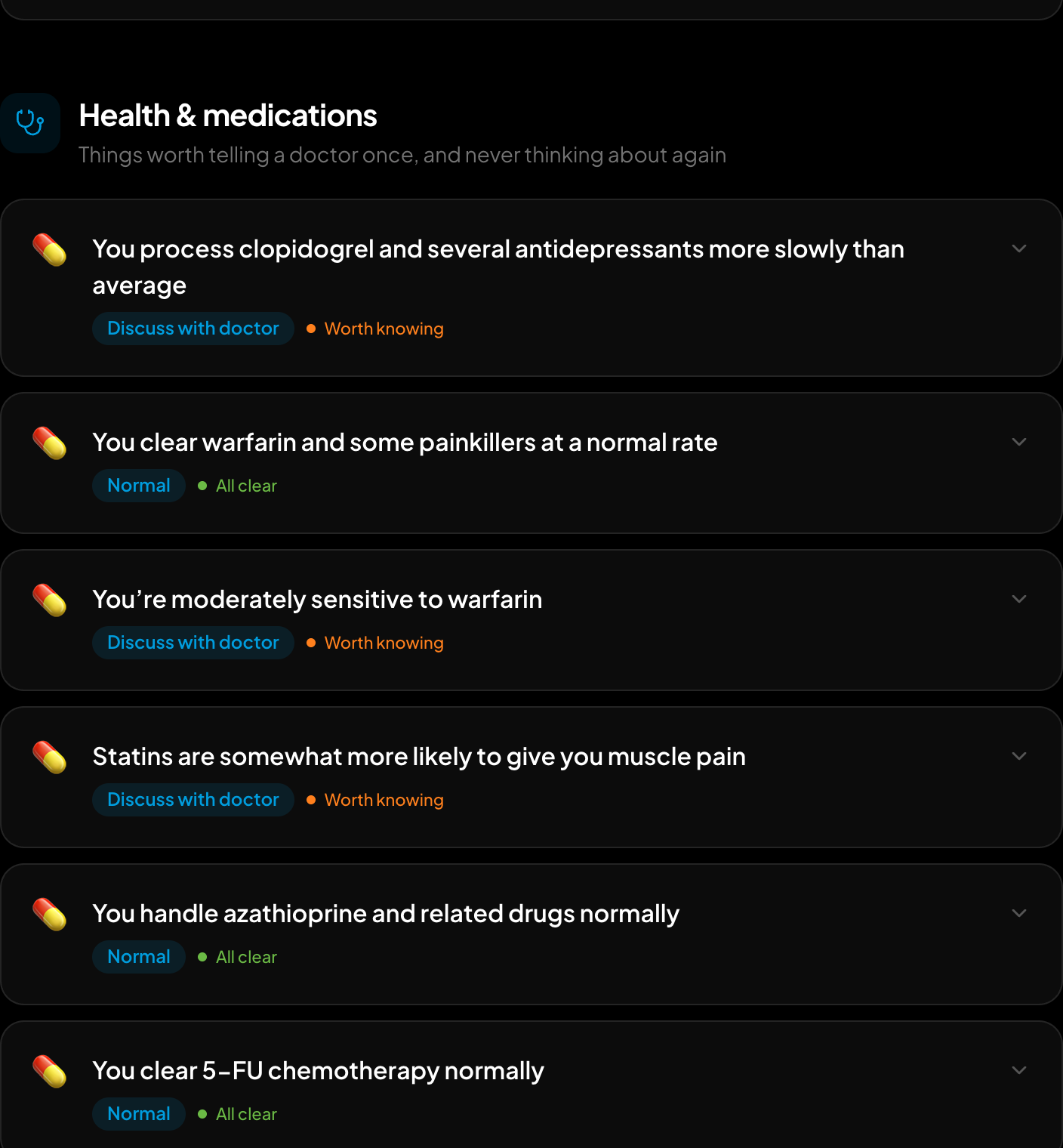
Medication genes, kept behind a tap rather than sprung on you.
To see what your own file contains, the free DNA tool at HealthOS parses a raw whole-genome VCF in the browser. Ancestry uses the AADR Human Origins panel, runs on the server only with explicit consent, and sends only the markers it needs. A raw VCF without rsIDs can work for ancestry only when its positions are matched on GRCh37 coordinates. Health findings require named positions. With a low-pass file, a missing medical finding is not the same as a clean test.
New to raw DNA files? Start with the full guide: How to Download & Analyze Your 23andMe Raw Data Free
Written by
HealthOS Research