The Lactose Intolerance Gene: Reading LCT and MCM6 From Raw DNA
Whether you still digest milk as an adult depends on variants near the LCT gene, and different populations evolved different ones. Which positions to check, including the Arabian variant, and what a result means.
Free gene check
Check it in your own file
Drop your raw DNA file here and see which row of this guide is yours. It is read in your browser and never uploaded.
Choose or drop your raw DNA file
.txt · .csv · .zip · .vcf · .vcf.gz
Whether you still digest lactose as an adult is mostly decided by a switch in the MCM6 gene, which controls the lactase gene LCT. In people of European ancestry the key position is rs4988235: an A on the plus strand (the T allele in papers, known as −13910T) keeps lactase switched on. Arabian and Middle Eastern populations evolved a different switch, rs41380347 (−13915G). Most adults worldwide carry neither and gradually lose the ability to digest milk. The free report at healthosx.com/dna reads both positions from your raw file, in your browser.
Why adults lose lactase
Every baby makes lactase to digest milk. In most mammals, and most humans, production falls after weaning. That's the ancestral state, called lactase non-persistence, and it's true of roughly two-thirds of adults worldwide.
In populations that herded cattle, camels or goats, variants that kept lactase switched on spread quickly, and they arose independently in different places:
- −13910T (rs4988235): Europe, and parts of South Asia
- −13915G (rs41380347): the Arabian Peninsula and nearby, linked to camel herding
- Other variants in East Africa (−14010C and more) that consumer files often don't carry
That's why a test that only checks rs4988235 can wrongly tell a Saudi or Gulf reader they're lactose intolerant.
| Variant | Where it spread | In your raw file | Read on /dna? |
|---|---|---|---|
| −13910T · rs4988235 | Europe, parts of South Asia | Plus-strand A = persistent | Yes |
| −13915G · rs41380347 | Arabian Peninsula and nearby | Plus-strand C = persistent | Yes |
| −14010C and others | East Africa | Often absent from consumer chips | No call made |
Scroll the table sideways for the rest →
One persistence allele is enough to keep lactase switched on. A tool that checks only the European variant can wrongly call a Gulf or Levantine reader lactose intolerant.
Reading your raw file
rs4988235, on the plus strand as 23andMe and AncestryDNA report it:
- AA or AG: lactase-persistent, you can digest milk as an adult (one copy is enough)
- GG: no European persistence allele; check rs41380347
rs41380347, the Arabian variant:
- A C allele on the plus strand means persistence. (Papers call it −13915G. The genes sit on the minus strand, so it reads as C in your file.)
If neither shows a persistence allele and both positions were read, non-persistence is likely. If one position is missing from your file, you can't conclude anything, and the /dna report stays silent instead of guessing.
What the result means in daily life
- Persistent: dairy is simply a useful source of protein and calcium for you.
- Non-persistent: you'll likely get symptoms from large amounts of lactose, but most people with this result tolerate about a cup of milk, especially with food. Yoghurt and hard cheeses contain much less lactose. There's no need to cut dairy out entirely.
- Symptoms but a persistent result: look at other causes. Gut conditions, other food intolerances and infections can reduce lactase temporarily.
Genetics tells you your baseline. A lactose breath test tells you what's happening now.
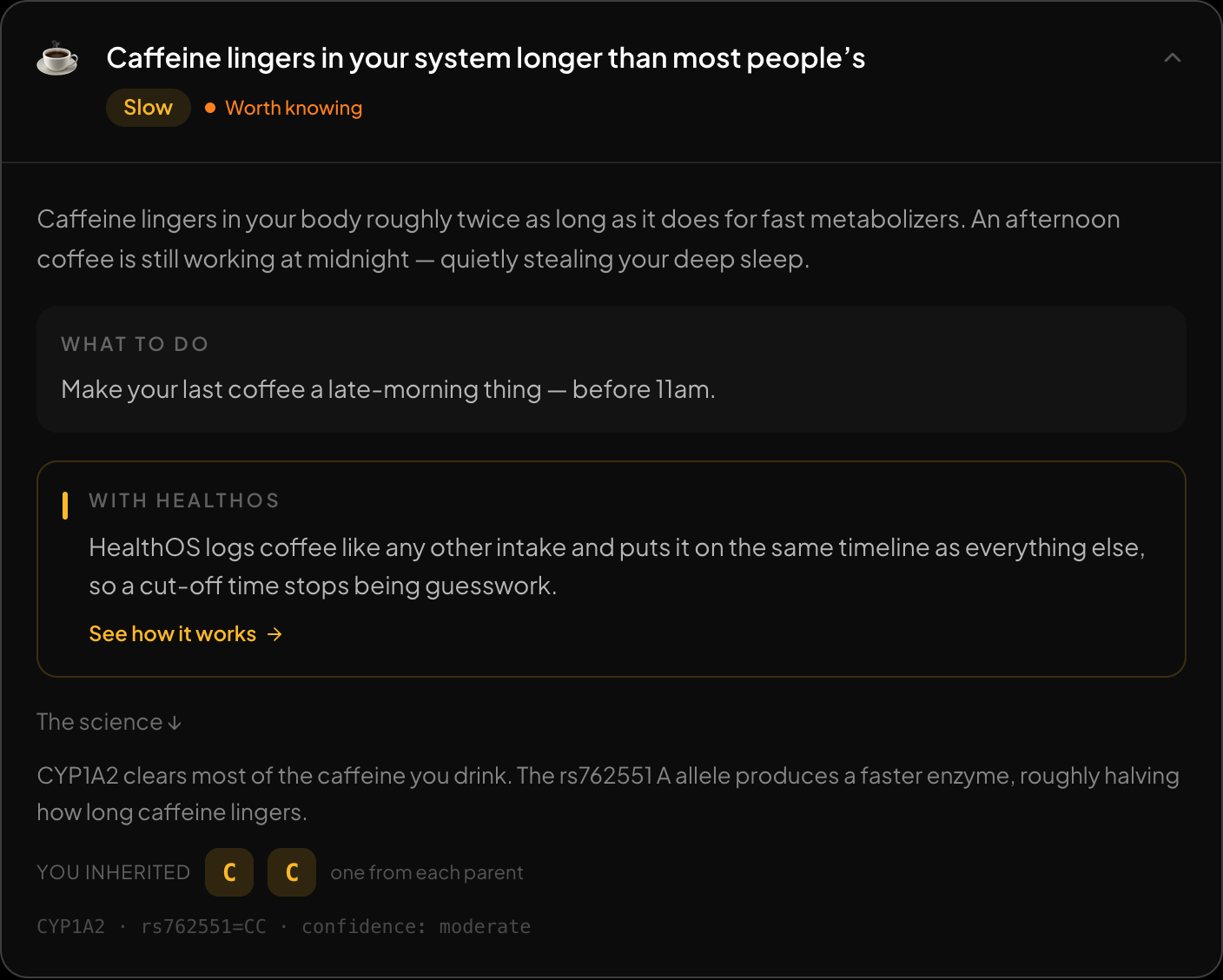
Every finding opens up: what it means, what to do, and the genotype behind it.
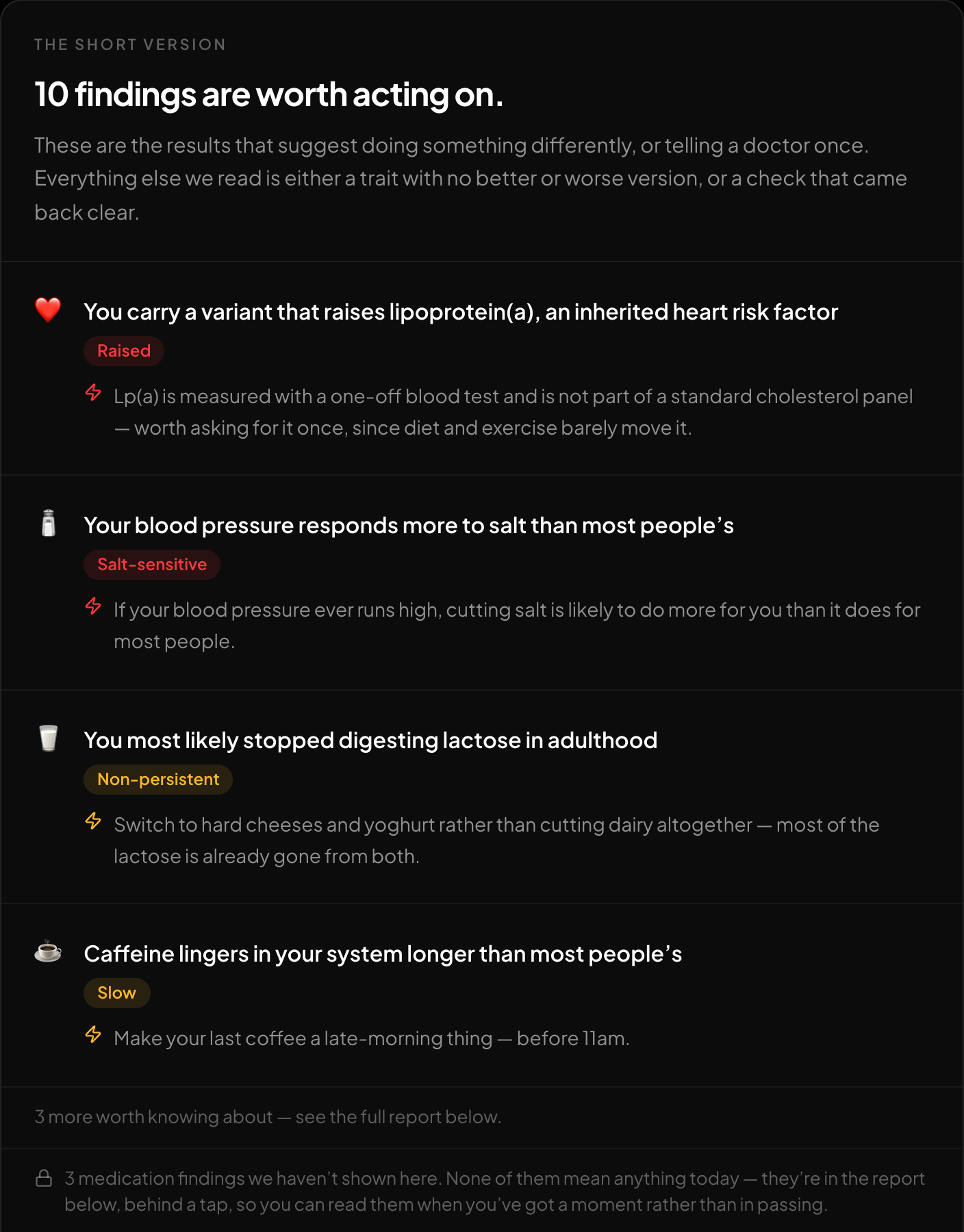
The short version: what is worth acting on, first.
How much lactose you can actually handle
Non-persistence is not an allergy, and it isn't all-or-nothing. Most people who stop making much lactase still tolerate a useful amount, especially spread through the day and taken with other food:
- A glass of milk (around 12g of lactose) is tolerated by most non-persistent adults, particularly with a meal.
- Hard cheeses — cheddar, parmesan, gouda — contain very little lactose: it leaves with the whey, and what remains is largely fermented.
- Yoghurt and kefir come with live bacteria that digest lactose for you, so they're usually easier than milk.
- Butter and cream are mostly fat, and low in lactose.
- Lactase tablets work, taken with the first mouthful.
Cutting dairy out entirely also costs you a convenient source of calcium and protein, which matters more than most people assume.
When genetics and symptoms disagree
- Symptoms but a persistent genotype: something else is likely going on. Gut infections, coeliac disease and inflammatory bowel disease all reduce lactase temporarily, and fructose or FODMAP sensitivity can feel identical.
- No symptoms but a non-persistent genotype: perfectly normal. Plenty of people carry no persistence allele and eat dairy happily, because gut bacteria adapt to a regular intake.
- A hydrogen breath test measures what's happening now; the genotype tells you the baseline you were born with.
FAQ
Can lactose tolerance change over time?
Lactase production usually declines gradually after childhood, and how much dairy you eat trains your gut bacteria rather than the enzyme. So tolerance shifts even though the genotype doesn't.
Is lactose intolerance the same as a milk allergy?
No. A milk allergy is an immune reaction to milk protein and can be serious. Lactose non-persistence is a digestive enzyme difference.
Which variant do most tools check?
Usually just rs4988235, the European one. If your ancestry is Arabian, Levantine or East African, a tool that checks only that position can get your result backwards.
Check both lactase switches, European and Arabian, free: healthosx.com/dna
New to raw DNA files? Start with the full guide: How to Download & Analyze Your 23andMe Raw Data Free
Common questions
- How do I check the lactose intolerance gene in my 23andMe raw data?
- Look at rs4988235, near MCM6 and LCT. On the plus strand 23andMe reports, AA or AG means you keep making lactase as an adult; GG means no European persistence allele. Then check rs41380347, the Arabian variant: a C on the plus strand means persistence. If neither shows persistence and both were read, non-persistence is likely. healthosx.com/dna reads both free in your browser.
- Why can a DNA test wrongly say a Saudi or Gulf reader is lactose intolerant?
- Arabian populations evolved their own persistence variant, rs41380347 (−13915G). A test that checks only the European rs4988235 misses it.
- Does a non-persistent result mean I have to cut out dairy?
- No. Most people with this result tolerate about a cup of milk, especially with food, and yoghurt and hard cheeses contain much less lactose.
No raw DNA file yet?
Get a HealthOS DNA Kit: spit in a tube at home, and your ancestry, lineages and traits arrive in your HealthOS account, with the raw file.
See the DNA kitReferences
- 1.Enattah NS et al. Identification of a variant associated with adult-type hypolactasia. Nat Genet 2002
- 2.Enattah NS et al. Independent introduction of two lactase-persistence alleles into human populations reflects different history of adaptation to milk culture. Am J Hum Genet 2008
- 3.Tishkoff SA et al. Convergent adaptation of human lactase persistence in Africa and Europe. Nat Genet 2007
For informational purposes only. For medical advice or diagnosis, consult a professional.
Written by
HealthOS Research