What HOXB13 G84E Means in Your 23andMe Raw Data
HOXB13 G84E is a rare inherited prostate cancer risk variant reported as rs138213197 in raw data. In a standard 23andMe GRCh37/forward-strand file, G/G means no G84E copy, A/G means one copy, and A/A means two copies.
HOXB13 G84E is a rare inherited change in the HOXB13 gene that is associated with hereditary prostate cancer. This guide assumes a standard 23andMe raw data export using GRCh37/hg19 forward-strand calls. The expected 23andMe raw line has four tab-separated columns: rsid, chromosome, position, genotype. Example: rs138213197\t17\t46805696\tA/G. Other files or builds may report the same variant as C/T or T/C if the strand is flipped; do not self-call from other formats.
Clinical-safety note: 23andMe raw data is not a diagnostic result. Consider confirming any HOXB13 finding in a clinical laboratory and discussing it with a clinician or genetic counselor.
What does HOXB13 G84E mean in my 23andMe raw data?
Open the raw text file and search for rs138213197. In a standard 23andMe file, G/G means no G84E copy, A/G or G/A means one copy, and A/A means two copies. If rs138213197 is missing, the chip version may not have genotyped it; missing is not a negative.
| Genotype | What it means |
|---|---|
| G / G | Does not carry G84E. This result only addresses G84E. |
| A / G or G / A | Carries one copy. Elevated prostate cancer risk in published studies. |
| A / A | Carries two copies. Rare; consider discussing with a clinician or genetic counselor. |
| Missing | Cannot interpret G84E from this file. Missing data, not a negative. |
For rs138213197, this interpretation assumes a standard 23andMe GRCh37/hg19 forward-strand file. Other files may report flipped letters.
If the file is not a standard 23andMe export or the variant is absent, use the HealthOS /dna/check tool or a clinical laboratory rather than self-calling.
The mechanism, without the jargon
HOXB13 is a transcription factor, a protein that helps control gene activity. The G84E change is associated with hereditary prostate cancer. It is a rare inherited change that alters risk over time, but it is not a diagnosis and it does not act alone.
How much does it raise risk?
Published studies in men of European ancestry report carrier frequency around 0.5-1% depending on the cohort, and relative risk estimates such as an odds ratio around 3-5 for prostate cancer compared with non-carriers. Higher relative-risk estimates appear in early-onset or familial cases. There is no widely accepted absolute-lifetime-risk number; published models vary, and HealthOS does not predict absolute risk.
| Carrier status | Evidence strength | Uncertainty |
|---|---|---|
| G/G, no G84E copy | No G84E-related risk from this SNP; most prostate cancer occurs in this group. | Does not rule out family history, age, other genetic risk, or ancestry. |
| A/G or G/A, one copy | Published European-ancestry studies report odds ratio roughly 3-5 compared with non-carriers. | No widely accepted absolute lifetime risk; published model estimates vary. |
| A/A, two copies | Rare; limited direct evidence. | Clinical significance less well characterized; consider genetic counseling. |
Scroll the table sideways for the rest →
Published evidence in men of European ancestry; absolute risk estimates vary and are modelled, not HealthOS predictions.
Relative risk tells you how a group compares. It does not tell you exactly what will happen to you. Some research cohorts report higher lifetime risk estimates, but those cohorts were enriched with high-risk families. General population estimates may differ.
What a carrier result does not mean
One common mistake is to read an A as a diagnosis. It is not. Many carriers never develop aggressive prostate cancer. Another mistake is to read G/G as an all-clear. Most prostate cancer occurs in men without G84E, because the variant is rare.
- A carrier result is a risk flag, not a diagnosis.
- A negative result does not erase family history, age, or other genetic risks.
- The risk evidence is strongest in men of European ancestry. It is weaker for other backgrounds, where the variant is rare.
- Women can carry and pass G84E to sons. The main known clinical risk is prostate cancer in men.
I'm a carrier. What do I actually do?
You may consider discussing PSA screening with a clinician or genetic counselor. Bring the raw data result and your family history. PSA screening has false positives and can lead to biopsies, so the decision is genuinely a trade-off. Tell first-degree male relatives. They may want the same conversation.
What if I don't have it?
G/G means you are not in the known G84E carrier group. It does not mean no prostate cancer risk. A negative rs138213197 result only addresses G84E, not other HOXB13 variants, family history, ancestry, age, or overall prostate-cancer risk. Prostate cancer is common, and family history, age, and ancestry still matter. If your father or brother had it, that may matter more than this one negative result. If your file lacks rs138213197 entirely, treat it as missing data, not a negative.
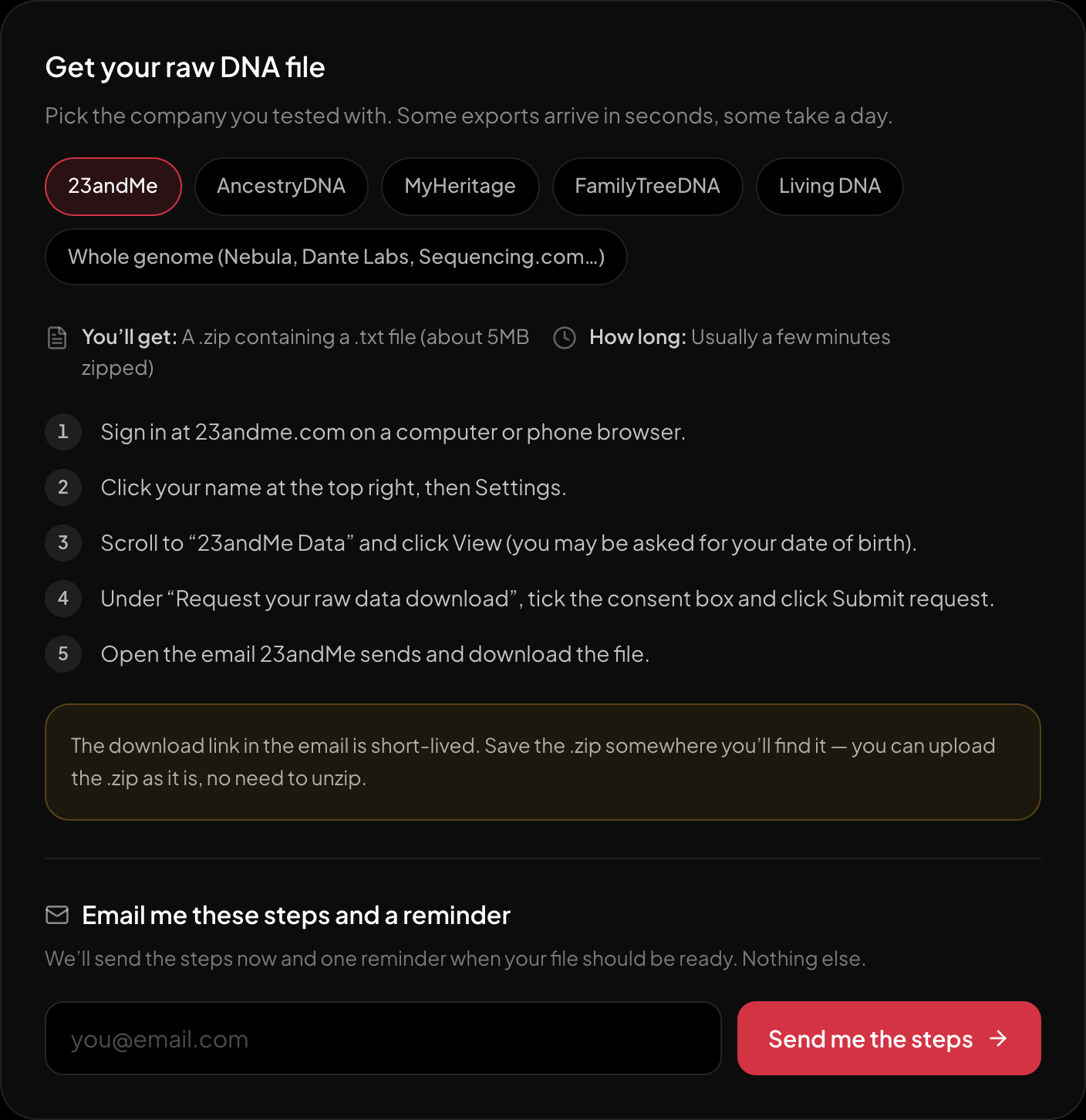
The download steps for 23andMe, on the page itself.
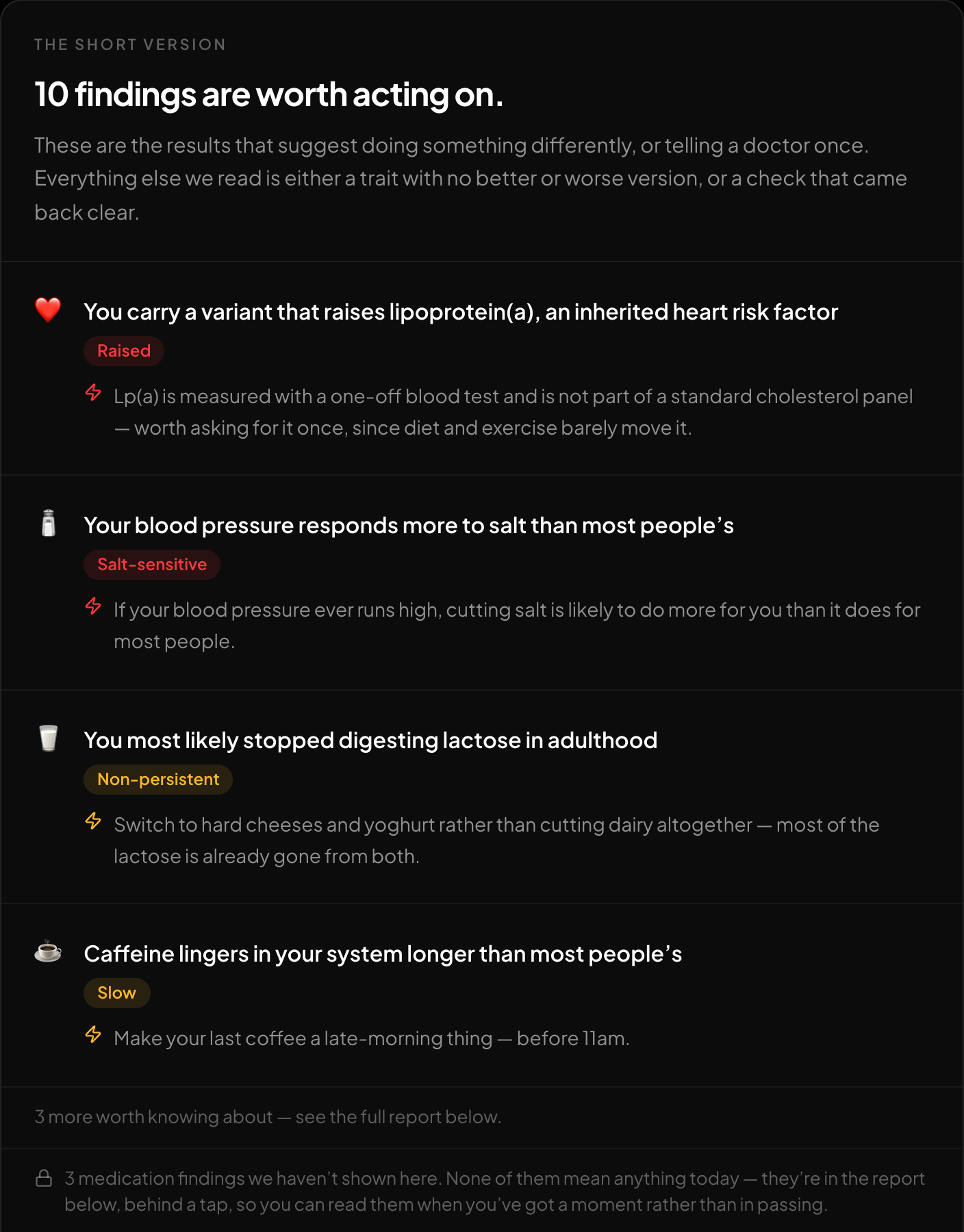
The short version: what is worth acting on, first.
The free DNA tool at https://healthosx.com/dna reads a 23andMe, AncestryDNA, MyHeritage or whole-genome VCF file in the browser. HOXB13 is one of the single-variant health findings. The initial story needs no account; the full report opens after a one-time email code. Sequencing files without rsIDs cannot produce health findings.
New to raw DNA files? Start with the full guide: How to Download & Analyze Your 23andMe Raw Data Free
Written by
HealthOS Research