What GBA N370S and L444P Mean in My 23andMe Raw Data
What GBA N370S and L444P mean in 23andMe raw data: possible Gaucher carrier status and uncertain Parkinson's risk, with limits of consumer chips.
In a 23andMe raw data file, GBA N370S and L444P are calls at rs76763715 and rs421016. One copy of either marker suggests possible carrier status. Two copies of one marker, or two different pathogenic GBA calls, need clinical confirmation. A missing marker means not tested, and a no-call means a tested position failed to read. Neither is a negative result.
What does GBA N370S and L444P mean in my 23andMe raw data?
Open your 23andMe text file and look for the rows with rs76763715 (N370S) or rs421016 (L444P). Each row has rsid, chromosome, position and genotype. The genotype column is two letters. Assuming standard plus-strand orientation, the N370S risk allele is G and the L444P risk allele is C. A line with A/G for N370S or T/C for L444P means one variant copy. A line with G/G for N370S or C/C for L444P means two copies of that one variant. If your file has been aligned to the opposite strand or a different build, those letters can flip or the marker may be missing, so match the rsID and use a tool that annotates the risk rather than eyeballing letters. If rs76763715 or rs421016 is absent from the file, that marker was not tested and must not be read as negative.
Consumer raw data is not diagnostic. GBA has a pseudogene that can confuse some assays, and strand or build issues can occur. Any concerning result should be confirmed by a clinical laboratory or genetic counsellor.
| Result | N370S (rs76763715) | L444P (rs421016) |
|---|---|---|
| No variant (normal) | A/A | T/T |
| One N370S only | A/G | T/T |
| One L444P only | A/A | T/C |
| One copy of each | A/G | T/C |
| Two N370S | G/G | T/T |
| Two L444P | A/A | C/C |
| No-call (tested but failed to read) | -- | -- |
| Missing marker (not tested) | absent | absent |
Scroll the table sideways for the rest →
Educational only, not clinical interpretation. Single-marker calls only. Assuming standard plus-strand orientation. If your file is on the opposite strand or a different build, use the rsID, not the letters alone. A one-copy-of-each scenario is A/G for N370S plus T/C for L444P and needs clinical confirmation. No-call means the chip failed to read a tested position. Missing marker means the rsID was not tested. Neither is a negative result.
A result like A/A for N370S or T/T for L444P is normal for that marker. A no-call (--) means the chip did not read that position, not that you are negative. A missing rsID means that marker was not tested, which is also not a negative result.
The GBA gene: why one broken copy is usually silent
GBA encodes glucocerebrosidase, an enzyme inside lysosomes that breaks down glucocerebroside. In Gaucher disease, both copies of GBA carry pathogenic variants, enzyme activity drops far enough that the substrate builds up in macrophages. That can enlarge the spleen and liver, lower platelets, cause bone pain and, in some forms, affect the brain. A carrier with one variant usually keeps enough enzyme activity to avoid Gaucher disease.
Gaucher disease: what your combination means
Gaucher is autosomal recessive. You need two pathogenic GBA variants to have the disease. The common chip genotypes map out like this, but the table is educational and not clinical interpretation:
- One N370S or one L444P alone: usually consistent with Gaucher carrier status if confirmed by clinical testing.
- Two N370S: consistent with Gaucher disease if confirmed by clinical testing; often described as non-neuronopathic type 1 and may be milder, but severity is variable.
- N370S plus L444P: two GBA variant calls. Raw data cannot show whether they are on the same chromosome or opposite chromosomes, so this is not confirmed Gaucher disease. Clinical confirmation is needed.
- Two L444P: consistent with Gaucher disease if confirmed by clinical testing; often more severe and may include neuronopathic type 3, but severity is variable.
- One of these plus another rare GBA variant not on the chip: possible disease if the other variant is pathogenic and confirmed clinically.
N370S is particularly common in people with Ashkenazi Jewish ancestry. Gaucher disease has enzyme replacement and substrate reduction treatments, so a result consistent with two pathogenic GBA variants is worth pursuing clinically.
Parkinson's disease risk: the part people miss
GBA variants are among the most common known genetic risk factors for Parkinson's disease. GBA variants are associated with increased Parkinson's risk, but the absolute lifetime risk for any one person is uncertain. L444P is often treated as a more severe Gaucher variant, but Parkinson's risk estimates vary by study and population.
This is a risk factor, not a diagnosis. Most GBA carriers never develop Parkinson's. A single variant may increase lifetime risk, but the absolute lifetime risk for any one person is uncertain.
Why "not detected" on N370S and L444P is not an all-clear
23andMe and similar chips test specific positions, not whole genes. A not detected result means those two markers were not found. There are many other GBA variants, and full gene sequencing can find a clinically relevant variant a chip misses.
People commonly mistake a negative chip result for a full gene test. If you have a strong family history of Gaucher disease or early Parkinson's, a negative result on these two markers should lower suspicion but not end it.
When to act on it
- One GBA variant call: note possible carrier status, and confirm clinically if relevant. If a partner is also a carrier, genetic counselling about Gaucher is reasonable before pregnancy.
- Two GBA variant calls, or one call plus symptoms or family history: ask a doctor about glucocerebrosidase enzyme assay, full GBA sequencing, or genetic counselling as appropriate.
- No variant on chip but family history: ask about full GBA sequencing or clinical genetics input.
- Parkinson risk with one variant: worth mentioning to a neurologist if you have symptoms, but most carriers never develop disease.
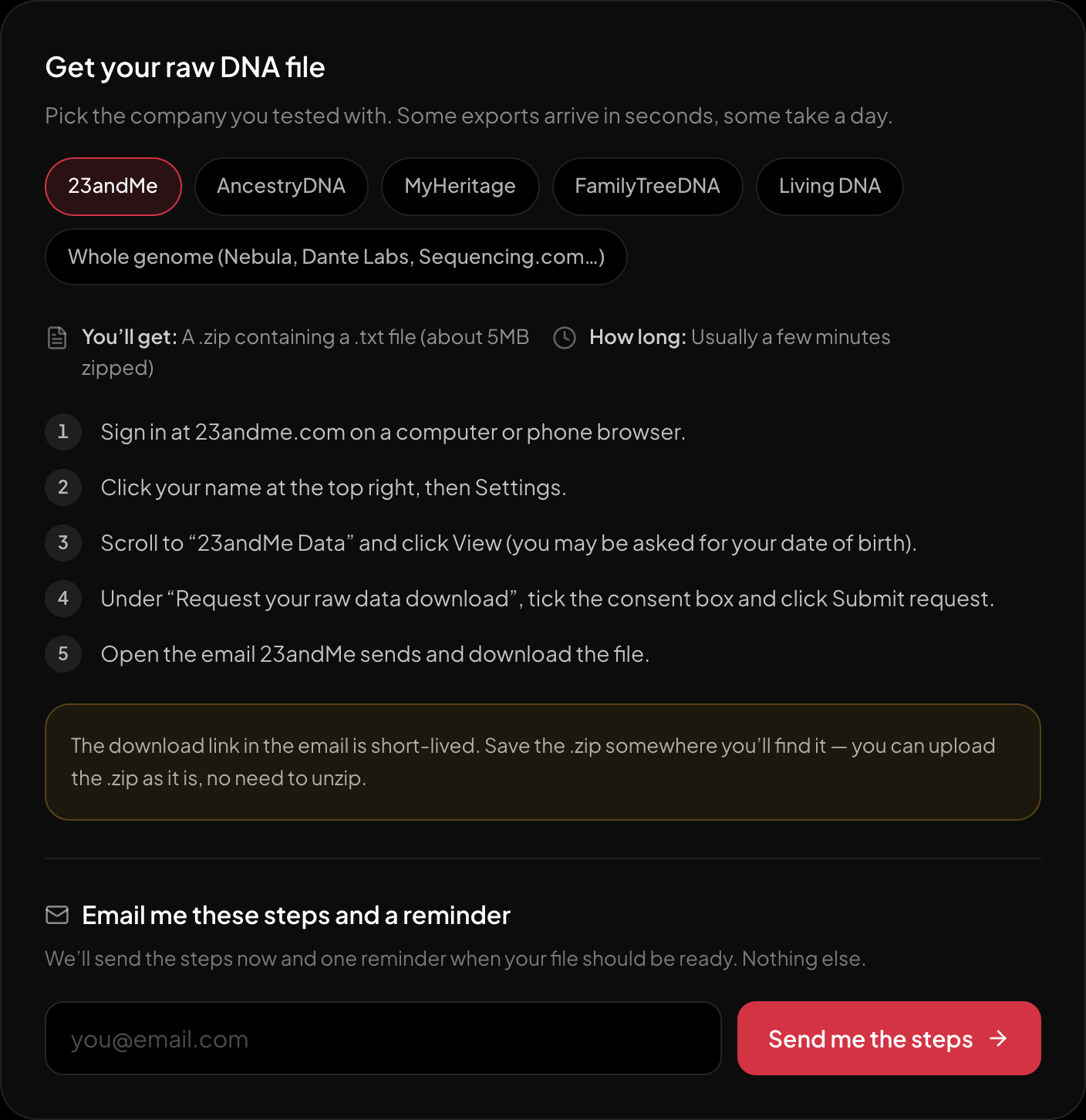
The download steps for 23andMe, on the page itself.

The short version: what is worth acting on, first.
The free DNA tool at https://healthosx.com/dna accepts 23andMe, AncestryDNA, MyHeritage and whole-genome VCF files, parses the file in the browser, includes GBA among single-variant health findings and carrier status, and opens the free full report after a one-time email code. Review any result with a clinician.
New to raw DNA files? Start with the full guide: How to Download & Analyze Your 23andMe Raw Data Free
Written by
HealthOS Research