How Do I Find My Biological Father Using DNA Matches
Work from your closest unknown DNA matches, cluster them into working grandparent-line hypotheses, and build trees until paternal clusters intersect. No surname required.
To find a biological father using DNA matches, test with a consumer DNA database that offers relative matching, such as AncestryDNA or 23andMe, then work from your closest unexplained match downward. Sort by shared centimorgans, cluster matches into working grandparent-line hypotheses, and build trees until two or more paternal clusters point at the same man or couple. You are looking for the intersection of multiple trees, not for a name.
How do I find my biological father using DNA matches?
Start by testing with a relative-matching database such as AncestryDNA if you can, then upload the raw file to MyHeritage, FamilyTreeDNA and GEDmatch. Testing with more than one database can increase the chance that a close paternal relative has already tested. The process itself works from one list: your closest unknown matches sorted by shared cM.
Your biological father is not one match. He is the point where two or more paternal clusters intersect.
The common mistake is to search for the surname of the man your mother named. Surnames change. Adoptions happen. Records are wrong. Start with DNA, not with the story.
- Open your match list and sort by shared DNA, high to low.
- For every match above about 90 cM, note shared cM, predicted relationship, age if shown, and whether they have a public tree.
- Star anyone above about 400 cM. Those matches usually share a recent ancestor close enough to work with.
- Set aside matches under about 20 cM for the first pass; they can be noisy, but they may still help later with triangulation.
Treat these thresholds as rough ranges, not cutoffs. Use shared cM as a rough map, not a hard rule. Ranges overlap, so a 1,800 cM match can be a half-sibling, an aunt, an uncle or a grandparent depending on age.
Illustrative only. Typical average shared cM by relationship; individual ranges overlap and company algorithms vary.
Test your mother or known maternal relatives first
If your biological mother is willing to test, test her. Matches who also match her are likely maternal, so the matches who do not match her are the paternal side to work on. If you cannot test her, use any known maternal relatives who have tested or ask a maternal aunt, uncle, or first cousin to test. Assign those known maternal matches to columns before you try to label the unknown columns as paternal.
Start with your closest unknown match, not with a surname
Shared cM is a rough measure of how recently you and a match share an ancestor. More shared DNA usually means fewer generations back to that ancestor. If your closest unknown match shares roughly 1,600 to 2,200 cM, you may be looking at a half-sibling, an uncle, an aunt, a grandparent or a double first cousin. Age and gender narrow it fast. A half-sibling often shares roughly 25% of your DNA. An uncle or aunt shares a similar amount but is a generation older.
A first cousin often shares roughly 550 to 1,300 cM, commonly around 850. A second cousin often shares roughly 90 to 400 cM, commonly around 230. A third cousin is often under 200 cM, commonly 70 to 90, and sometimes zero. Treat these ranges as illustrative only, because individual cases and company algorithms vary.
A paternal half-sibling should mostly share paternal matches with you and few or no maternal ones, but endogamy, pedigree collapse, small segment sizes, and company thresholds can blur side assignment. If your closest unknown match shares both your mother's and father's relatives, consider a full sibling, a double first cousin, or a pedigree-collapse scenario, not an ordinary aunt or uncle, who would usually share only one side.
Cluster the matches before you try to build trees
The Leeds method uses your matches between about 90 and 400 cM. Put each match on a row in a spreadsheet. Then group the people who share DNA with each other into columns. Shared-match lists are hints about who may match whom. They do not prove the listed people match one another, and 23andMe Relatives in Common is not a full Leeds-method cluster matrix. Use them as a starting point while you build the spreadsheet from your own match list.
Each column is a working hypothesis for one grandparent or great-grandparent line. Clusters do not always map cleanly to one grandparent, great-grandparent, or great-great-grandparent line. If you have known maternal relatives, assign them to columns first. The leftover columns may be paternal.
Do not skip this step. A list of individual matches looks random. A cluster chart shows that five scattered matches all descend from the same Ohio couple, which is the unit you actually need.
Turn shared centimorgans into a candidate position on a tree
Once a cluster appears to point to one set of great-grandparents, you have a working hypothesis that your father descends from that couple. One cluster alone is not enough. Find a second paternal cluster. If one cluster points to a Harding family in Ohio and another points to a Merton family in the same county around 1940, the candidate father is a descendant of both lines, often the child of a Harding and a Merton, or a man who connects the two through siblings. Then use age, location and paper records to test the hypothesis.
A 200 cM match might be a second cousin, so you may need to build several trees before the intersection appears. Work each cluster back to a shared ancestor, then look for a man of the right age who connects them.
What if your closest match is only a second or third cousin?
This is common. If your closest paternal match is under 400 cM, do not try to identify a father directly from that one match. Build trees for every paternal cluster above about 90 cM. Aim for four to six paternal clusters if you can, but treat each cluster as a working hypothesis, not as a clean label for one great-grandparent or great-great-grandparent line.
The candidate father sits in the gap between them. If you can identify a couple who appear in the trees of two clusters, or a man whose parents each descend from a different cluster couple, you have a strong candidate. Then contact the closest match from each cluster and ask about family lines, not about your father directly. People answer a request about a great-grandparent more readily than a request about a stranger's paternity.
If you are dealing with an endogamous community or only fourth cousins have tested, the shared cM can be too small to trust and the clusters may blur. In that case, the last confident step is to contact the matches with the most detailed trees and ask for family history, not for a direct answer.
Protect your privacy and respect consent
Use a neutral username when you test or upload. In first contact, do not share identifying details about yourself or another person, and do not start with a paternity hypothesis. Ask about family lines, documents, and trees first. Results may reveal misattributed parentage, donor conception, adoption, or other sensitive information. The other person may not know, so give people room to respond or not respond.
Confirm the candidate before you call it certain
After you identify a candidate, do not treat a tree-only intersection as proof. Test the candidate or direct descendants if possible, compare documentary records such as birth, marriage, census, and obituary records, and look for DNA amounts that fit the predicted relationship. A candidate found through intersecting trees is a hypothesis until additional DNA or documentation confirms it.
What the free DNA tool can and cannot do here
HealthOS DNA is free and does not require an account. It cannot identify a biological father, cannot produce a relative match list, cannot separate paternal and maternal matches, and cannot replace the testing company's match list or GEDmatch. It only helps interpret a raw DNA file you already have.
For trait and health reports, the file is read in the browser and does not leave your device. Ancestry is optional and uses a server; it sends only the needed markers, and deletes them unless you choose to keep the file. The trait and health processing is local to your device, while ancestry requires server processing for the markers needed for that report. HealthOS DNA does not provide a relative matching database, sequencing, or polygenic risk scores. APOE and haplogroups are not in the free report.
Choosing a file. The report is read on your own device.
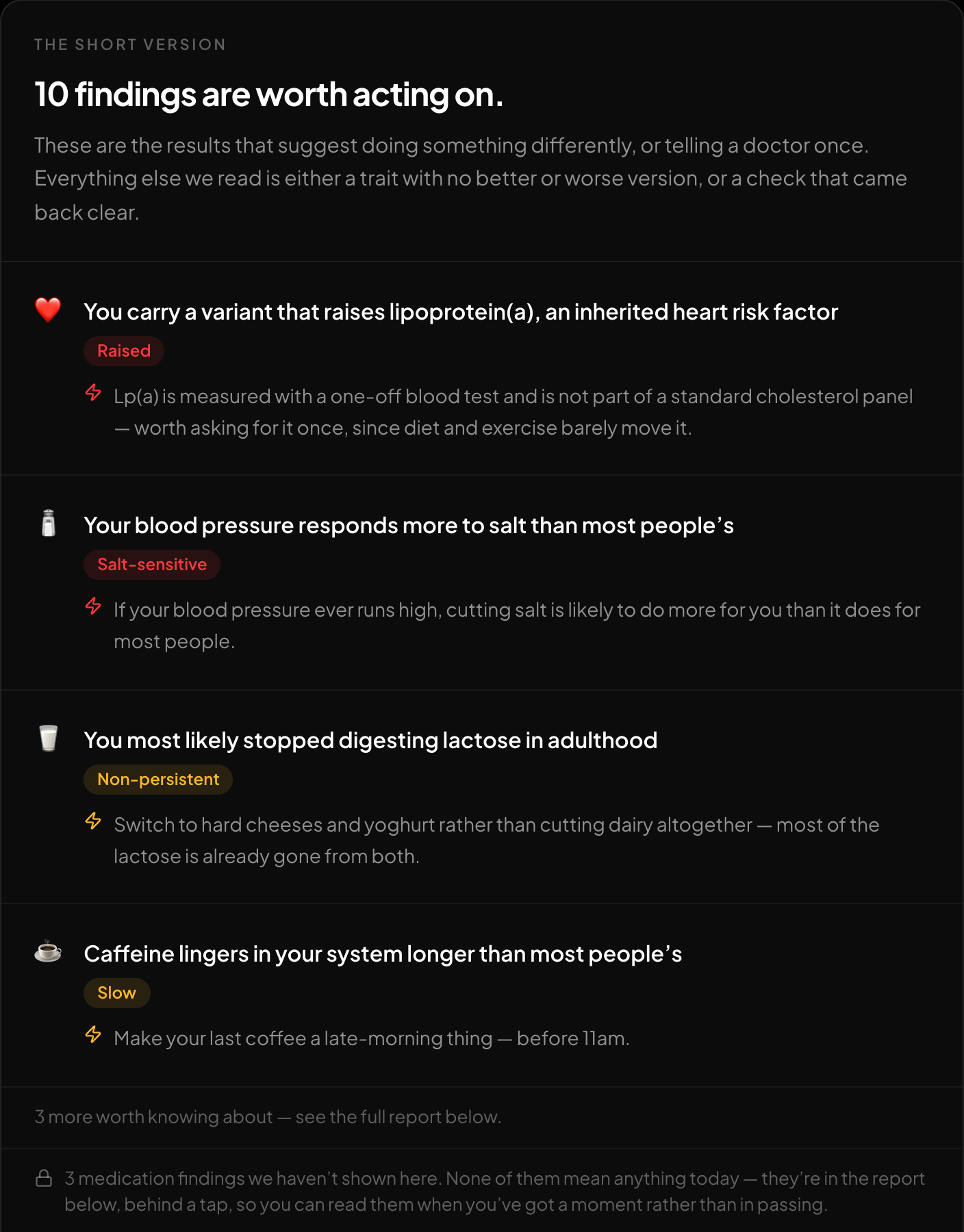
The short version: what is worth acting on, first.
For finding a biological father, you still need the testing company's own relative matching list, plus GEDmatch if you want extra matches. When you already have the raw file, you can run it through HealthOS DNA to see the trait and health report and ancestry alongside the match list you are working from. It will not replace your match list, but it can help you understand the file.
New to raw DNA files? Start with the full guide: How to Download & Analyze Your 23andMe Raw Data Free
Written by
HealthOS Research