Should You DNA Test Your Elderly Grandmother to Solve Family Mysteries?
When a match is genuinely on her side and she is two generations closer, expected sharing for the same inherited segment can be roughly fourfold as an illustration only, but recombination, low-cM false positives, and different inheritance paths can break the pattern. Test the oldest willing relative first.
If your grandmother is willing and you can afford it, yes, test her now. When a match is genuinely on her side and she is two generations closer to the shared ancestor, expected sharing for the same inherited segment can be roughly fourfold, but real segments vary widely, and recombination, low-cM false positives, or different inheritance paths can break the pattern. That extra generation is one you cannot reconstruct exactly. Her own sample cannot be replaced; later testing of siblings, children, or cousins may recover some of the same ancestral segments but not her exact genome.
Should I DNA test my elderly grandmother to help solve family mysteries?
Yes. A standard autosomal test from AncestryDNA, 23andMe, MyHeritage or FamilyTreeDNA is the right first step for almost every family mystery. The cost is worth it if you have an unsolved family mystery and no tested grandparent on that side. Her own sample cannot be replaced; later testing of siblings, children, or cousins may recover some of the same ancestral segments but not her exact genome. The reason is signal size, not sentiment. You inherited about half of your parent's DNA, and your parent inherited about half of hers, so you carry roughly 25% of your grandmother's autosomal DNA on average. As an illustration only, a match that shares 15 cM with you might share 30 cM with your parent and 60 cM with her if it is genuinely on her side, if it is the same inherited segment, and if the extra generations scale that cleanly. Recombination, low-cM false positives, or different inheritance paths can make that pattern fail. That can move a match from 'unusable noise' to 'identifiable branch'.
Autosomal DNA from a grandparent carries two extra generations of signal that may not be present in your own sample. Test the oldest willing relative first.
What a grandmother's autosomal DNA can and cannot solve
It can solve three things well.
- It can pull distant cousin matches up above the noise threshold.
- It can separate your maternal and paternal sides when she is the only tested grandparent on one side.
- It can recover DNA from a great-grandparent you never met, because she carries about half of each of her parents' genomes on average, while you carry roughly 12.5% of each.
What it will not do is hand you a name. A DNA test returns shared centimorgans and predicted relationships. You still need to build a small tree, group the matches and work out which branches overlap. It also cannot always identify which of two full brothers was her father from her sample alone. A tested grandmother can often distinguish whether her father was one of two full brothers because parent-child sharing is about 50% versus about 25% for an uncle, but certainty may require testing descendants, the mother, or targeted segment analysis.
Average autosomal sharing; real values vary.
Which test is actually useful for her
The default is an autosomal DNA test, not a mitochondrial or Y-DNA test. Autosomal DNA covers all lines. Mitochondrial DNA follows only the direct maternal line, and Y-DNA is not present in a grandmother at all.
| Test | What it traces | Use for a grandmother |
|---|---|---|
| Autosomal DNA | All ancestral lines | Yes |
| mtDNA | Direct maternal line only | Only maternal line |
| Y-DNA | Direct paternal line | No |
Scroll the table sideways for the rest →
Autosomal is the default for family mysteries. mtDNA answers only the direct maternal line, and Y-DNA is not relevant for a grandmother's sample.
AncestryDNA has one of the largest consumer genealogy match databases, especially for US/UK/European research, and database usefulness varies by country. 23andMe also gives a solid autosomal match list and health-relevant raw data. MyHeritage is worth thinking about if your family is outside the US or if you already have raw data from another company, because MyHeritage accepts uploads. FamilyTreeDNA is fine but smaller. Do not pay extra for a mtDNA test for your grandmother unless the specific question is her strict maternal line.
Why the oldest relative matters more than the most interested one
A common mistake is testing the person who asks first. The most interested person is often the youngest. The most informative person is usually the oldest. Each generation loses half the autosomal signal for any particular line. A grandparent carries segments you simply do not have, because recombination shuffled them out before they reached you. Those segments can link you to matches three or four generations further back.
The window is not about her DNA getting worse with age. Her genome does not decay. The window is about the person being alive, able to consent, and able to provide enough saliva or a cheek swab. Test only with her informed consent. Use her own email or a jointly managed login she authorizes. Discuss the possibility that DNA may reveal misattributed parentage or unexpected close relationships. Do not download or upload raw data without her permission. If she lacks capacity, follow appropriate legal and ethical guidance. Saliva collection can be harder for an older person with dry mouth or dementia, so a cheek-swab kit may be easier. If a kit fails, check whether the company offers a replacement kit or cheek-swab option before you give up.
What to do before the window closes
- Test her now only with her informed consent, and have the kit sent to her home or yours while she can still spit or swab.
- Help her set up an account with her own email or a jointly managed login she authorizes, not a forgotten password.
- Discuss the possibility that DNA may reveal misattributed parentage or unexpected close relationships before results arrive.
- Do not download or upload raw data without her permission.
- Download the raw data file only with her permission as soon as results are ready. Store a copy in two places.
- Upload the raw data to MyHeritage or FamilyTreeDNA only if she agrees and you want more match databases.
- Ask her the old questions while you are waiting: full names of grandparents, places, sibling names, who lived where.
If she has already died, options narrow but do not disappear. A saved hair sample with the root may yield DNA through a specialist lab, but it is expensive and may fail. A direct-to-consumer kit cannot use a hair sample. A better move is to test her siblings if they are alive, or her children. Do not wait because a swab now is cheaper and more reliable than any post-mortem extraction.
What you will actually see in the results
In an Ancestry or 23andMe match list, your grandmother will see matches with labels like 1st cousin, 2nd cousin and shared cM numbers. As an illustration only, a match that appears at 80 cM for her may appear at 20 cM or not at all in your own list, but real segments vary widely and small matches may not scale cleanly. That is the whole point. Downloading her raw file lets you run it through interpretation tools for the health and trait side, but it will not find relatives outside the testing company unless you upload it.
If you want to see the non-matching side of her DNA, the free tool at HealthOS /dna reads raw 23andMe, AncestryDNA, MyHeritage, FamilyTreeDNA, Living DNA, WeGene or whole-genome VCF files and reports trait and health findings. The trait and health report is read in the browser and the file does not leave the device for that report. Ancestry is optional, needs a server, sends only needed markers, and they are deleted afterwards unless the person chooses to keep the file. VCFs without rsIDs get ancestry only; the trait report needs rsIDs. It does not do relative matching, sequencing, or polygenic risk scores, and APOE and haplogroups are not in the free report; they are only available through Ask your DNA when the file is stored with consent. Use it as a way to see what else is in the file you already paid for, not as a substitute for a match database.
When not to rely on this
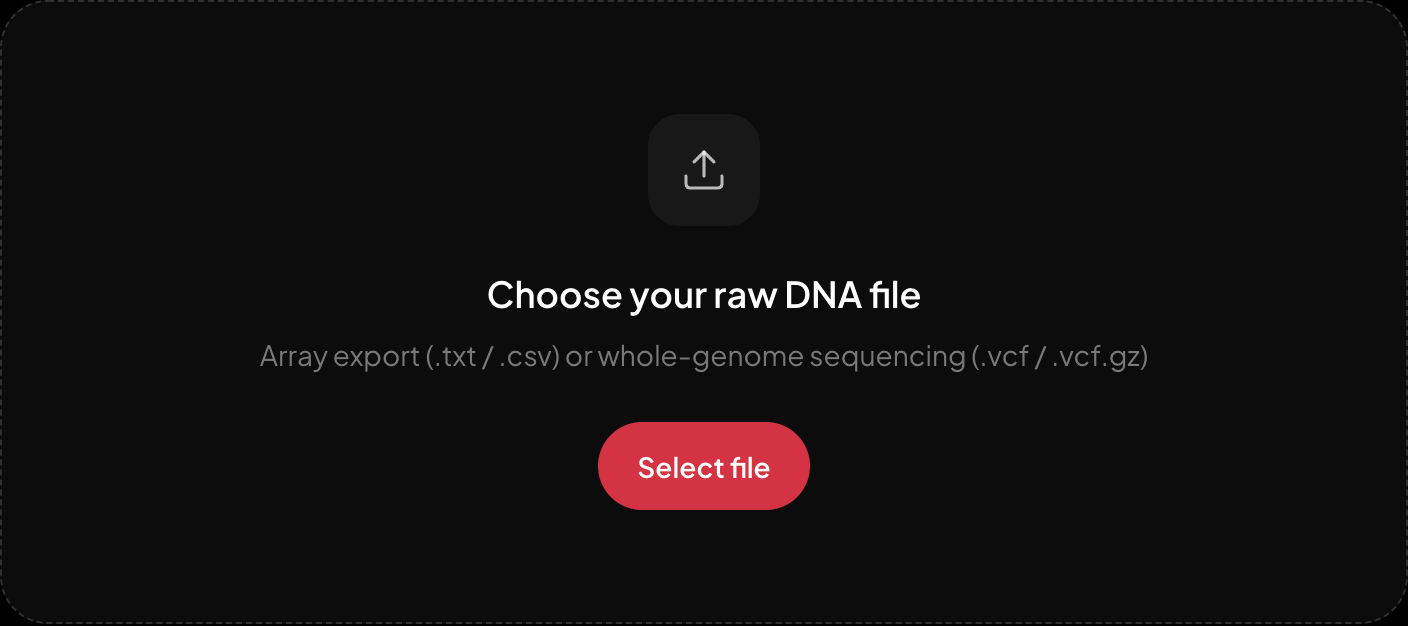
Choosing a file. The report is read on your own device.

The short version: what is worth acting on, first.
Direct-to-consumer results are not legal paternity tests and may reveal unexpected family relationships.
New to raw DNA files? Start with the full guide: How to Download & Analyze Your 23andMe Raw Data Free
Written by
HealthOS Research