Why Different DNA Testing Companies Give Different Haplogroups for the Same Person
Different haplogroup names from different DNA tests usually mean different marker coverage or tree versions, not a contradiction.
Different companies can return H and H1a1 for the same person, or J-M172 and J2a1a. The reason is not usually an error. They tested different marker sets, used different reference tree versions, or stopped at different branch depths. A mismatch like H vs H1a1 is usually the same finding at lower resolution.
Why do different testing companies give different haplogroups for the same DNA?
A haplogroup is not a single marker. It is a branch on a mutation tree. When a company says your maternal line is H, it means your mitochondrial DNA carries the mutations that sit on the H branch. When another says H1a1, it means your DNA also carries mutations that sit on a smaller branch inside H. Both can be true at once.
The same raw file or two different test kits can produce different names because the company or tool chooses where to stop. The main constraints are marker coverage, tree version, and clade resolution.
A different haplogroup name is usually the same tree seen at a different zoom level, not a different tree.
Marker coverage decides how far a test can go
A direct-to-consumer chip tests selected positions, not every base. The mitochondrial genome is 16,569 base pairs. A chip may cover only a few hundred positions in it. Whole-genome sequencing covers nearly all of it. The Y chromosome is much larger, and consumer chips also sample a sparse set of positions there.
If a chip includes markers that define H but not the extra markers that define H1a1, the honest call is H. Another company with a denser selection may see H1a1. That is not a different answer about your ancestry. It is a different depth of measurement.
The same logic applies when you upload one raw file to two different websites. The markers are already fixed in the file. If one site says H and another says H1a1, the difference is in how the sites map those fixed markers to a tree, not in what was measured.
Reference tree versions can rename the same branch
Mitochondrial haplogroups use the PhyloTree reference. Y haplogroups use the ISOGG tree. Both are updated regularly. Branches get split, merged, or moved when new sequence data arrives. A branch that had one name in an older tree can appear under a new name in a newer tree. A tool using an old tree can report H1a1, while a tool using a newer tree can report H1a1a for the same markers.
Naming systems also differ. Some services use short names like H1a1. Others label Y lines by a defining SNP. Two labels can sit next to each other on the same branch or have a parent-child relationship without being a conflict.
Shallow is not wrong, and deeper is not always better
A company can choose to report a broad haplogroup even when its raw data can see further. That is often a conservative choice. A deeper call from sparse chip data can be wrong. If a subbranch is defined by two mutations and only one is present, a tool may call it anyway. Another tool refuses. You then see H1a1 from one and H from another.
The broader call is less informative but more reliable. The deeper call is usually useful as a working hypothesis.
What does a real mismatch look like?
| What you see | What it usually means | Contradiction? |
|---|---|---|
| H vs H1a1 | One report stopped at a higher branch | No |
| H1 vs H1a1 | Parent and child branch | No |
| J-M172 vs J2a1a | Same larger lineage, different depth or naming system | No |
| H vs J | Different major maternal or paternal line | Check |
Scroll the table sideways for the rest →
Examples are real naming patterns, not diagnostic.
The common patterns are parent and child labels. H and H1a1 are not a contradiction. H1 and H1a1 are not a contradiction. J-M172 and J2a1a can be the same larger lineage reported at different depths or with different naming systems.
A real red flag is a different major letter from high-confidence results from the same raw file, like H and J. That is not a shallow-deep difference. It points to a file quality issue, a missing marker, a strand mapping problem, or a low-confidence call. Your biology did not change. The report did.
What should you do with two different results?
- Keep the broader label as the solid part. If one report says H and another says H1a1, H is the part you can lean on.
- Treat the deeper label as provisional. It can change with a new tree build or more markers.
- If the major letter differs, do not try to average them. Check the raw file quality or test with whole-genome sequencing.
- For the most stable maternal or paternal placement, a whole-genome VCF usually beats a genotyping chip because it covers nearly all of the mitochondrion and far more Y positions.
See your own maternal and paternal haplogroups from a file you already have
Choosing a file. The report is read on your own device.
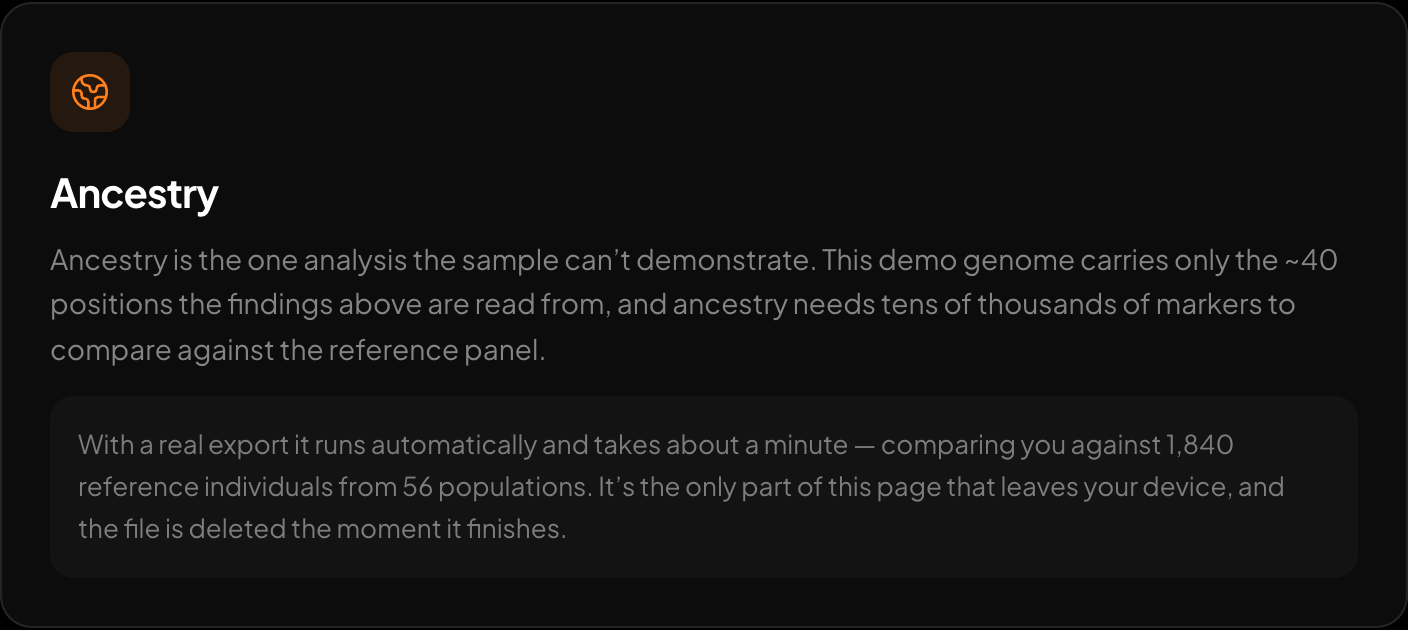
Ancestry across 15 regions and 157 reference populations.
The free DNA tool at https://healthosx.com/dna reads a raw 23andMe, AncestryDNA, MyHeritage or whole-genome VCF file in the browser and reports maternal and paternal lines on your device. It also reports traits, medication response and carrier-relevant findings, with optional ancestry. If you want to see how your own file is placed on the tree, start there.
New to raw DNA files? Start with the full guide: How to Download & Analyze Your 23andMe Raw Data Free
Written by
HealthOS Research