What CYP2C9 rs1799853 and rs1057910 Mean in My 23andMe Raw Data
CYP2C9 rs1799853 and rs1057910 in 23andMe raw data can point to reduced CYP2C9 activity for susceptible substrates, not a dose.
In your 23andMe raw data, CYP2C9 rs1799853 and rs1057910 usually mark the CYP2C92 and CYP2C93 decreased-function alleles. These alleles reduce CYP2C9 activity and are associated with reduced metabolism of susceptible substrates such as S-warfarin and some NSAIDs. This may be associated with lower warfarin dose requirements, but VKORC1, age, weight, interacting medicines, and INR measurements contribute to clinical dosing decisions.
What CYP2C9 rs1799853 and rs1057910 mean in my 23andMe raw data
CYP2C9 is a liver enzyme gene. rs1799853 is a common marker for CYP2C92. rs1057910 is a common marker for CYP2C93. The allele letters shown in a raw file can depend on strand, genome build, and phasing, so do not infer star alleles from raw letters alone. Use HealthOS as a screening headline and confirm with a clinical pharmacogenomic test for prescribing decisions.
Raw 23andMe data is usually unphased. If both rs1799853 and rs1057910 are heterozygous, the file alone cannot prove a 2/3 diplotype without phasing because it does not show which chromosome carries each marker. A definitive star-allele assignment may require phased data or a clinical pharmacogenomic test.
1 is the common working allele. 2 and 3 are decreased-function alleles. A raw file may show no decreased-function marker result, one decreased-function marker result, or two decreased-function marker results. One decreased-function allele usually means lower CYP2C9 activity than 1/*1. Two decreased-function alleles can mean markedly lower activity, but formal phenotype depends on the exact alleles and drug.
| Reduced-function marker observations | Activity interpretation | Screening implication |
|---|---|---|
| 0 reduced-function markers observed | No *2 or *3 marker seen at rs1799853 or rs1057910 | May be consistent with usual CYP2C9 activity at these markers, but rare variants are not excluded |
| 1 reduced-function marker observed | A reduced-function marker is present at one rsID; zygosity can range from one decreased-function allele to two copies at that position | CYP2C9 activity may be lower or markedly lower depending on zygosity, exact alleles, and drug; formal phenotype requires confirmation |
| 2 reduced-function markers observed | Reduced-function markers are seen at both rsIDs; phasing is needed to know how they are distributed across chromosomes | Can mean markedly lower CYP2C9 activity if two decreased-function alleles are present, but the formal phenotype depends on the exact alleles and drug |
Scroll the table sideways for the rest →
Simplified screening view. It is not a dosing table. Counts refer to marker positions with a reduced-function call, not allele copies. Heterozygosity at both rs1799853 and rs1057910 cannot prove *2/*3 without phasing.
CYP2C9 rs1799853 and rs1057910 can flag reduced CYP2C9 activity for susceptible substrates, but they do not set the dose.
What reduced CYP2C9 activity means for susceptible substrates
Warfarin is a mixture of R-warfarin and S-warfarin. S-warfarin is the stronger form and is mainly cleared by CYP2C9. CYP2C92 and CYP2C93 are associated with reduced metabolism of susceptible substrates such as S-warfarin and some NSAIDs.
Less metabolism means more active drug remains in the body for longer. For warfarin, that can push INR higher at the same dose. For NSAIDs that depend on CYP2C9, such as ibuprofen or celecoxib, slower clearance can raise exposure. The evidence is strongest for warfarin. For many painkillers, the genotype is a warning label rather than a fixed rule, because dose, duration, kidney function, stomach risk, and other medicines matter.
The common mistake is reading these two SNPs as a complete CYP2C9 answer. They are common and useful, but they do not catch every rare reduced-function CYP2C9 variant. They also say little about drugs that mainly use other pathways.
What this can and cannot say about your warfarin dose
This can suggest a direction. It cannot give a milligram dose. Do not start, stop, or change warfarin, phenytoin, NSAID, celecoxib, or other CYP2C9-substrate dosing based on this raw-data result. Discuss with a prescriber and rely on INR or clinical monitoring where relevant.
- CYP2C9 mainly answers clearance.
- VKORC1 mainly answers sensitivity.
- INR answers control.
VKORC1 is the target enzyme pathway that warfarin suppresses. A VKORC1 variant can make a person sensitive to warfarin even if CYP2C9 is normal. A person with reduced CYP2C9 activity and a sensitive VKORC1 type may have lower dose requirements, but dosing decisions come from monitoring and clinical context.
Common INR target ranges are clinical and are not derived from genotype.
Clinicians may use CYP2C9 and VKORC1 results, along with age, weight, bleeding risk, indication, interacting medicines, and INR measurements, to choose initial dosing and monitoring. The prescriber decides the final plan.
Why your 23andMe file may not produce a CYP2C9 answer
The free report only reads CYP2C9 when the file has the rsIDs it needs. That sounds obvious, but raw files are not uniform. Different 23andMe versions, exports, and genome builds can omit positions or represent them differently.
- If rs1799853 or rs1057910 is absent or no-call, the report cannot give a full CYP2C9 answer, and the absence is not a normal result.
- A raw file can have both markers without providing phased star alleles.
- A VCF without rsIDs can be useful for other analyses, but this report needs rsIDs.
A missing call is not the same as a result without reduced-function markers. A result without reduced-function markers at these two positions is also not a guarantee that every CYP2C9 function is typical, because rare variants may be absent from the chip. This limit matters when someone has unexpected INR results or a family history of unusual drug response.
Where this belongs in a health record
These markers are worth keeping with medication history, especially before warfarin, phenytoin, or regular NSAID use. They are also worth revisiting if an INR result seems hard to explain. Bring the raw marker names and the genotype. Bring the medicine list too.
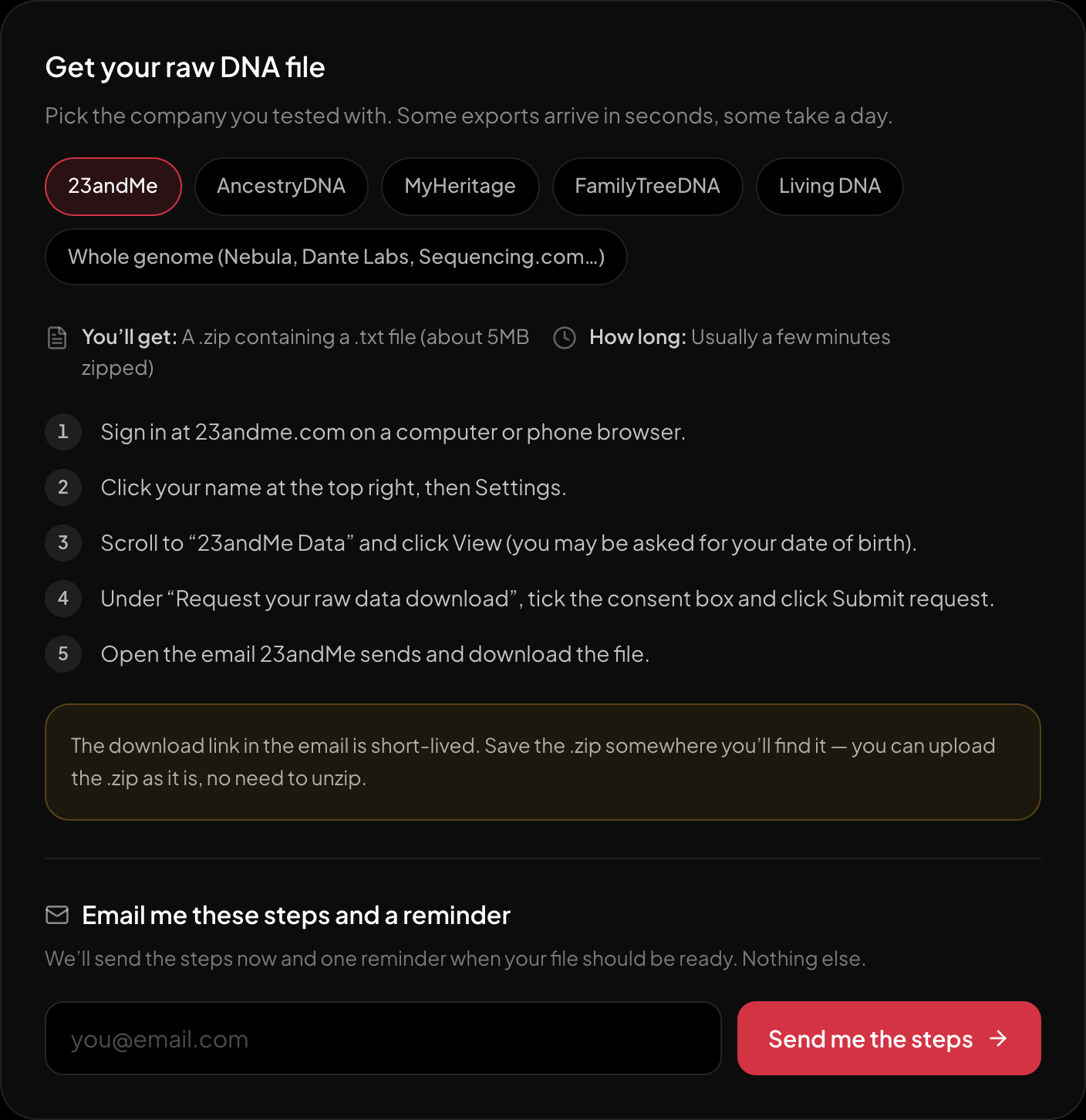
The download steps for 23andMe, on the page itself.
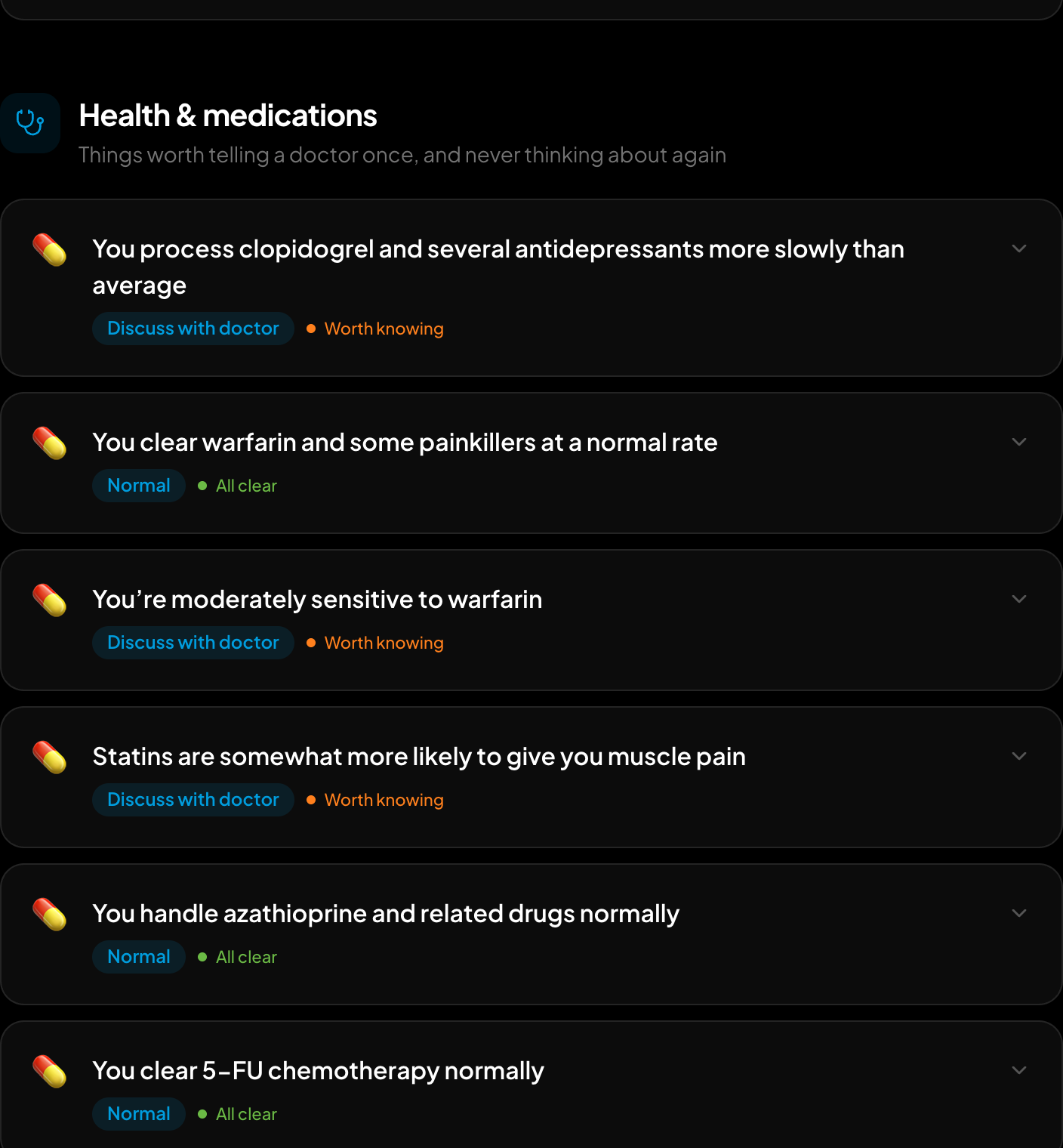
Medication genes, kept behind a tap rather than sprung on you.
The free HealthOS DNA tool browser report can show the CYP2C9 headline when required rsIDs are present. It is not a clinical pharmacogenomic diagnosis, full star-allele assignment, phased diplotype, or dosing recommendation.
New to raw DNA files? Start with the full guide: How to Download & Analyze Your 23andMe Raw Data Free
Written by
HealthOS Research