What CYP2C19 rs4244285 Means in Your 23andMe Raw Data
CYP2C19 rs4244285 is the marker for the CYP2C19*2 no-function variant. G/G means no *2 was detected at this marker, not that the whole gene is normal. A/G or A/A may be relevant for clopidogrel and some antidepressants, but a full panel is needed.
CYP2C19 rs4244285 is the marker for the common CYP2C192 no-function variant. In a 23andMe raw file, G/G means no CYP2C192 allele was detected at this marker, not that the whole CYP2C19 gene is normal. A/G means one CYP2C192 allele is present at this marker. A/A means two CYP2C192 alleles are present at this marker. Other CYP2C19 variants such as 3, 4, or 5 are no-function alleles, and 17 is an increased-function allele; none are covered by this single marker. This may affect how you clear clopidogrel, omeprazole-class drugs, and several antidepressants, but medication decisions need more than a raw-data SNP.
What does CYP2C19 rs4244285 mean in my 23andMe raw data?
rs4244285 is a one-letter change in the CYP2C19 gene. At rs4244285 the G base is the base seen with the normal-function CYP2C191 reference sequence, but it does not prove the whole allele is functional. The A base defines CYP2C192, a common no-function version in many populations. Mechanistically, the A change creates a bad splice signal, so the gene makes a shortened enzyme that the body cannot use.
Because you have two copies of the gene, the raw data gives a three-way result at this marker:
| Genotype at rs4244285 | CYP2C19*2 alleles | What this marker alone suggests |
|---|---|---|
| G/G | Zero *2 alleles detected | No CYP2C19*2 variant at this marker; other CYP2C19 variants may still be present |
| A/G | One *2 allele detected | One no-function CYP2C19*2 allele; full panel needed for diplotype |
| A/A | Two *2 alleles detected | Consistent with two *2-defining alleles at this marker; a full panel or clinical report is needed to confirm phenotype |
Scroll the table sideways for the rest →
This marker detects CYP2C19*2 only. It does not assign a full CYP2C19 diplotype. Assumes a standard G/A strand call; reverse-complement displays may show C/T.
23andMe raw files usually have a genotype field with two letters, such as G/G, A/G, or A/A. Raw lines may also show GG, AG, or AA without slashes. Reverse-strand displays may show CC, CT, or TT. Do not translate strand without checking the testing company's orientation or a verified source. This single SNP cannot assign a full CYP2C19 star-allele diplotype. G/G may be 1/1, 1/17, or another non-2 combination. A/G and A/A also need a full CYP2C19 panel to assign the complete diplotype, because variants such as 3, 4, or 5 may change the interpretation, and *17 is an increased-function allele that this marker does not detect. A clinical lab report often says normal, intermediate, or poor metabolizer instead of showing raw bases.
Some displays may use reverse-complement letters such as C/T, and the orientation may not be obvious. Do not guess if the orientation is unclear.
G/G at rs4244285 means no CYP2C192 was detected at this marker. A/G means one 2 allele at this marker. A/A means two *2 alleles at this marker. A full CYP2C19 panel is needed to assign a clinical metabolizer status.
What actually changes with clopidogrel
Clopidogrel is a prodrug. It does nothing until CYP2C19 converts it to the active form that blocks platelet P2Y12 receptors. If you carry one or two CYP2C19*2 alleles, the conversion is slower and less complete.
CPIC guidance for clopidogrel is context-dependent, especially for acute coronary syndrome or percutaneous coronary intervention. In people with CYP2C19 intermediate or poor metabolizer status, prescribers may consider prasugrel or ticagrelor instead of clopidogrel when the clinical situation supports it. This is not a universal recommendation for every setting. A prescriber should decide whether an alternative P2Y12 inhibitor is appropriate. Do not stop, start, or change medication based only on a raw-data SNP.
On a lab test, reduced clopidogrel activation can show up as low active metabolite or high platelet reactivity on a platelet function test. The raw genotype is a screening signal, but a clinical lab panel confirms it before changes.
Omeprazole, esomeprazole, and the other PPIs
CYP2C19 also clears omeprazole, esomeprazole, lansoprazole, and, to a lesser extent, pantoprazole. Two CYP2C19*2 alleles at this marker suggest slower clearance, so a standard dose may produce higher drug levels and stronger acid suppression than expected, but a full panel is needed because other variants can change this.
This is usually not an emergency. Low magnesium, B12 deficiency, and fracture risk are long-term PPI concerns or associations, not established consequences of this genotype alone. Dose, duration, indication, kidney and liver function, and drug interactions all matter. Short courses are usually tolerated.
One thing people get wrong: higher omeprazole levels are not always bad. In H. pylori eradication, people with reduced CYP2C19 function often get better acid control from omeprazole-based regimens, which can improve cure rates. The same variant that complicates clopidogrel can help here.
Antidepressants: why the same dose hits differently
Citalopram and escitalopram depend heavily on CYP2C19 for clearance. Sertraline, amitriptyline, clomipramine, and imipramine also use it, but to varying degrees. Two CYP2C19*2 alleles may lead to higher drug levels at the same dose, which can increase side-effect concerns such as nausea, drowsiness, or QTc prolongation risk for citalopram, but dose, duration, kidney and liver function, and other drugs matter.
Pharmacogenetic guidance suggests a lower starting dose for citalopram or escitalopram in CYP2C19 poor metabolizers, often 50% of the usual starting dose, or choosing an alternative with less CYP2C19 dependence. One *2 allele can make someone an intermediate metabolizer, but dosing depends on the full phenotype, drug, indication, and prescriber judgment.
| Drug class | Possible effect with two *2 alleles | Practical question |
|---|---|---|
| Clopidogrel | Reduced active metabolite and weaker platelet inhibition expected; CPIC guidance may suggest an alternative P2Y12 inhibitor in ACS or PCI | Ask prescriber whether prasugrel or ticagrelor is appropriate |
| Omeprazole / esomeprazole | Higher drug levels and stronger acid suppression possible | Long-term dose review with prescriber |
| Citalopram / escitalopram | Higher drug levels at standard dose possible | Ask about lower starting dose or alternative |
Scroll the table sideways for the rest →
A/A means two CYP2C19*2 alleles are detected at this marker. Clinical interpretation requires a full CYP2C19 panel.
Where a raw file cannot replace a lab test
A 23andMe or AncestryDNA file is not a clinical CYP2C19 test. It usually reads rs4244285, which tags 2, but it may not report 3, 4, 5, rare loss-of-function variants, or the increased-function *17 allele. A lab panel covers more of the gene. Raw files can also have no-calls, wrong calls, or strand differences. If the result is A/A or A/G and a medication decision depends on it, get a confirmatory CYP2C19 test from a lab that offers clinical reporting.
This is one gene in a larger picture. Kidney function, liver disease, other drugs, and drug interactions can matter as much as CYP2C19. The genotype tells you about one clearance pathway, not the whole drug response.
What to do with the result
- A/A at this marker and clopidogrel: ask the prescriber whether prasugrel or ticagrelor is appropriate in your setting.
- A/A at this marker and citalopram or escitalopram: ask about a lower starting dose before starting or changing dose.
- A/G: lower concern than A/A, but still relevant for clopidogrel.
- G/G: no 2 was detected at this marker, but other no-function variants such as 3 would not show up in this single marker.
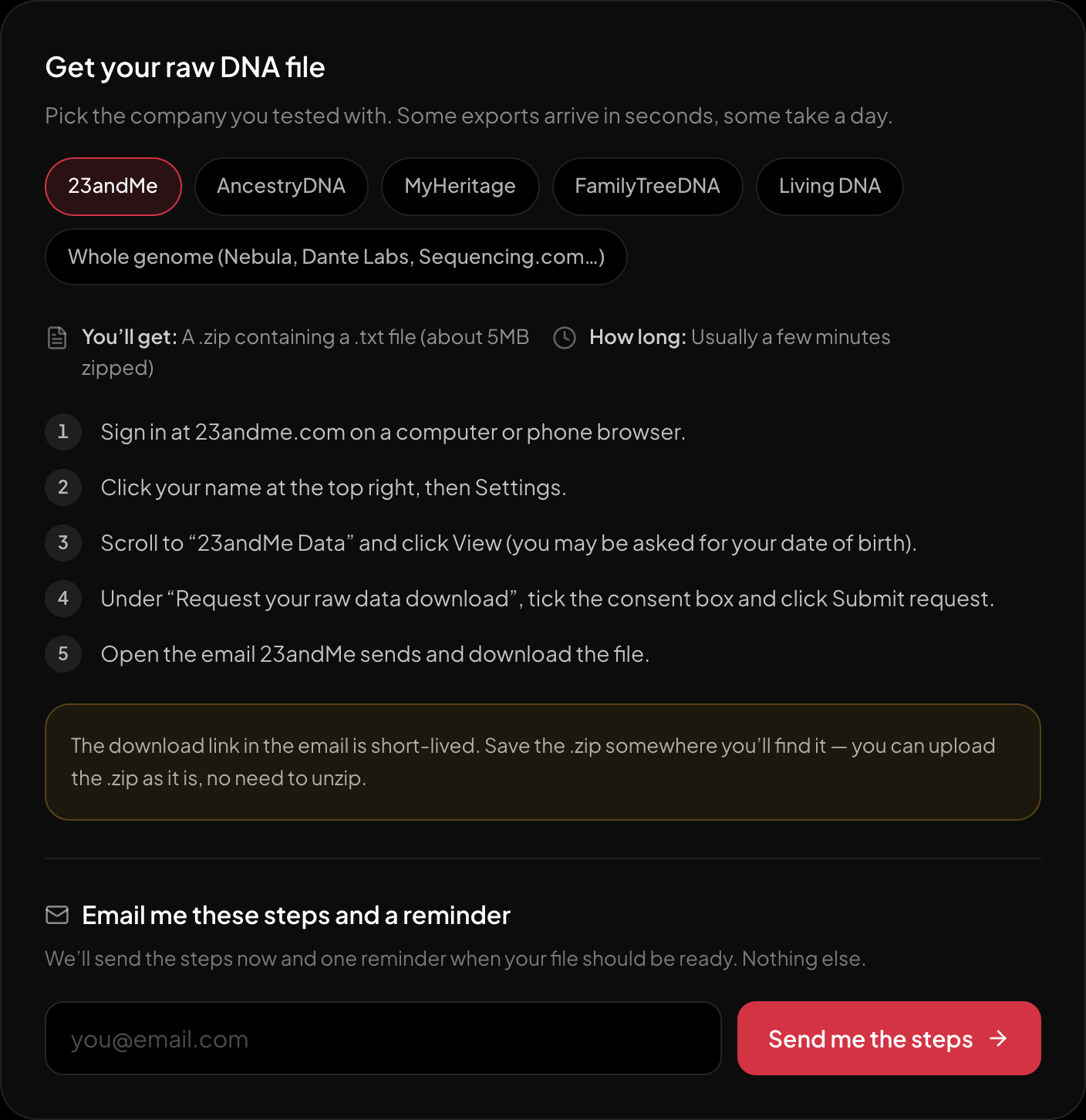
The download steps for 23andMe, on the page itself.
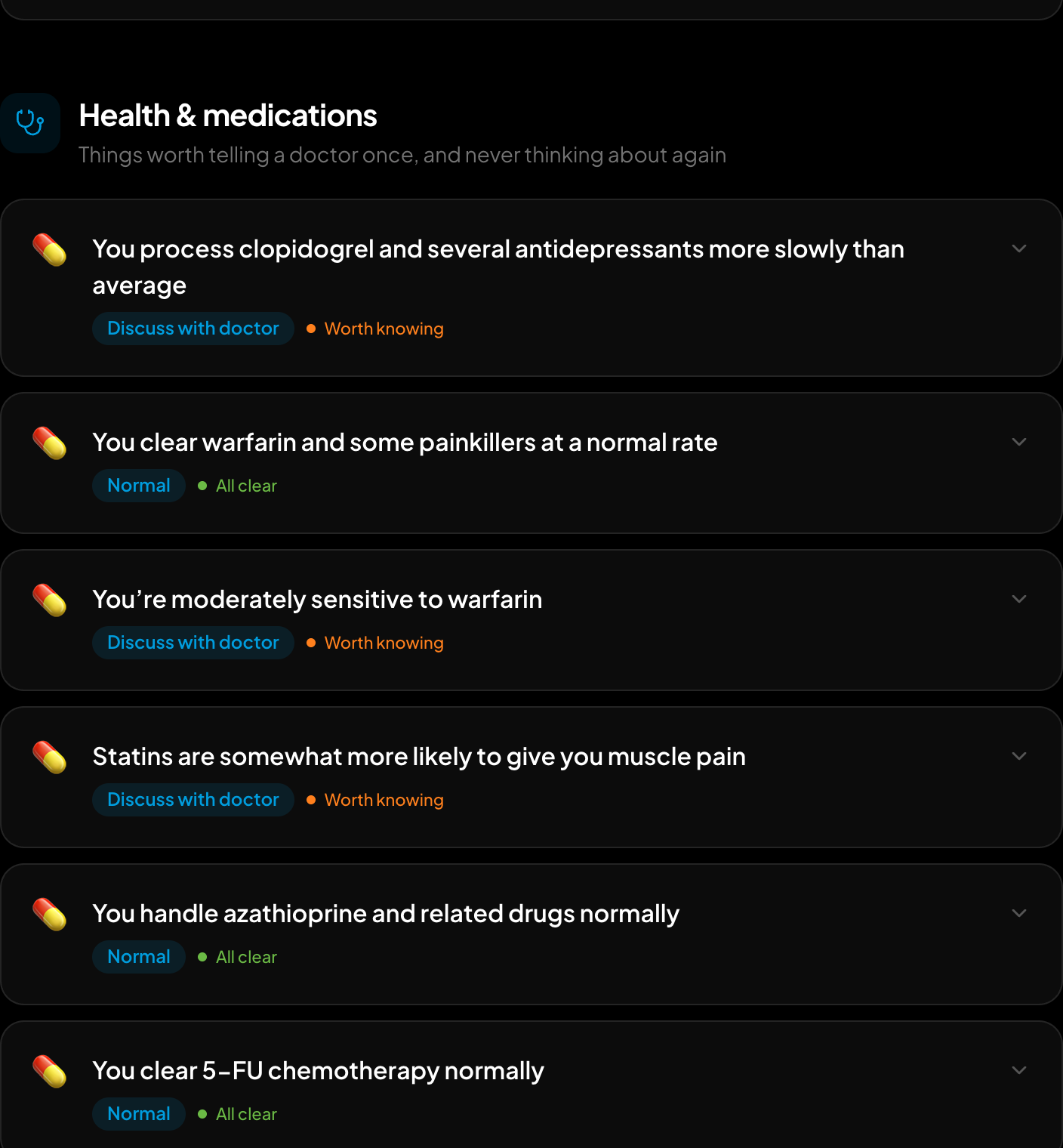
Medication genes, kept behind a tap rather than sprung on you.
To see this variant in your own file, upload it to the free HealthOS DNA tool at https://healthosx.com/dna. It can read 23andMe, AncestryDNA, MyHeritage, or whole-genome VCF data in the browser. Medication-response findings require named variants or rsIDs; whole-genome VCFs with '.' in the ID column may only support ancestry unless annotated. The story needs no account. The full report opens with a one-time email code and is not diagnostic.
New to raw DNA files? Start with the full guide: How to Download & Analyze Your 23andMe Raw Data Free
Written by
HealthOS Research