Caffeine Metabolism and CYP1A2: Are You a Fast or Slow Metabolizer?
One position in CYP1A2, rs762551, separates fast from slow caffeine metabolizers, and every consumer DNA file reads it. What AA, AC and CC mean, how strong the evidence is, and what to change.
Free gene check
Check it in your own file
Drop your raw DNA file here and see which row of this guide is yours. It is read in your browser and never uploaded.
Choose or drop your raw DNA file
.txt · .csv · .zip · .vcf · .vcf.gz
Your caffeine metabolism gene is CYP1A2, and the position consumer DNA files read is rs762551. AA means a fast metabolizer, AC intermediate, CC slow: caffeine lingers longer, so an afternoon coffee is more likely to still be active at bedtime. 23andMe, AncestryDNA, MyHeritage and other exports all include it. The free report at healthosx.com/dna reads it in your browser, alongside the separate genes that shape how much coffee you're drawn to drink.
What CYP1A2 does
CYP1A2 is the liver enzyme that clears about 95% of the caffeine you drink. How quickly it works sets how long caffeine stays in your blood. Caffeine's half-life is typically around 5 hours, but it ranges from about 2 to 10.
The rs762551 A allele (known as CYP1A2*1F) makes the enzyme more inducible: its activity rises more in response to things like smoking and some foods. People with AA clear caffeine fastest. People with C alleles, especially CC, clear it more slowly.
| Your genotype | Metabolizer | What it means in practice | A sensible cut-off |
|---|---|---|---|
| AA | Fast | Caffeine clears quickly; the enzyme is highly inducible | Later than most people — if you sleep badly, caffeine is less likely to be why |
| AC | Intermediate | About average clearance | Early afternoon, around 2pm, then watch your sleep |
| CC | Slow | Caffeine lingers; an afternoon coffee can still be working at bedtime | Late morning, before about 11am |
Scroll the table sideways for the rest →
Moderate-confidence finding: smoking, pregnancy, oral contraceptives and some medicines shift caffeine clearance as much as this variant does.
How strong is the evidence?
It's moderate, which is why we treat this finding as moderate confidence and not high.
- The best-known study (Cornelis et al., JAMA 2006) found that among slow metabolizers, drinking 2 to 3 or more cups a day was linked to a higher risk of heart attack, while fast metabolizers who drank 1 to 3 cups showed no increase, and possibly lower risk.
- Other studies link slow metabolism with blood-pressure effects and, in athletes, a smaller performance boost from caffeine.
- The genotype isn't the whole story. Smoking speeds CYP1A2 up a lot. Pregnancy, oral contraceptives, some medicines (fluvoxamine and ciprofloxacin, for example) and liver function slow it down. Those can outweigh your genes.
Two different coffee genes
People often confuse how fast you clear caffeine with how much coffee you drink. They're separate:
- Clearance: CYP1A2 rs762551
- Consumption: variants near AHR (rs4410790) and CYP1A1/CYP1A2 (rs2472297) are linked in large studies with drinking more coffee. People with the "heavy" versions tend to clear caffeine efficiently and top up more.
The /dna report reads both, which explains a common surprise: "I drink a lot of coffee but I'm told I'm a slow metabolizer."
We don't report ADORA2A (the "caffeine and sleep" gene) or the CLOCK chronotype variant: we couldn't pin down a reported effect allele for them in the sources we validate against, and a trait we can't source is worse than a missing one.
What to do with your result
- CC (slow): make your last coffee a late-morning one, before about 11am, and watch whether your sleep improves. If you have high blood pressure, it's worth keeping to a couple of cups.
- AC (intermediate): an early-afternoon cut-off, around 2pm, is a sensible experiment.
- AA (fast): your cut-off can probably sit later. If you sleep badly anyway, caffeine is less likely to be the reason.
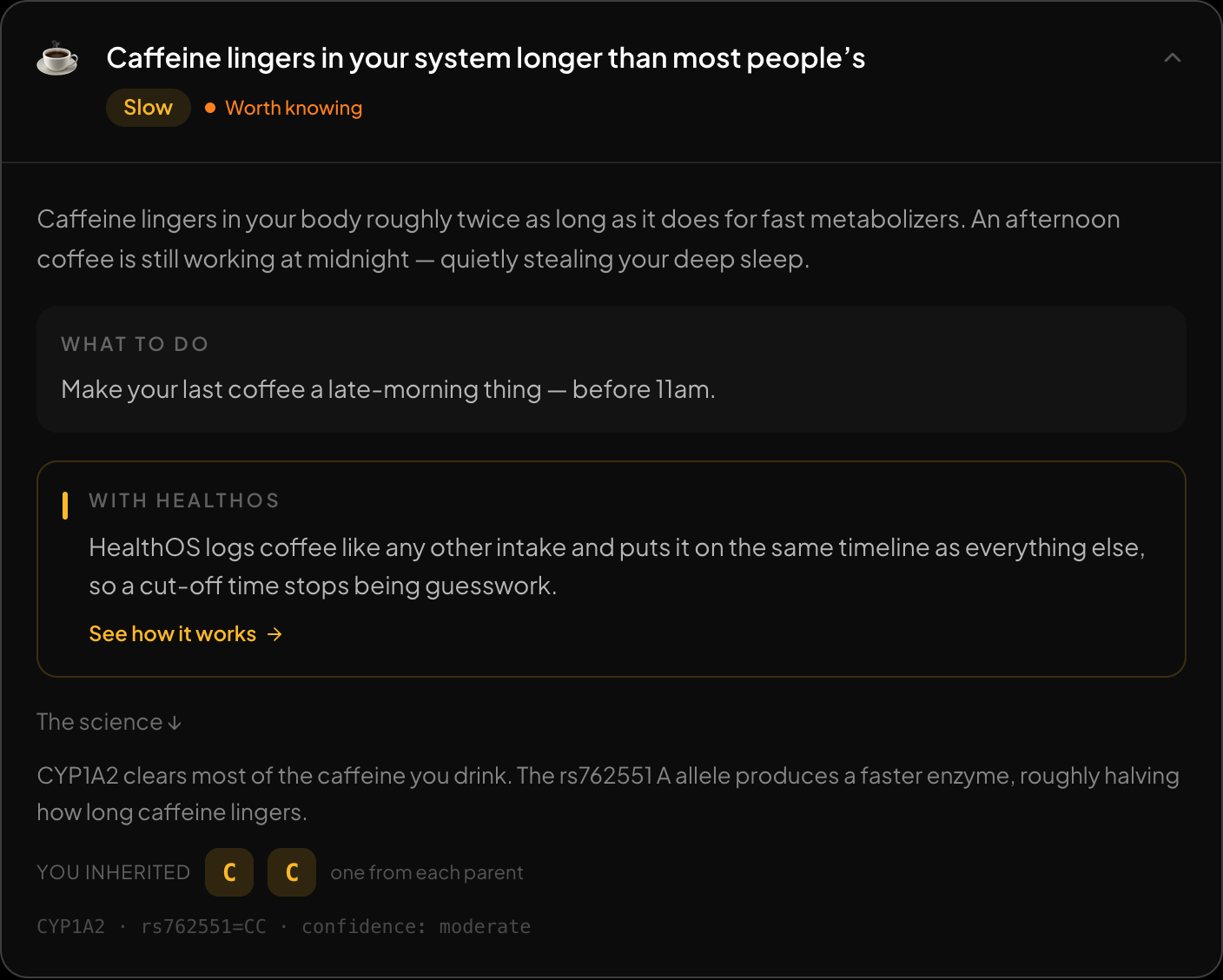
Every finding opens up: what it means, what to do, and the genotype behind it.

The short version: what is worth acting on, first.
How to test it on yourself in two weeks
Genetics gives you a prior; your own sleep settles it. The cheapest experiment there is:
- 1.Week one: keep your coffee habit exactly as it is, and note when you fall asleep and how rested you feel.
- 2.Week two: move your last caffeine of the day to before 11am. Keep everything else the same, including the number of cups.
- 3.Compare. If week two is noticeably better, the genotype was telling you something. If nothing changes, caffeine wasn't your sleep problem, and that's worth knowing too.
The reason this works better than trusting the result alone: caffeine's effect on sleep is often invisible while you're awake. Slow metabolizers usually fall asleep fine and get lighter, less restorative sleep, with no obvious cause to blame.
Things that change your caffeine clearance more than your genes
- Smoking speeds CYP1A2 up substantially, so quitting effectively raises your caffeine levels on the same number of cups.
- Pregnancy slows clearance dramatically, which is part of why intake limits are advised.
- Oral contraceptives slow it, roughly halving clearance in some studies.
- Some medicines — fluvoxamine, ciprofloxacin — are strong inhibitors.
- Cruciferous vegetables and chargrilled food induce the enzyme mildly.
FAQ
Does this mean coffee is bad for me?
No. Coffee is associated with neutral-to-favourable outcomes in most large studies. The genotype is about timing and dose, not about whether to drink it.
What about jitters and anxiety?
Those track adenosine-receptor genetics more than clearance. We don't report ADORA2A, because we couldn't pin down a defensible effect allele for the positions consumer files carry.
Is decaf caffeine-free?
Not quite — a cup holds a small fraction of a regular one's caffeine. It rarely matters unless you're very sensitive and drinking several late.
Find out whether coffee lingers in you, free, from your raw file: healthosx.com/dna
New to raw DNA files? Start with the full guide: How to Download & Analyze Your 23andMe Raw Data Free
Common questions
- How do I know if I metabolize caffeine fast or slow from my raw DNA data?
- Look up rs762551 in the CYP1A2 gene. AA means a fast metabolizer, AC intermediate and CC slow, so caffeine stays active longer. 23andMe, AncestryDNA, MyHeritage and other exports include it, and healthosx.com/dna reads it free in your browser. Smoking speeds CYP1A2 up, while pregnancy, oral contraceptives and some medicines slow it, and those can outweigh the genotype.
- Is caffeine metabolism the same as how much coffee I drink?
- No. How fast you clear caffeine is CYP1A2 rs762551. How much coffee you drink is linked to variants near AHR (rs4410790) and CYP1A1/CYP1A2 (rs2472297). The /dna report reads both.
- How strong is the evidence for CYP1A2?
- Moderate. The best-known study (Cornelis et al., JAMA 2006) linked 2 to 3 or more cups a day with a higher risk of heart attack in slow metabolizers but not in fast ones. Other studies link slow metabolism with blood-pressure effects.
No raw DNA file yet?
Get a HealthOS DNA Kit: spit in a tube at home, and your ancestry, lineages and traits arrive in your HealthOS account, with the raw file.
See the DNA kitReferences
- 1.Cornelis MC et al. Coffee, CYP1A2 genotype, and risk of myocardial infarction. JAMA 2006
- 2.Cornelis MC et al. Genome-wide meta-analysis identifies regions on 7p21 (AHR) and 15q24 (CYP1A2) as determinants of habitual caffeine consumption. PLoS Genet 2011
For informational purposes only. For medical advice or diagnosis, consult a professional.
Written by
HealthOS Research