What CFH Y402H and ARMS2 A69S Mean in Your 23andMe Raw Data
What CFH Y402H and ARMS2 A69S actually mean in your 23andMe raw data: the genotypes, the real risk numbers, and why smoking multiplies both.
Your 23andMe macular degeneration result comes down to two markers in the raw file: CFH Y402H (rs1061170) and ARMS2 A69S (rs10490924). Neither is a diagnosis. They are common variants that shift your lifetime risk of age-related macular degeneration (AMD) up or down by a few fold each, and smoking multiplies whatever the genes hand you.
What does my 23andMe macular degeneration result mean?
The 23andMe report rests on those two SNPs, and both sit in current 23andMe raw data exports whether or not the app shows you the health report. Search the raw text file for rs1061170 and rs10490924 and you will find a two-letter genotype for each.
The letters trip people up. For CFH the risky genotype is CC; for ARMS2 it is TT. There is no rule that one letter is bad everywhere. The risk allele is simply different at each marker, because each marker changes a different protein. What you would see, and what each combination means:
| Marker | Raw data letters | What it means | Approximate odds |
|---|---|---|---|
| CFH Y402H (rs1061170) | TT | Two tyrosine copies, typical | 1x |
| CFH Y402H (rs1061170) | CT | One histidine copy | ~2-3x |
| CFH Y402H (rs1061170) | CC | Two histidine copies | ~4-6x |
| ARMS2 A69S (rs10490924) | GG | Two alanine copies, typical | 1x |
| ARMS2 A69S (rs10490924) | GT | One serine copy | ~2-3x |
| ARMS2 A69S (rs10490924) | TT | Two serine copies | ~7-8x |
Scroll the table sideways for the rest →
Approximate odds vs the typical genotype, from large European-ancestry studies.
What the risk attaches to: AMD is a slow breakdown of the macula, the central patch of retina you use for reading and for faces. Early AMD means drusen, yellow deposits under the retina, and usually no symptoms. Late AMD comes in two forms: dry, a gradual loss of retinal cells, and wet, where fragile new vessels leak and can take central vision in weeks. It is the commonest cause of irreversible sight loss in over-60s in developed countries, and the odds climb steeply with age, rising roughly three to four fold each decade past 60.
CFH Y402H weakens an immune brake in the retina
CFH makes complement factor H, the off-switch for part of the immune system called the complement cascade. Complement patrols your blood and tags foreign cells for destruction. Factor H stops it tagging your own cells: it coats self surfaces and shuts the cascade down where it lands.
The retina leans on this hard. Under the photoreceptors sits a thin sheet called Bruch's membrane, and the Y402H change, a single amino acid swap, makes factor H grip that layer less well. The result is not disease. It is slightly weaker immune control in one tissue for your whole life. Drusen are packed with complement proteins; they are, fairly literally, the debris of that chronic low-grade inflammation.
The numbers: one C allele roughly doubles or triples the odds of AMD, and two copies raise them about four to six fold. The C allele rides on about 36% of European chromosomes, so around 6 in 10 Europeans carry at least one. It is far rarer in East Asian and African ancestry.
ARMS2 A69S: the stronger signal, the murkier mechanism
ARMS2 is the more powerful marker and the less understood gene. Its T allele raises odds two to three fold per copy, and two copies reach around seven or eight fold, the largest effect of any common AMD variant.
The honest caveat: nobody fully agrees what ARMS2 does. Early work placed its protein in photoreceptor mitochondria, later work argues it acts in the tissue matrix outside cells, and A69S sits in near-perfect linkage with a variant in the neighbouring HTRA1 gene that many researchers think is the real driver. For your raw file this changes nothing about the number. It is a reminder that genetic association runs ahead of biological explanation.
The T allele sits on about 20% of European chromosomes, so just over 1 in 3 Europeans carry one. How that adds up across the two genes:
Computed from the cited European allele frequencies (0.36 for CFH C, 0.20 for ARMS2 T) under independence between the two loci; the 74% either-gene value is derived, not measured.
The two loci stack, multiplying rather than adding. People homozygous for risk at both have shown odds around 40 to 50 times the lowest-risk combination in some analyses. That sounds grim until you remember the baseline: 50 times a small lifetime risk is a much bigger number, not a certainty.
Most people who carry these alleles never develop macular degeneration. The genes load the dice; age and smoking decide how often you roll.
Smoking stacks on top of both
Smoking is the largest modifiable risk for AMD, roughly two to four fold on its own, and it multiplies genotype rather than adding to it. Studies that looked at both together found smokers carrying two CFH risk copies with risks 20 fold or more above non-smokers with none.
The mechanism ties the story together. Cigarette smoke activates the complement system and burns through the antioxidants, vitamin C especially, that help keep it in check. Factor H is the brake on that same system. A weaker brake from CFH plus a heavier foot from smoke, on the same pathway, in the same tissue.
The risk alleles are fixed. The smoking multiplier is not, and former smokers' risk falls substantially within years of quitting.
What you can actually do about it
- Do not smoke. If you do, quitting beats everything else on this list.
- Get a dilated eye exam and mention the genotype plus any family history. Early AMD is visible in the retina years before symptoms.
- Glance at an Amsler grid (a free grid of straight lines) every month or so. Lines going wavy or a grey patch means wet AMD until proven otherwise. Wet AMD is treatable with anti-VEGF injections that stop the leaking vessels, but the window is weeks, so sudden distortion is an urgent appointment.
- Eat the boring pattern: leafy greens and oily fish a few times a week. Lutein and zeaxanthin concentrate in the macula, the trial evidence for prevention is modest, and the downside is nil.
The supplement question: the original AREDS trial found that a high-dose formula (vitamins C and E, beta-carotene, zinc, copper) cut progression from intermediate to advanced AMD by about 25% over five years versus placebo.
AREDS2, the follow-up, had no placebo arm and its primary add-on analyses were null; its contribution was a reformulation, swapping beta-carotene for lutein and zeaxanthin, the mix now sold as AREDS2.
That benefit was in people who already had intermediate AMD on examination. It has not been shown to prevent AMD in people with clear retinas, so a risk genotype alone is not a reason to take it. Smokers and ex-smokers should skip the old beta-carotene version, which raised lung cancer risk in trials, the reason AREDS2 swapped it out. Worth asking an eye doctor about rather than self-prescribing.
Two honest limits. First, two loci are not the whole genome: dozens of smaller variants contribute, so a clean result is not zero risk. Second, the risk maths comes mostly from European-ancestry studies, and the estimates transfer less well to other ancestries. CFH C is indeed rare outside European ancestry, but ARMS2 T breaks that pattern: it is common in East Asians, on roughly 40% of chromosomes, higher than in Europeans. If your ancestry is not European, the tidy odds above are rougher guides than they look.

The download steps for 23andMe, on the page itself.
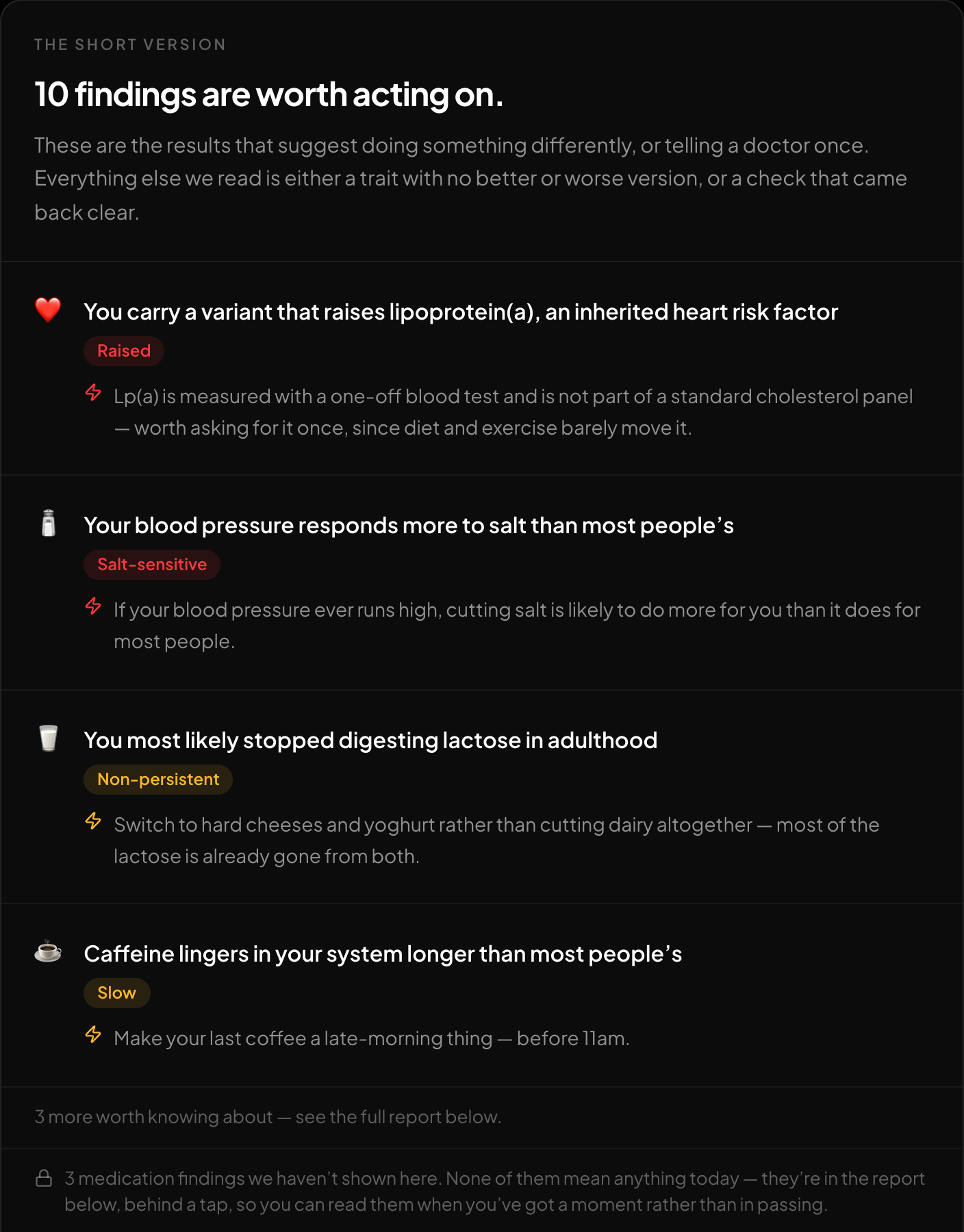
The short version: what is worth acting on, first.
If you would rather not search a text file by hand, the free HealthOS DNA report at healthosx.com/dna reads both loci for you. Upload a 23andMe, AncestryDNA or MyHeritage export, or a whole-genome VCF, and it parses in your browser with nothing uploaded, reporting macular degeneration alongside other single-variant health findings, traits and medication response (health findings, including macular degeneration, require an rsID-annotated VCF; a raw GATK or Sentieon VCF with '.' in the ID column gets ancestry only). Two minutes with your raw file beats an evening of forum threads.
New to raw DNA files? Start with the full guide: How to Download & Analyze Your 23andMe Raw Data Free
Written by
HealthOS Research