Can MTHFR or Methylation Problems Cause Anxiety or OCD?
Common MTHFR and COMT variants are not established causes of anxiety or OCD and cannot diagnose them. They can affect folate processing and neurotransmitter clearance; here is what the data actually shows.
Common MTHFR and COMT variants are not established causes of anxiety or OCD and cannot diagnose them. A raw DNA file can show the genotype; it cannot show the disorder.
If you have severe anxiety, panic, functional impairment, suicidal thoughts, or acute distress, seek urgent clinical care. This post is not a substitute for emergency evaluation.
Can MTHFR or methylation problems cause anxiety or OCD?
Not in the way the question usually means. This discussion covers common MTHFR variants such as C677T and A1298C and the common COMT Val158Met variant. Rare severe folate or methylation disorders can cause neuropsychiatric symptoms and need specialist evaluation; a standard raw DNA file is not a diagnostic test for those rare conditions.
MTHFR is an enzyme that converts dietary folate into 5-methyltetrahydrofolate. That form donates a methyl group to homocysteine, with vitamin B12 as a cofactor, to form methionine. Methionine becomes SAM, the main methyl donor in the cell. If you have the common C677T or A1298C variant, the MTHFR enzyme is less efficient. In the lab that shows up as slower conversion. In a blood test it may show up as lower active folate or higher homocysteine when folate intake is low.
COMT sits downstream. It uses SAM to methylate and clear dopamine and noradrenaline, especially in the prefrontal cortex. The common Val158Met variant changes that clearing speed. That is a real biochemical difference. But a slow or fast COMT is not a measure of anxiety or OCD. Brain circuits have too many other controls.
The popular idea that anxiety means overmethylation and OCD means undermethylation is not a validated clinical finding. It is a framework that got repeated enough to sound biological.
Illustrative. The biochemical steps are measurable; the diagnostic jump is not.
What a raw DNA file actually shows
A raw DNA file can call MTHFR and COMT variants, but it cannot call anxiety or OCD. Here is the gap between a report line and a psychiatric label.
| Finding | What it changes | Anxiety or OCD? |
|---|---|---|
| MTHFR C677T TT | Folate enzyme works less well; homocysteine may run higher if folate or B12 is low | No |
| COMT Val158Met | Speed of catecholamine clearance in some brain regions | No |
| High homocysteine | Can point to low folate, B12, B6, kidney or thyroid issues | Indirect at most |
| Low folate or B12 | Treatable nutrient deficiency | Treat the deficiency, not the gene |
Scroll the table sideways for the rest →
MTHFR result is in the full free DNA report after a one-time email code. COMT is not currently reported. None of these rows is a diagnosis.
What would a lab report show? Someone with two C677T T alleles might have folate in the low-normal range and homocysteine above the lab's reference interval, especially on a diet low in leafy greens or with poor B12 status. People with the same genotype may have completely normal folate and homocysteine.
What the evidence does and does not show
What the evidence does show: - MTHFR C677T lowers enzyme activity in laboratory studies. - Low folate and low B12 can cause fatigue, low mood, and irritability. Correcting a real deficiency can improve those. - COMT Val158Met changes catecholamine clearance in some brain regions.
What the evidence does not show: - MTHFR or COMT genotype reliably predicts anxiety or OCD. - A single methylation marker explains most anxiety or OCD. - Routine methylfolate supplementation improves anxiety or OCD in people with normal folate.
The candidate-gene evidence linking MTHFR to anxiety or OCD is limited and inconsistent. Studies often fail to control for folate status and ancestry, and larger studies do not consistently confirm them.
A genetic variant is a setting, not a sentence. MTHFR can show how you process folate; it cannot tell you whether you have anxiety or OCD.
What if my folate, B12, or homocysteine is actually off?
This is the useful follow-up. If homocysteine is high and folate or B12 is low, correcting the deficiency makes sense because deficiency itself can cause neuropsychiatric symptoms. B12 deficiency in particular can look like anxiety, low mood, or cognitive fog. Homocysteine can also be high from kidney disease, thyroid problems, some medications, and smoking, so a high number is not just an MTHFR story.
When homocysteine is high, a clinician may consider follow-up tests including homocysteine, serum folate, vitamin B12, methylmalonic acid, B6, kidney function, and thyroid status.
A doctor may recheck homocysteine after correcting low B12 or folate. If the level normalises, that deficiency was the treatable cause. An MTHFR variant may not change the treatment plan when folate and B12 are normal, but this is a clinical decision.
What actually helps when the marker is real
- Low B12 or low folate is worth treating if confirmed. The reason is the deficiency itself, not the MTHFR result.
- High homocysteine with normal B12 and folate is worth reviewing for B6, kidney function, thyroid, and medication causes.
- Anxiety and OCD are clinical diagnoses based on symptoms and history. For anxiety, the strongest evidence is cognitive behavioural therapy (CBT) and, for some people, SSRIs or SNRIs. For OCD, exposure and response prevention (ERP) is first-line and SSRIs or clomipramine can help. These options should be discussed with a clinician.
- Methylfolate is an option when someone has a real folate deficiency or malabsorption; it is not a universal upgrade for a genotype.
- Treat the gene result as one lab value, not a diagnosis.
Choosing a file. The report is read on your own device.
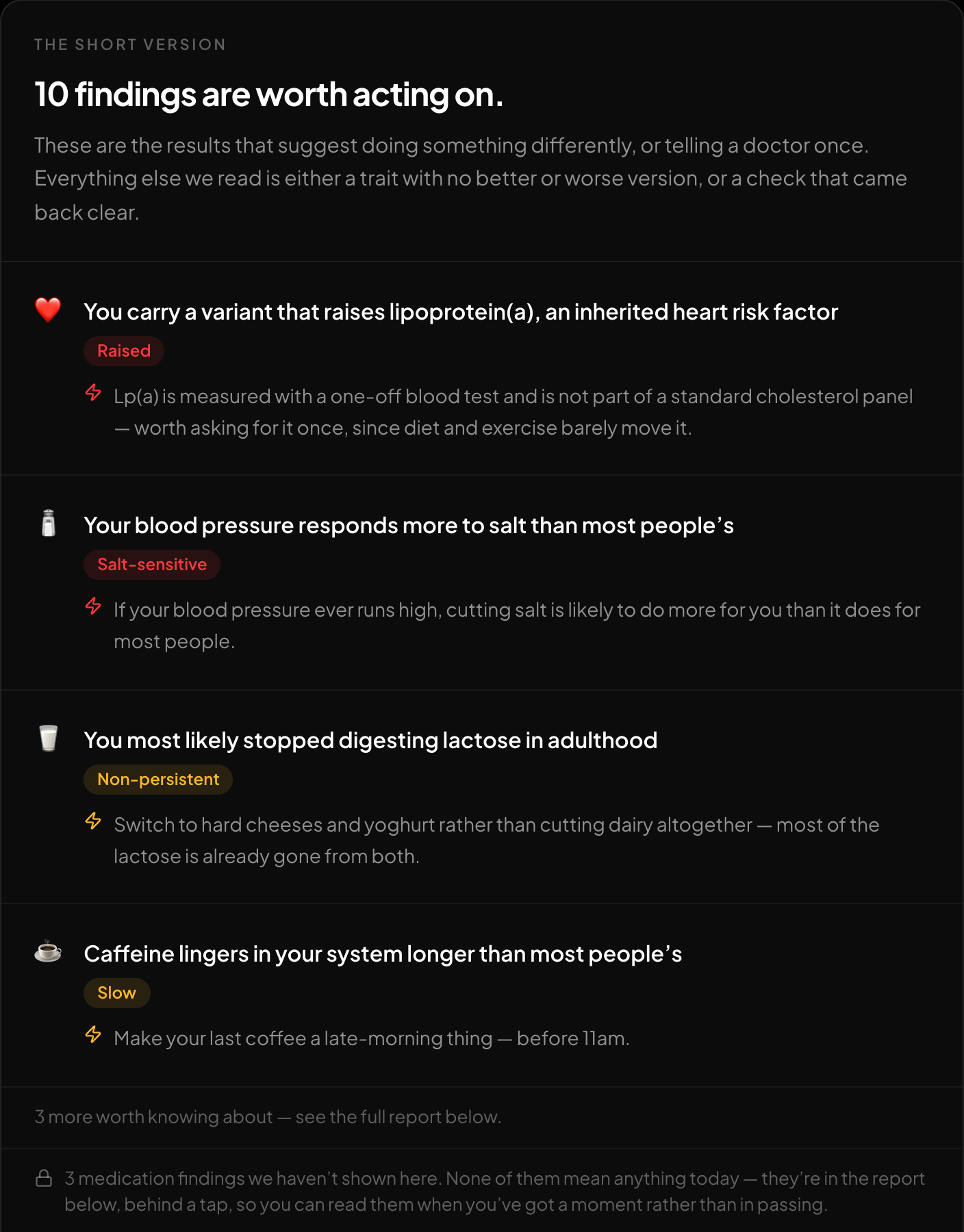
The short version: what is worth acting on, first.
If you already have a raw 23andMe, AncestryDNA, MyHeritage or whole-genome VCF file, the free DNA tool at https://healthosx.com/dna parses the file in the browser. The DNA story needs no account; the full free report opens after a one-time email code. The report includes MTHFR but does not currently include COMT. Neither the report nor the DNA file can diagnose anxiety or OCD. You can see the sample report and file-check links at https://healthosx.com.
New to raw DNA files? Start with the full guide: How to Download & Analyze Your 23andMe Raw Data Free
Written by
HealthOS Research