Can 23andMe Tell the Difference Between Ghanaian and Nigerian Ancestry?
Yes, but only weakly. 23andMe can sometimes split Ghanaian from Nigerian ancestral patterns, but the labels are statistical best-fits and overlap heavily.
Yes, but only weakly. 23andMe can sometimes separate a Ghanaian-associated pattern from a Nigerian-associated pattern, because it keeps separate reference groups for parts of West Africa. The two are close neighbours in the reference panel and overlap heavily, so a result can sometimes show a share assigned to the neighbouring country or a large 'Broadly West African' estimate.
Can 23andMe tell the difference between Ghanaian and Nigerian ancestry?
At the 50% confidence setting, 23andMe will paint more segments with specific West African labels, including 'Ghanaian, Liberian & Sierra Leonean' and 'Nigerian'. At the 90% confidence setting, it walks many of those back into 'Broadly West African'. The honest read is that the test is seeing real West African ancestry, and only sometimes enough local structure to prefer Ghanaian over Nigerian reference samples.
A country label on a consumer DNA test is a statistical best-fit against modern reference people, not a genealogical fact about your ancestors.
Why Ghanaian and Nigerian reference groups overlap
The reference samples are usually people whose grandparents were born in a place, not ancient populations. Ghana and Nigeria sit inside a region with a lot of shared deep ancestry. The colonial borders cut through language and family networks: for example, Ewe communities straddle Ghana and Togo, while Yoruba communities straddle Nigeria and Benin. For an algorithm, neighbouring West African populations are far harder to split than, say, Nigerian and Irish.
A typical consumer chip reads hundreds of thousands of autosomal markers, not the whole genome. In West Africa, the variants that differ between Ghanaian and Nigerian populations are a small part of the total signal, so short DNA windows often fit both labels equally well. When a window fits both, the algorithm either assigns it to the closest group with low confidence or puts it in Broadly West African.
What you actually see on a 23andMe report
Under Sub-Saharan African, a person with known Ghanaian ancestry might see an illustrative breakdown such as: Ghanaian, Liberian & Sierra Leonean 22%, Nigerian 18%, Broadly West African 60%. A small Senegambian & Guinean or Congolese & Southern East African share can also appear in some reports. These numbers are illustrative, not a fixed expectation. A sibling might see different numbers, even though the genealogy is identical, because each sibling inherits different DNA from the same parents.
Illustrative. Percentages shift by version, confidence threshold, and reference panel.
The chromosome painting view shows the uncertainty. At lower confidence, more segments get country-level colour. At higher confidence, large parts of West Africa collapse into a broad grey band. That is the model being honest about not knowing.
Why a label can be smaller, larger, or switch after an update
23andMe updates its reference panel and algorithm periodically. A result can change not because your DNA changed but because the model now has more Ghanaians, more Nigerians, or a different smoothing approach. This is normal. A change from 15% Nigerian to 8% Nigerian is not a correction from a bad earlier test; it is the same data run through a different statistical model.
A specific ethnic group, like Igbo or Akan, is not guaranteed to be represented. If your actual group is absent or under-sampled, the algorithm will place you with whichever available group is nearest, which may be across a national border.
How to read a raw DNA file instead of treating the label as proof
Downloading your raw file and running it through another tool does not make country-level West African labels more certain. It can be the opposite. A broad research panel like the AADR Human Origins panel used by HealthOS gives proportions across 15 world regions and closest present-day populations, but some neighbouring West African groups may still overlap. The most defensible line is the broad one: the West African ancestry is clear. Whether a model calls it Ghanaian or Nigerian depends on the reference samples, the confidence threshold, and which DNA segments you inherited.
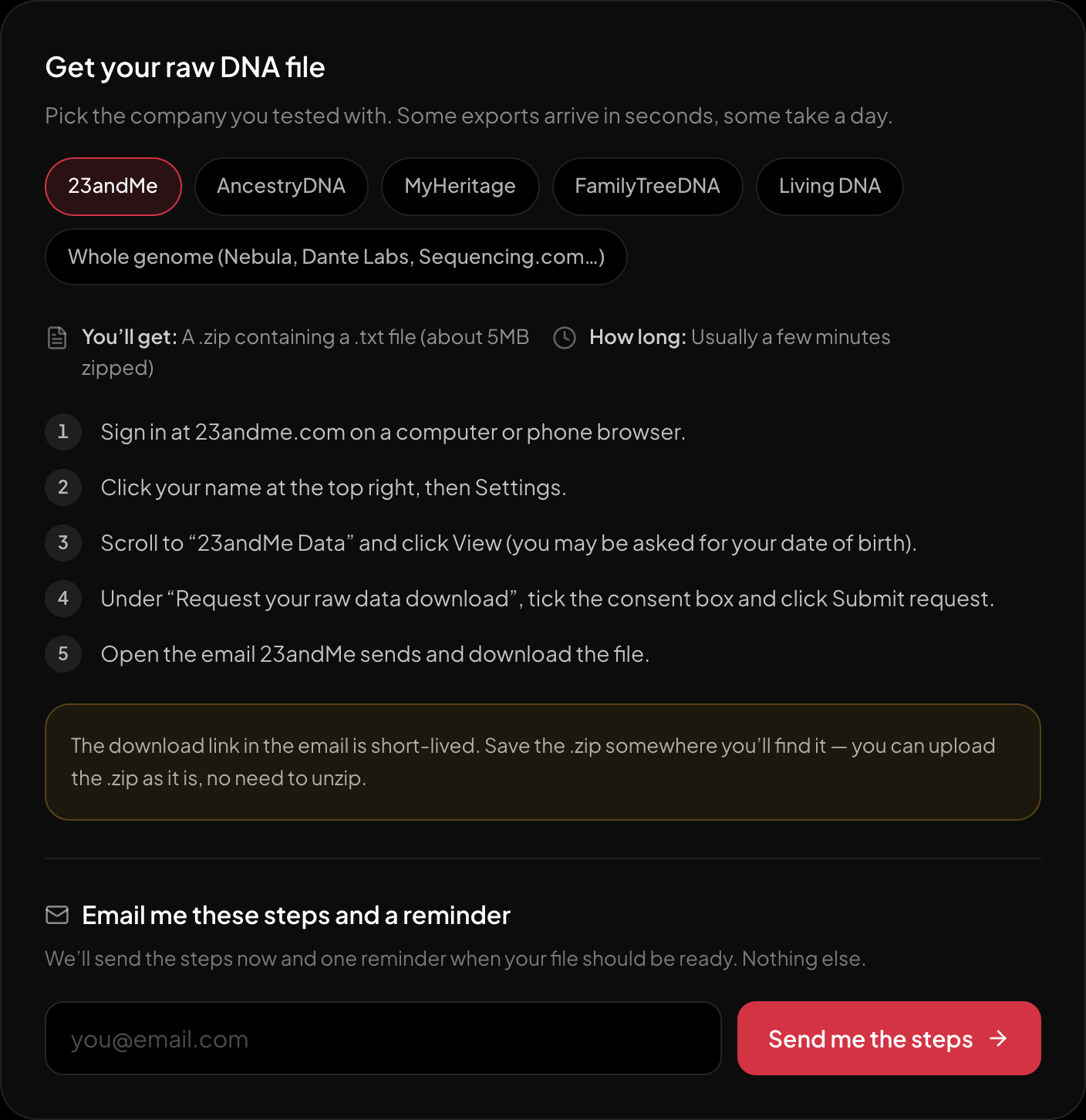
The download steps for 23andMe, on the page itself.
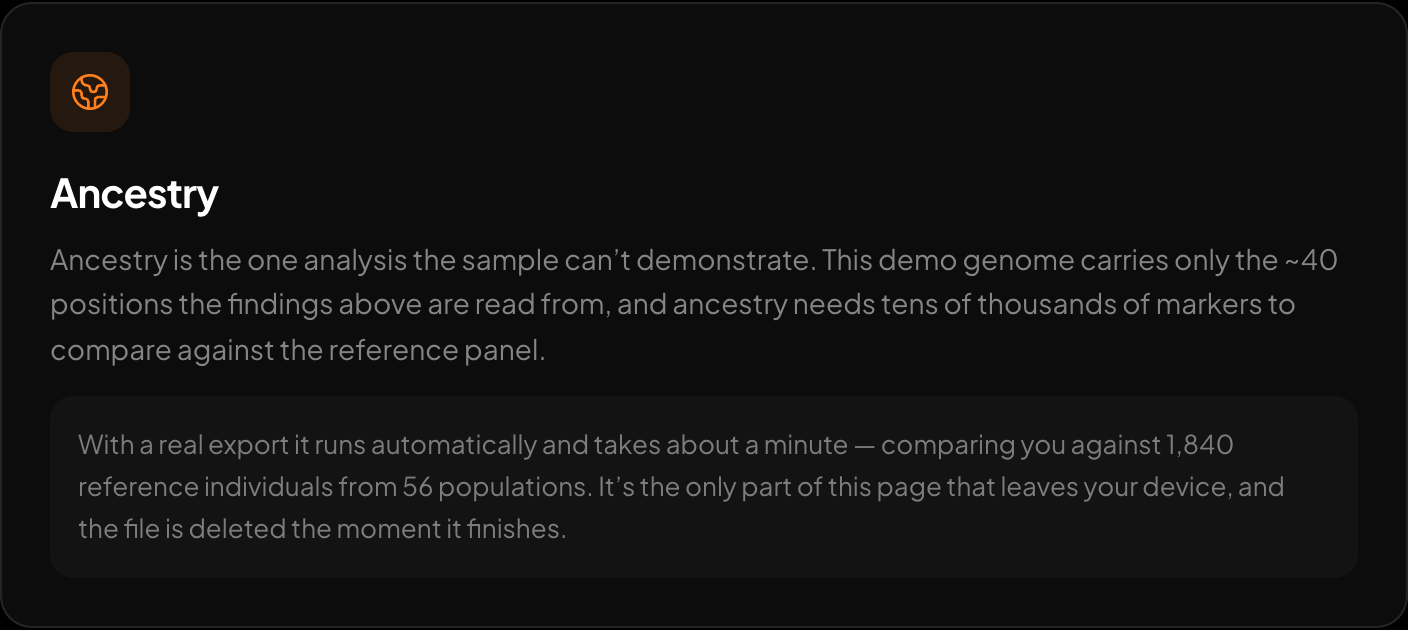
Ancestry across 15 regions and 157 reference populations.
Maybe useful next step: if you already have a raw 23andMe, AncestryDNA, MyHeritage or whole-genome VCF file, the free DNA tool at https://healthosx.com/dna reads the file in the browser and reports traits, medication response and carrier-relevant findings, with an optional genetic ancestry breakdown. It will not turn a statistical West African label into a passport entry, but it does let you see the broad proportions and ranges in your own numbers.
New to raw DNA files? Start with the full guide: How to Download & Analyze Your 23andMe Raw Data Free
Written by
HealthOS Research