Why AncestryDNA Confuses French and French-Canadian Ancestry
AncestryDNA labels French-Canadian DNA as French and French DNA as French Canadian because French Canadians descend from a small French founder pool, so the overlap is expected.
AncestryDNA reports French and French-Canadian ancestry as overlapping because French Canadians descend from a small founding group of French settlers, so their DNA still looks like the source regions in France. If your French-Canadian line comes back as France, or a France line shows a French Canadian community, that is expected, not a data error. The two categories sit on the same branch.
Why does AncestryDNA confuse French and French-Canadian ancestry?
French Canadian ancestry is a recent founder event. Around 8,500 French settlers left descendants in Quebec between 1608 and 1760, mostly from northern and western France. In a population that small, genetic drift and repeated marriage within the group made some French haplotypes very common and let others disappear. That is enough to make French Canadians detectable as a group, but not enough to make them biologically distant from France.
AncestryDNA compares your DNA to reference panels of people whose ancestry is reported to be from particular places. The France panel contains modern French people who share many of the same haplotypes that Quebec founders carried. So a segment from a French-Canadian person often matches the France reference strongly enough to be called France.
Then the community layer works differently. French Canadian communities are built from shared DNA among people who descend from the Quebec founder network, not from a fixed reference panel. The algorithm sees one segment that could fit both.
French Canadian is a recent branch of French DNA. Overlap is the correct result, not a sign your family history is wrong.
What this looks like in your AncestryDNA report
You might see a large France percentage and a French Canadian community sitting under it. You might also see the community but a lower France percentage than your tree suggests. The range matters more than the single number. AncestryDNA usually gives a range for each region. A France estimate of 35% with a range of 0-60% is weak; a range of 25-45% is stronger.
- Check the range, not the single percentage. Small percentages can disappear at higher confidence.
- French Canadian communities are driven by matches, not by a clean reference panel. If the community appears, you share DNA with the Quebec descendant network.
- A France result without a French Canadian community does not rule out Quebec ancestors. It can mean your French side is small or your matches are too few.
Is it an error?
No. It is a limit of labelling a recent founder population with modern reference groups. The ethnicity estimate says your DNA looks like modern reference populations. The community says you share many segments with a French Canadian network. Both can be true. Neither overrides parish records or a surname pattern.
The common mistake is treating the estimate as a pedigree. It is not reading your family tree. It is assigning the same DNA segment to the closest available label.
What to check in your raw data and matches instead
If the goal is to confirm French-Canadian ancestry, percentages are the weakest DNA tool. Matches and documents are stronger. The raw file itself is just genotype calls. It will not re-label your ancestry, but it lets you run other checks.
- Look at shared matches with Quebec surnames, locations, or known French-Canadian settler ancestors.
- Verify community assignments with trees. Many French Canadians descend from the same founders, so many distant matches are expected.
- If your French side is Acadian, Métis, Franco-Ontarian, or New England French Canadian, expect different labels. Acadian history is not identical to Quebec founder history.
When the simple answer does not hold
The simple answer is that French Canadian is a branch of French DNA. But there are cases where the label can mislead.
A person in France can show a French Canadian community if distant cousins emigrated to Quebec and left many descendants. That does not mean their French line went through Canada. A French-Canadian descendant can show a smaller France percentage because of British, Irish, Indigenous, or other ancestry in the same line. Acadian descendants often have a separate or weaker Quebec signal despite French origins. And small percentages below roughly 2% should be treated as noise unless they appear at high confidence.
In those cases, use the community as a clue, not a verdict. The tree and the matches usually tell you more than the map.
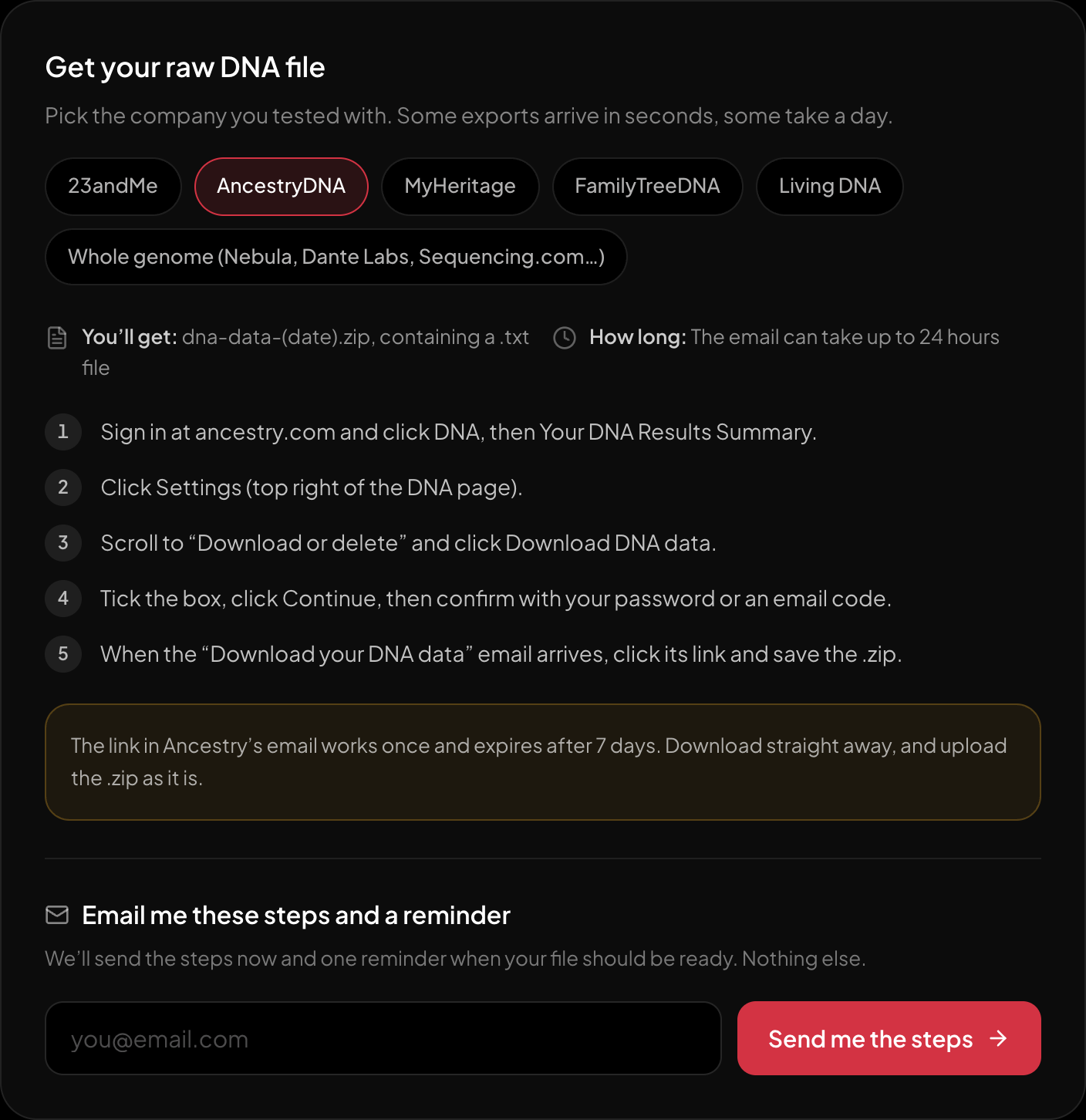
The download steps for AncestryDNA, on the page itself.
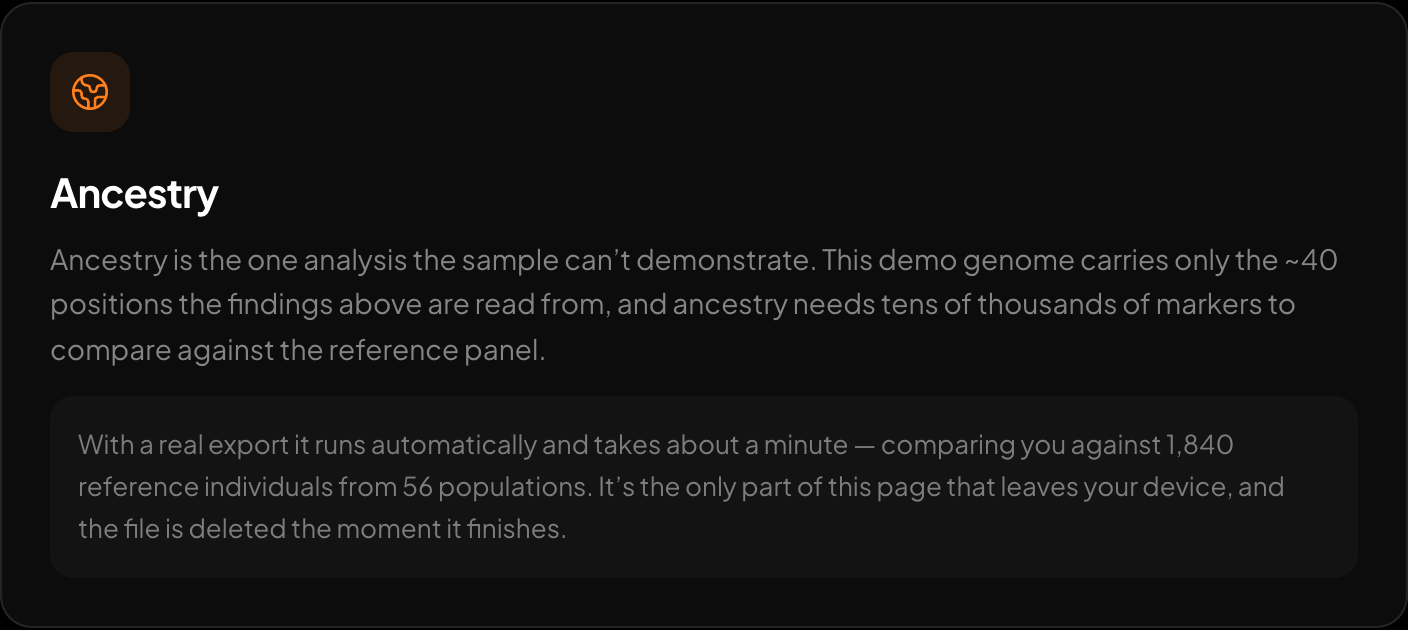
Ancestry against 1,840 reference genomes.
When you want to see what else your own raw file can tell you, run it through the free DNA tool at healthosx.com/dna. It reads 23andMe, AncestryDNA, MyHeritage and other raw files, reports traits and medication-response markers, and can optionally compare your ancestry against 1,840 reference genomes. If you want to see your own numbers rather than another description, that is the next step.
New to raw DNA files? Start with the full guide: How to Download & Analyze Your 23andMe Raw Data Free
Written by
HealthOS Research