What ABCC11 rs17822931 Means in Your 23andMe Raw Data
Your ABCC11 rs17822931 genotype in 23andMe raw data shows whether you have dry earwax and reduced underarm odor. Two A alleles are the low-odor version.
What does ABCC11 rs17822931 mean in my 23andMe raw data?
Your ABCC11 rs17822931 result is mainly a readout of earwax type and whether your underarm apocrine sweat glands produce much odor. In 23andMe raw data the letters are usually A and G, and A is the dry-earwax low-odor version. Two A alleles (or T/T if the file uses the opposite strand) mean dry earwax and little apocrine body odor. One or two G alleles (or C alleles) usually mean wet earwax and normal body odor.
| Genotype you see | Earwax type | Underarm odor baseline |
|---|---|---|
| A/A (or T/T) | Dry, flaky, pale | Much less apocrine odor |
| A/G (or T/C) | Wet, sticky, amber | Normal odor |
| G/G (or C/C) | Wet, sticky, amber | Normal odor |
Scroll the table sideways for the rest →
Typical phenotype for the rs17822931 genotype. A and G are the usual 23andMe letters. Some files use T and C instead; T pairs with A, C pairs with G.
Dry earwax is recessive. You need two copies of the A allele for the low-odor phenotype. One G allele is enough for wet earwax and normal body odor.
Two copies of the dry allele, not one
The A allele is a loss-of-function change in ABCC11, which stands for ATP binding cassette subfamily C member 11. The gene encodes a pump that moves lipids and other molecules into secretions from the ceruminous glands in your ear and the apocrine glands in your underarm. The rs17822931 change swaps glycine for arginine at position 180 in the protein, which weakens the pump. The G allele makes a working pump. One working copy is enough for the wet, sticky, amber earwax that most people have and for the usual amount of apocrine odor precursors on the skin. This is why an A/G person usually looks like a G/G person for this trait. Dry earwax and reduced underarm odor are the recessive phenotype. Wet earwax is the ancestral and most common global pattern.
What is the mechanism behind the body odor link?
Apocrine glands produce an oily sweat that is odorless when it leaves the gland. Skin bacteria then metabolize its components. ABCC11 controls how much of certain odor precursor molecules are secreted. If you have two A alleles, the pump works poorly, fewer precursors reach the skin, and bacteria have less raw material to turn into the classic underarm smell. This is the same reason the ear produces a dry, flaky, pale cerumen instead of wet, sticky, amber cerumen. The gene sets the raw material, not the smell itself. This is one of the clearest examples of a single gene controlling a visible everyday trait.
What you will actually see in your raw data file
Open your 23andMe raw data text file and search for rs17822931. The line will include the rsID, chromosome 16, a position, and two allele letters. In 23andMe exports the alleles are typically A and G. Some other files call the same SNP T and C. If you see T/T, that is equivalent to A/A. C/C is equivalent to G/G. T/C is equivalent to A/G. The exact position and allele order depend on the chip and genome build. If the SNP is missing from your chip, a raw-data tool cannot report this trait. The result is not a separate lab test. It is the raw call at that position in your file.
Do I still need deodorant if I have two A alleles?
The genotype reduces the main substrate for underarm odor, but it does not abolish all body odor. - A/A lowers baseline apocrine odor, not total body odor. - Eccrine sweat still appears with heat and exercise. - Feet, groin and scalp have their own gland mixes.
Skin bacteria act on dead skin cells and dietary breakdown products. Many people with A/A still use deodorant for cultural comfort, heat and exercise. The practical summary is less baseline smell, not zero smell.
What this result does not tell you
This SNP is not a disease marker. Dry earwax is a normal trait and is the common phenotype in many East Asian populations. The A allele is frequent in East Asian populations, often above 70%, and rare in most European and African populations, often below a few percent. The result does not give a complete body odor profile. Hygiene, diet, clothing, skin microbiome and other genes all change how you smell. It also does not say you cannot have medical sweat conditions. If you have sudden changes in smell, persistent unusual odor, or ear symptoms, the genotype is not the explanation.
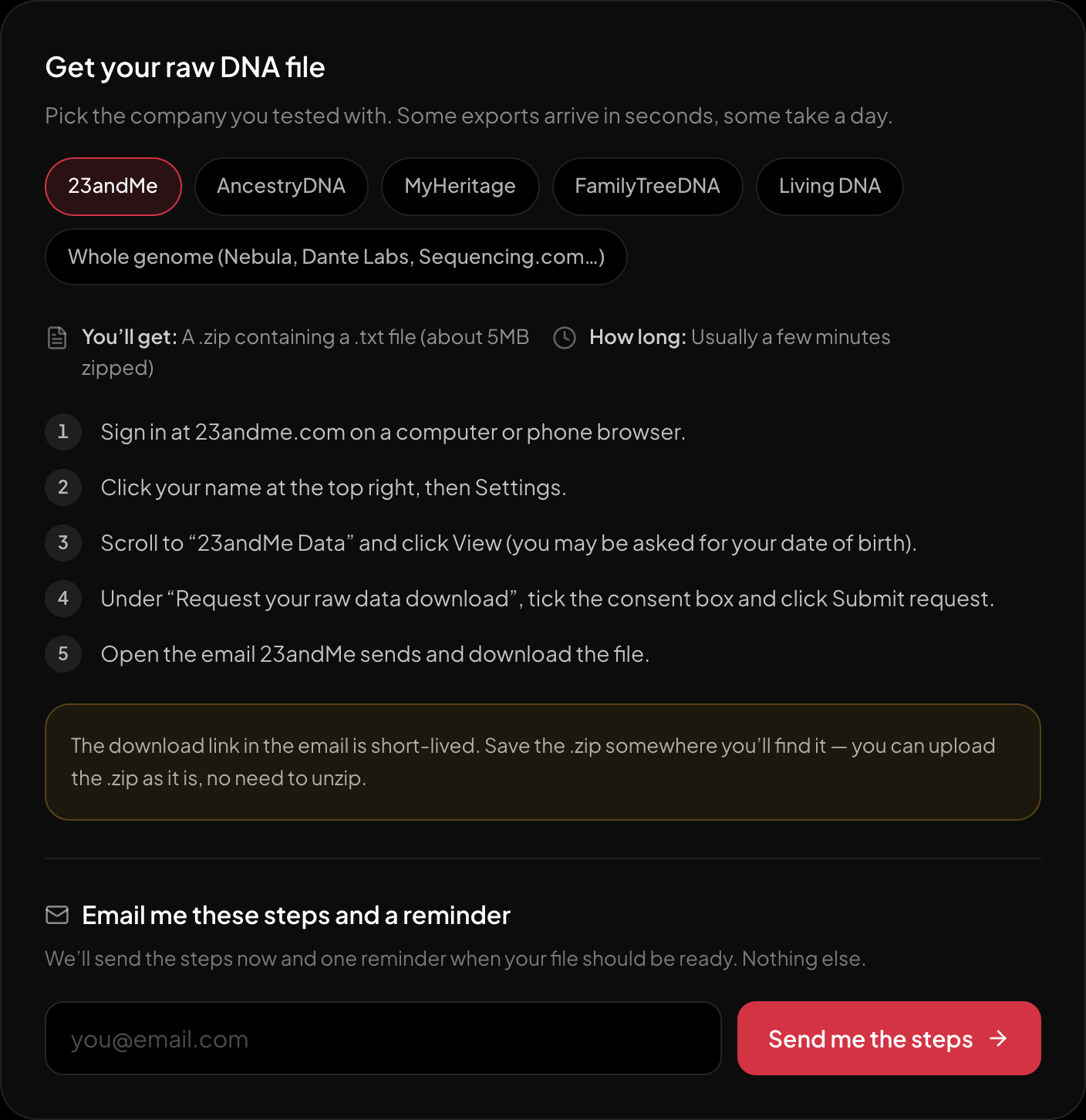
The download steps for 23andMe, on the page itself.

The short version: what is worth acting on, first.
If you want to see this in your own numbers, the free DNA tool at HealthOS DNA reads a 23andMe, AncestryDNA, MyHeritage or whole-genome VCF file in the browser and reports ABCC11 alongside 54 other trait, medication-response and carrier-relevant findings. The file stays on your device for the trait report. Ancestry is optional.
New to raw DNA files? Start with the full guide: How to Download & Analyze Your 23andMe Raw Data Free
Written by
HealthOS Research