Why Do Twins or Siblings Get Different MyHeritage DNA Results
Full siblings inherit different random halves of each parent's DNA, so ethnicity estimates and DNA matches vary unless they are identical twins.
Full siblings, including fraternal twins, get different MyHeritage DNA results because each child inherits a different random 50% of each parent's autosomal DNA. Identical twins share essentially the same DNA and their results should be nearly the same. Fraternal twins are full siblings born at the same time, so their results can differ just like any other sibling pair.
Same parents, different 50%
Each parent has 23 pairs of chromosomes. A child gets one chromosome from each pair from each parent. The copy that goes into the egg or sperm is not a clean whole copy. During meiosis, the parent's two copies of a chromosome pair line up and swap pieces, a process called recombination. The resulting chromosome is a mosaic: one chromosome made from pieces of both copies in that pair. This happens independently in each egg or sperm.
You inherit 50% of each parent's autosomal DNA, but it is a random 50%. A sibling inherits a different random 50%. That is why full siblings share about 50% of their DNA with each other, not 100%.
This also changes grandparent percentages. Each grandchild inherits roughly 25% from each grandparent on average, but the real number can differ by several points. One sibling might get more of one grandparent's Scandinavian segment and another sibling might get almost none of it. Because the process is random, there is no rule that siblings must each receive the same share from a grandparent. The average is 25%, but the observed share can be lower or higher. This is not a lab error.
How inherited segments become different results
MyHeritage compares large numbers of DNA markers to reference panels. The ethnicity estimate is not reading your whole family tree. It is reading the specific segments you inherited. If Sibling A inherited a segment that MyHeritage labels North African and Sibling B did not, the percentages will differ. The DNA Matches tool works the same way. A match appears only if you and the other person share a DNA segment. Since siblings carry different segments, a distant cousin can share enough DNA with one sibling and not the other.
Same parents, different 50%. Every child gets half of each parent's DNA, but almost never the same half.
What you actually see in MyHeritage
- The ethnicity estimate can differ by several percentage points between full siblings.
- Close relatives such as parents, children and full siblings normally appear for both siblings if they have tested and share DNA above the platform matching threshold.
- Distant cousins often appear for one sibling and not the other, provided they share a segment above the matching threshold.
- Full siblings average about 50% shared autosomal DNA, but the observed share can vary more widely.
Real results rarely show two siblings with identical ethnicity percentages. Expect differences in several regions, sometimes by several percentage points or more. The table below uses illustrative percentages to show how the same parents can produce visibly different percentages in two siblings.
| Region | Sibling A | Sibling B |
|---|---|---|
| Scandinavian | 34% | 18% |
| West African | 12% | 24% |
| Irish | 41% | 45% |
| Other regions | 13% | 13% |
Scroll the table sideways for the rest →
Illustrative percentages for selected world regions. Real siblings vary because they inherit different DNA segments.
A common mistake is to read these differences as a sign that one sibling is "more" of an ethnicity than the other. That is not how it works. The family tree is the same. The test only sees the random half each child happened to inherit. Ethnicity percentages are estimates, not exact ancestry fractions. The same person's results can shift slightly when MyHeritage updates its reference panel or algorithm.
What about identical twins?
Identical twins develop from the same fertilised egg and share essentially all of their autosomal DNA. Their MyHeritage results should be very similar. If identical twins get large differences, possible explanations include different file versions, chip versions, genotyping quality, sample mix-up, or platform support, not a real difference in ancestry.
Fraternal twins are siblings who happen to be born at the same time. They share about 50% of their DNA on average, so their results can differ as much as any sibling pair.
Which differences are worth a closer look
Expected: - An illustrative example is one sibling showing 12% Italian and another showing 24%. - A third cousin matches one sibling but not the other. - Full siblings may share somewhat more or less than 50% DNA instead of exactly 50%.
Worth a closer look: - Shared DNA near 25% instead of roughly 50%. That suggests a half-sibling, another close relationship, or a sample or file issue, and should be checked. - Identical twins with very different ethnicity estimates. Possible explanations include file version, chip version, genotyping quality, sample mix-up, or platform support.
If a parent or sibling has tested, their shared DNA percentages will usually resolve the question quickly.
What to do with your MyHeritage raw file
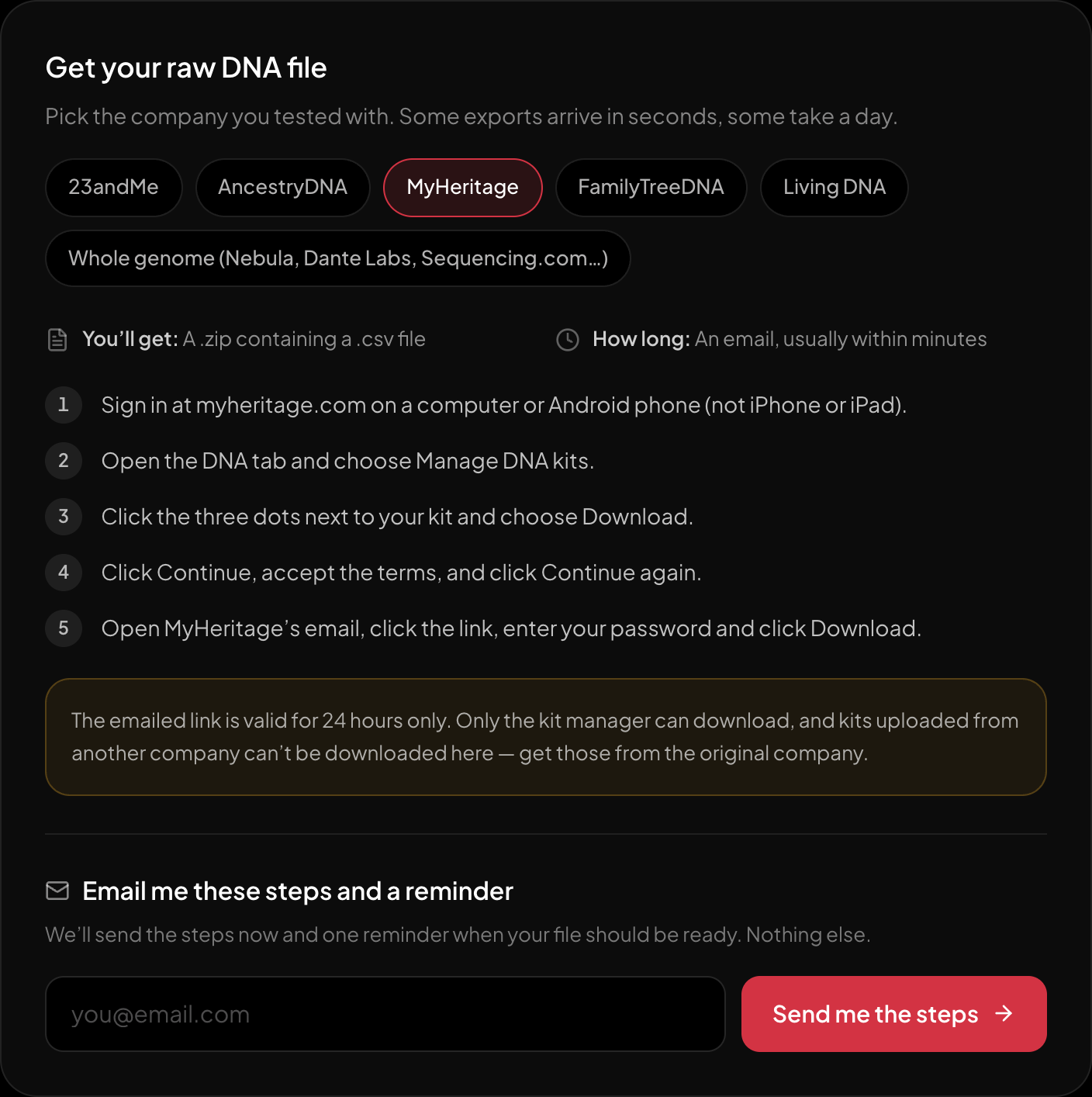
The download steps for MyHeritage, on the page itself.

The short version: what is worth acting on, first.
If you have a MyHeritage raw DNA file, the free tool at https://healthosx.com/dna reads it in the browser. The health and trait report runs without uploading the file. The ancestry breakdown is optional and needs a server. It sends only the markers the ancestry step needs, compares them against 1,840 reference genomes, reports 14 world regions plus closest present-day populations, and deletes the markers afterwards unless you choose to keep the file. HealthOS has no relative-matching database. You can use it to see how the same inheritance logic shows up in your own genes.
New to raw DNA files? Start with the full guide: How to Download & Analyze Your 23andMe Raw Data Free
Written by
HealthOS Research