Why Is My DNA Not Exactly 50/50 From My Parents?
Autosomal DNA really is 50/50 from each parent. A consumer report showing 49.8% or 50.2% is seeing chip noise, not a biological imbalance.
Your autosomal DNA is a 50/50 split from your parents, full stop. A consumer report that says 49.8% shared with one parent or 50.2% with the other is not showing you a true biological exception. It is showing you how a genotyping chip or raw-file comparison counts the slice of your genome it happened to read.
Why is my DNA not exactly 50/50 from my parents?
You asked it plainly, so here is the plain version. The 22 chromosome pairs called autosomes follow a strict rule. You inherited one copy of each pair from the egg and one copy of each pair from the sperm. That makes the autosomal part exactly 50/50. The number on a report is not always exactly 50.0 because the test does not read every base. It reads a fixed set of markers and estimates shared DNA from the ones that passed quality filters.
Autosomal DNA is a true 50/50 deal. A report reading 49.8% or 50.2% is showing measurement limits, not a hidden mismatch with your parent.
The 22 pairs that really are a coin flip
Each parent has two copies of each autosome, one from each of their own parents. When eggs or sperm are made, those copies separate so each gamete carries one copy of every autosome. At fertilization, the egg and sperm each contribute a single copy. You end up with two copies of each autosome, one from each parent.
This is why the autosomal part is a true coin flip. It is not that you randomly get a little more from one side. The chromosome-level inheritance is balanced by the rule itself.
Look at a raw data file and you will see the mechanism marker by marker. At any position on chromosome 1, you have one allele from the egg and one from the sperm. The report is not reading all of your genome. A standard consumer chip reads around 600,000 to 700,000 common markers, then converts stretches of shared alleles into centimorgans using a reference map.
The parts that genuinely come from one side
Mitochondrial DNA is a small loop of about 16,569 base pairs, and you inherit it from the mother's egg almost always. The Y chromosome, if you have one, comes from the father. For a son, the X chromosome from the mother is much larger than the Y chromosome from the father, so total nuclear DNA is not exactly 50/50. That is real biology, and it is almost never what a consumer DNA report's shared DNA percentage means. A commercial test's autosomal percentage is the number people ask about.
If you are looking at a whole-genome VCF that includes X and Y, a male may show more total base pairs from the maternal side because the X is roughly 155 million base pairs and the Y roughly 57 million. This does not break the autosomal rule.
What a report number actually counts
23andMe and AncestryDNA usually report parent-child sharing as 50% because they compare within their own curated marker set. A raw-file comparison or third-party tool can report 49.8% or 50.2% because it uses different markers, different no-call filters, or a different reference map.
No-calls are markers where the chip did not read clearly. Different tools remove them differently. Different reference maps use slightly different centimorgan lengths. A parent-child match on autosomal DNA lands around 50%, or roughly 3,500 to 3,700 centimorgans depending on the chip and map. A few tenths of a percent is normal.
Rare exceptions that do change the true number
Yes, but they are rare and usually small in effect when a single chromosome is involved.
- Uniparental disomy: a person inherits both copies of one chromosome from one parent. It changes that chromosome only.
- Sex chromosome variation: Klinefelter syndrome, Turner syndrome and other aneuploidies change the sex chromosome count.
- Chimerism: two cell lines from different zygotes can sometimes produce different DNA in different tissues.
If your report shows a parent match of 49.8% or 50.2%, uniparental disomy is not the explanation. The far more common answer is measurement, file quality, or reference map choice.
What to do with the 49.8 vs 50.2 number
Nothing. It is not a health finding. If you are confirming a parent relationship, a small deviation around 50% is expected. A large deviation, several percent or more, is worth checking for a file issue or a different relationship before assuming anything biological.
Choosing a file. The report is read on your own device.
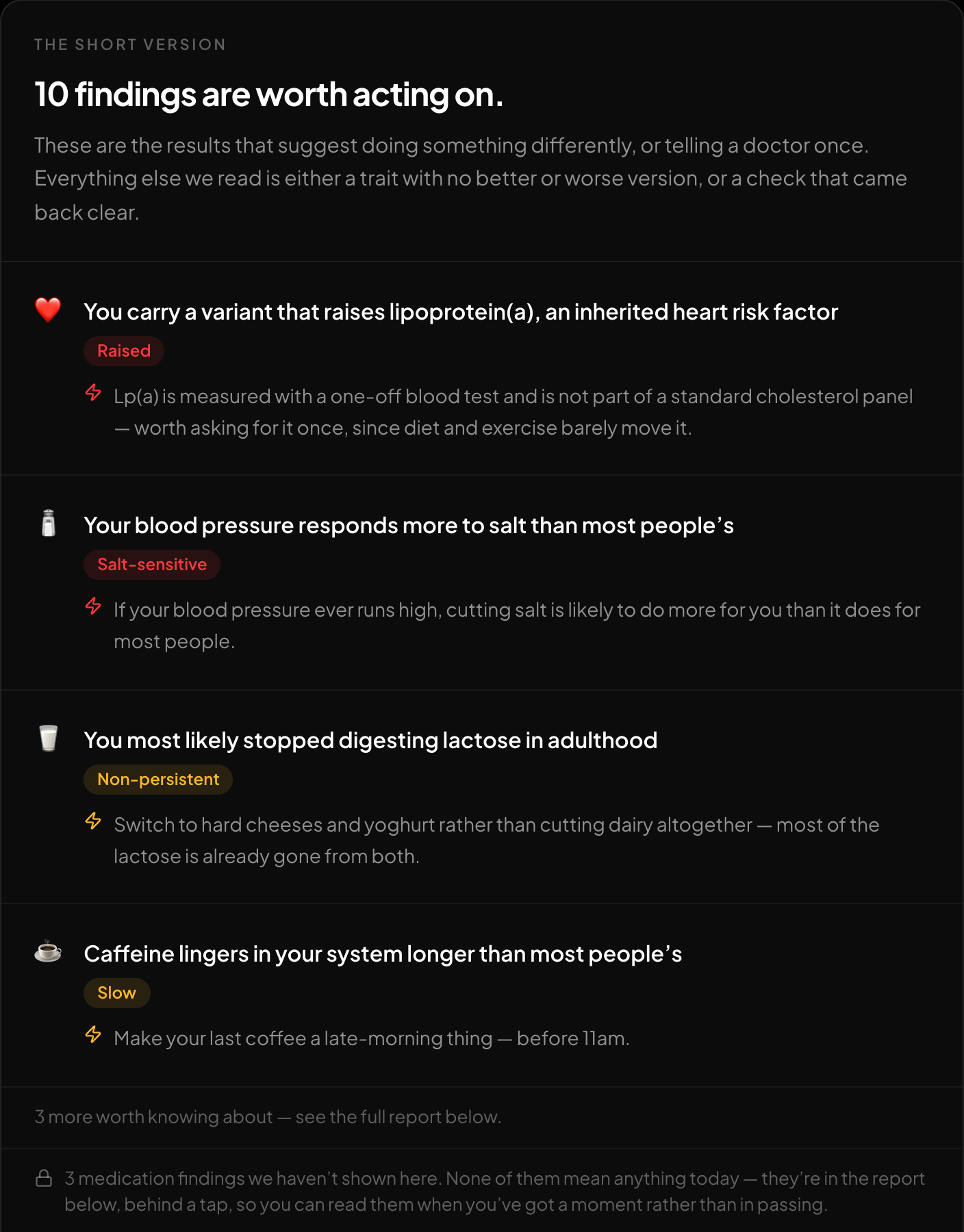
The short version: what is worth acting on, first.
The next useful step is to look at your own raw numbers. The free DNA tool at healthosx.com/dna reads a raw 23andMe, AncestryDNA, MyHeritage or whole-genome VCF file in the browser and reports traits, pharmacogenomics, carrier-relevant findings and optional ancestry breakdown. If you want to see your maternal and paternal lines, or ask why you respond differently to something, that is where to start.
New to raw DNA files? Start with the full guide: How to Download & Analyze Your 23andMe Raw Data Free
Written by
HealthOS Research