Why Does My Full Sibling Show as a Half Sibling on AncestryDNA?
AncestryDNA predicts relationships from shared centimorgans, and full sibling and half sibling ranges overlap. Here is what the label does and does not prove.
AncestryDNA may label a close match as a half sibling when the shared centimorgan (cM) count falls inside the half-sibling reference range. It is not proof that one parent is not shared, because full siblings and half siblings have overlapping ranges. A full sibling with an unusually low shared cM can be placed in the overlapping half-sibling range, so the label alone is not definitive.
Why does my full sibling show as a half sibling on AncestryDNA?
AncestryDNA's relationship label is a DNA-based estimate. It compares the amount of shared DNA, converted to centimorgans, against reference ranges for different relationships. Trees and shared matches can help you interpret the estimate, but the label itself is not a family-tree conclusion.
The numbers create the problem. The table below shows illustrative shared cM values from published data, not AncestryDNA's proprietary reference ranges.
| Relationship | Shared cM (illustrative) | Average cM |
|---|---|---|
| Parent/child | about 3487 | about 3487 |
| Full sibling | about 1613-3488 | about 2613 |
| Half sibling | about 1160-2436 | about 1759 |
| First cousin | about 553-1225 | about 866 |
Scroll the table sideways for the rest →
Illustrative values adapted from The Shared cM Project 4.0 (Blaine Bettinger), not platform-specific reference ranges. Actual values vary by platform and testing chip. The overlap is why predicted relationships are not facts.
A full sibling whose shared cM falls in the part of the full-sibling range that overlaps the half-sibling range can receive the half-sibling label. A half sibling whose shared cM falls in the same overlap can receive either label. The label alone cannot tell those two cases apart.
A predicted relationship is a statistical estimate from shared DNA. It does not, by itself, override confirmed parentage, a known family history, or the rest of the match list.
Shared centimorgans are a game of random halves
The reason full siblings vary this much is hidden in how gametes are made. Each child gets 50 percent of each parent's autosomal DNA, but not the same 50 percent. During egg and sperm production, chromosomes recombine and segregate randomly. Full siblings share DNA from both parents, half siblings share DNA from only their one shared parent.
Full siblings can share more or less than the average because at any given DNA position they can share zero, one, or two copies. Shared cM metrics used by DNA testing platforms are based on half-identical segments. Fully identical regions are not counted twice. That pulls the full sibling average down to about 2613 cM instead of the 3487 cM that a parent and child share. It does not mean full siblings are only half as related; it reflects how the platform counts shared segments.
Half siblings only have one shared biological parent, so they share one copy at most. Their shared cM average is lower, but the high end of their range reaches into the low end of the full sibling range.
What you actually see in your match list
On AncestryDNA, the match page shows a predicted relationship and a shared cM number. Do not stop at the label.
Check these before you decide what it means:
- Note the shared cM total. If it is well above the half-sibling part of the overlap, full sibling is the stronger guess. If it is below the full-sibling part of the overlap, half sibling or another close relationship becomes more likely.
- Look at shared matches. Full siblings usually share matches on both the maternal and paternal lines. Half siblings usually share matches on only one side. This is an interpretation aid, not part of the label.
- Test the parents if possible. Parent testing is usually conclusive for distinguishing full from half siblings when the tested identities and biological relationships are confirmed. A full sibling will match both parents at the parent-child level. A half sibling will match only the shared parent. If both parents match each sibling as parent-child, that makes half sibling unlikely, but lab error, donor conception, adoption, or misattributed parentage can still complicate the picture.
Could it actually be a half sibling?
Yes, it could. A half sibling prediction is sometimes the correct result trying to tell you something. The cases where the simple answer does not hold go both ways.
The label is more likely to be real when the shared cM total sits in the middle of the half-sibling range, around 1700-1800 cM, and the shared matches clearly trace to only one parent. It is also more plausible if there is a known non-paternity event, donor conception, adoption, or a child from another relationship.
But if you already know you grew up with the same two parents, and especially if both parents have tested and match each of you at the parent-child level, the half-sibling label is more likely a misclassification. However, parent tests are not immune to lab error, sample mix-up, donor conception, adoption, or misattributed parentage, so confirm the tested identities and family context before treating a parent test as final. DNA cannot tell you what happened socially. It can only tell you how much autosomal DNA you share.
What the label does and does not prove
The AncestryDNA relationship label is a probability, not a verdict. It proves you share a certain amount of DNA. It does not prove which of several close relationships produced that amount. Full sibling and half sibling are only two of several possibilities in the overlapping zone. Grandparent/grandchild and aunt/uncle/niece/nephew can also share similar totals.
The way to resolve it is more data, not more worry. Parent tests are usually the fastest route when parentage and sample identity are confirmed. If no parent can test, a first cousin on one side or the other can anchor which lines you share. Without more data, you are left with a range, and the label is just the most likely estimate inside it.
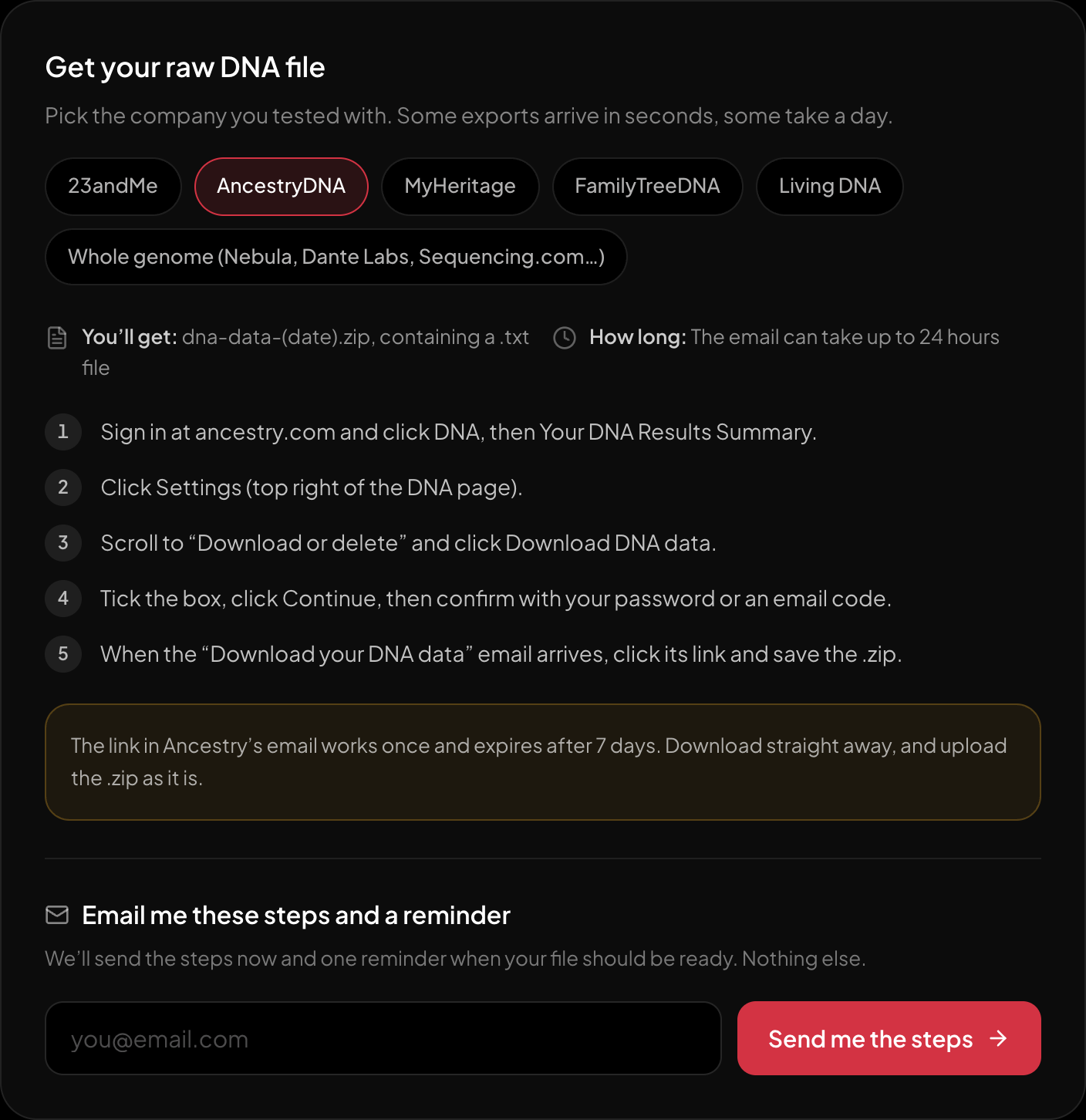
The download steps for AncestryDNA, on the page itself.
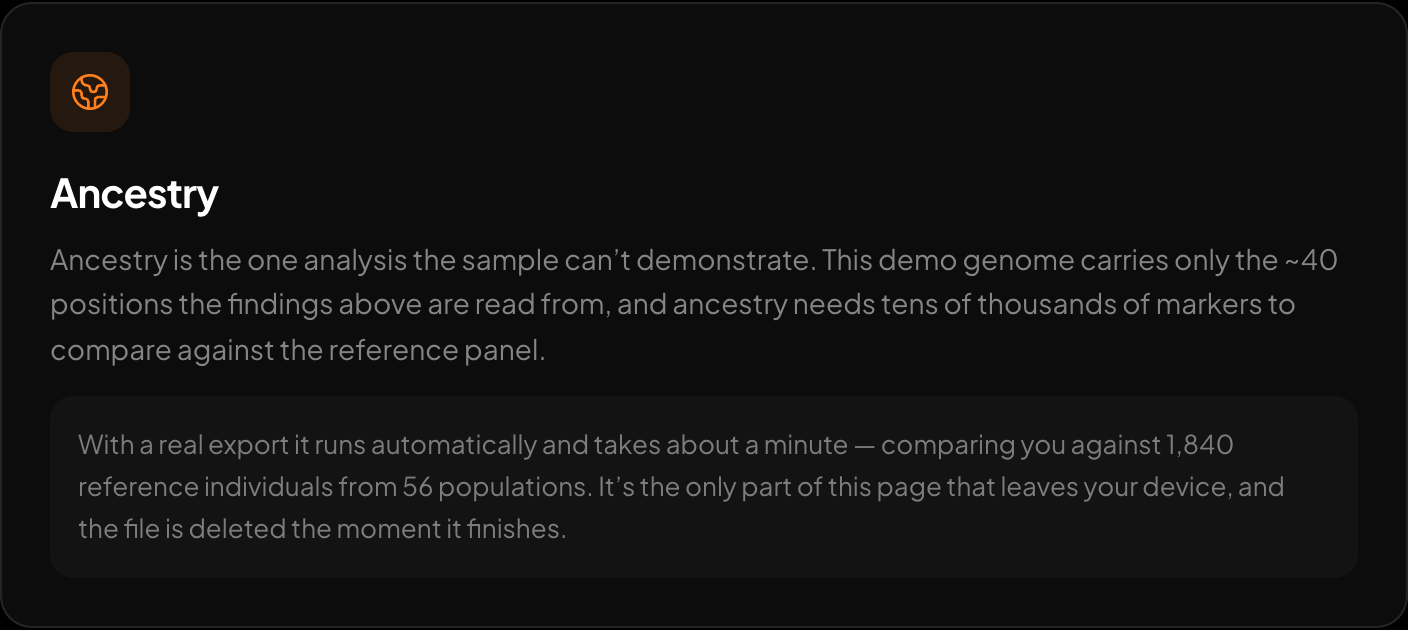
Ancestry across 15 regions and 157 reference populations.
The free DNA tool at HealthOS can take your raw AncestryDNA file and report traits, medication response, and carrier-related findings. The initial trait/health story runs in the browser with no account to start. An optional ancestry breakdown runs on HealthOS servers only with explicit consent, and the full report requires a one-time email code. HealthOS cannot determine whether two people are full or half siblings from one uploaded file. HealthOS has no relative-matching database and cannot resolve the sibling relationship from one file. Any two-file relatedness feature requires two files stored with consent and is not a verified sibling-relationship test. To see your own numbers beyond a relationship label, upload your raw file at https://healthosx.com/dna.
New to raw DNA files? Start with the full guide: How to Download & Analyze Your 23andMe Raw Data Free
Written by
HealthOS Research