Why Does My Raw DNA Show Two Letters on the X Chromosome When I Am a Man
A man has one X, so his raw DNA should show one letter per X position. A few dozen two-letter calls at most are usually pseudoautosomal or probe artefacts. Hundreds or thousands spread along the whole X are a different pattern.
A man has one X chromosome, so outside two small regions at its tips his 23andMe raw data should show one letter per X position, not two. A handful of two-letter calls is usually harmless. They come from the pseudoautosomal regions where men really do carry two copies, from probes that also bind similar DNA elsewhere, or from genotyping noise. Two-letter calls spread along the whole X, in the hundreds or thousands, are a different pattern, and the explanation may be about the file rather than your body.
What a normal male X looks like in the file
Women have two X chromosomes, so every X position gets two alleles, just like positions on chromosomes 1 to 22. Men have one X and one Y. A position on X therefore has a single allele, which geneticists call hemizygous, and the chip reports one letter, such as A. Many X positions in a man's file will instead show --, a no-call. Single-letter calls and -- are the normal state of a man's X, so ignore them.
A call like AG on a man's X, outside the small shared regions below, means the chip saw two different signals where the biology says there should be one. That needs an explanation, and there are only a few candidates.
Why a few two-letter calls can be real
The X and Y chromosomes are not entirely different. They share two stretches, the pseudoautosomal regions (PAR1 and PAR2), at the tips of X. PAR1 is about 2.7 million bases at the end of the short arm. PAR2 is about 330,000 bases at the end of the long arm. In these stretches the Y carries a matching copy, and the two recombine during sperm formation, which is how X and Y pair up and separate properly.
So a man has two copies of every PAR position, one on X and one on Y, and he can be heterozygous there exactly like anyone else. Those AG calls are real. In genome build 37, which most consumer files use, PAR1 is roughly positions 60,001 to 2,699,520 on X and PAR2 roughly 154,931,044 to 155,260,560.
Go by position rather than by label. In a 23andMe download these positions are generally listed under X, but other tools may relabel them, for example as XY.
The other explanations
Outside the PARs, a two-letter call in a man usually has one of these causes.
- Cross-matching probes. A probe is a short stretch of DNA built to catch one location. If another location looks nearly the same, it catches that too, and the signal becomes a mix. The classic case is the X-transposed region in Xq21, a segment about 3.4 million bases long that was copied to the Y and is still very similar. In build 37 it lies at roughly 89 to 92.4 Mb on the X, with approximate edges, so allow a little margin. A man's Y contributes a second signal to probes there.
- Genotyping error. The chip reads fluorescence and sorts each position into one of three clusters. Positions with weak or overlapping clusters get misassigned now and then, so a small number of such calls is expected.
- A converted or merged file. A conversion tool, a phasing step or a merge with another file can end up doubling a single allele, or adding a second letter the chip never called. Any downstream tool that treats the X as diploid can do this to a hemizygous letter.
- A different person or a woman's file. A sample mix-up, or a download from the wrong account, can give you a file that is not yours or not male. A woman's X shows two letters at many positions.
- Mixed or contaminated DNA. Two people's DNA in one sample raises heterozygous calls everywhere, including the X. This is less common, and array data cannot tell it apart from other causes on its own.
How to check which one applies to you
A 23andMe raw file is a plain text file, tab-separated. It starts with comment lines beginning with #, then a header row, then one line per position with the columns rsid, chromosome, position and genotype. Open it in Excel or Google Sheets as tab-delimited. Say chromosome is in column B, position in C and genotype in D. Put this in E2 and fill it down:
=IF(AND(LEN(D2)=2,D2<>"--",D2<>"DI",LEFT(D2,1)<>RIGHT(D2,1)),1,0)
It gives 1 only for a two-letter call with different letters. Single-letter calls, -- no-calls and the indel code DI give 0. Then count the flagged rows on the X outside the PARs:
=SUMIFS(E:E,B:B,"X",C:C,">2699520",C:C,"<154931044")
Count the same thing on chromosome 1 with =SUMIFS(E:E,B:B,"1"). For a share rather than a count, divide each by the number of real two-letter calls on that chromosome, meaning rows where LEN(D2)=2 and D2<>"--".
- 1.Start with the original. Re-download the file from 23andMe and repeat the count, because a converted or merged file is the first thing to rule out.
- 2.Note the position of each flagged row on the X. Ones below about 2.7 million or above about 154.9 million are in the PARs and are expected.
- 3.Look for a cluster between about 89 and 92.4 million. Those are probably the X-transposed region.
- 4.Compare what is left with chromosome 1. A man's X outside the PARs should show only a few dozen two-letter calls at most, against thousands on chromosome 1. If your X count or share is close to chromosome 1, the file is telling you something other than noise. These are rules of thumb, not validated cutoffs, and they differ between chip versions.
- 5.Then check chromosome Y. Y calls simply mean a male sample. Woman-like X heterozygosity plus Y calls is the pattern that fits 47,XXY. Woman-like X with no Y calls at all fits a female or wrong sample.
| Pattern on a man's X | Most likely cause | Needs follow-up? |
|---|---|---|
| `--` no-calls and single letters | Normal for a man's X | No |
| Calls in the first ~2.7 Mb or last ~330 kb (PAR1, PAR2) | Pseudoautosomal regions, real two copies | No |
| Cluster in Xq21, about 89 to 92.4 Mb | Probes cross-matching the Y copy | No, usually an artefact |
| A few scattered singles, a few dozen at most | Genotyping noise | No |
| A two-letter call at G6PD, about 153.8 Mb | Unconfirmed call, outside the PARs | Confirm clinically |
| Hundreds to thousands along the whole X, at about a woman's rate or somewhat lower, Y calls present | Fits an extra X, such as 47,XXY | Ask a doctor |
| Woman-like X and no Y calls at all | Female sample, or a mix-up or wrong account | Check the file |
| Odd doubled or extra letters after conversion or merging | Converted, phased or merged file that treats X as diploid | Re-download the original |
| Excess heterozygosity on every chromosome | Mixed or contaminated sample | Re-test |
Scroll the table sideways for the rest →
Positions refer to genome build 37 and are approximate. A guide, not a diagnosis.
When it is a chromosome variation
Klinefelter syndrome (47,XXY) is commonly cited in the clinical literature as affecting roughly 1 in 500 to 1,000 males, and many cases are reported to go undiagnosed. A 47,XXY man can look much like a woman on the X in the file, with many two-letter calls and Y calls still present. The density depends on whether the two X chromosomes came from one parent or from both, so it can be lower than a woman's. Mosaic versions, where only some cells have the extra X, give something in between, and array data can miss low-level mosaicism.
A raw file cannot diagnose this, and other sex-chromosome explanations exist. Only a clinician or a karyotype can sort them out. If you have symptoms, fertility difficulties or family concerns, a doctor and a karyotype test are the right route, whatever your file shows.
A handful of calls, and G6PD
A handful of odd calls does not deserve much weight, and it is no reason to distrust the rest of the file. A dozen odd calls on one chromosome tell you about those probes, not about your chromosomes 1 to 22.
The practical exception is a variant you care about. G6PD sits on the X outside the PARs, at about 153.8 Mb in build 37, so a two-letter G6PD call in a man is unconfirmed and should be checked by a clinical test before you rely on it.
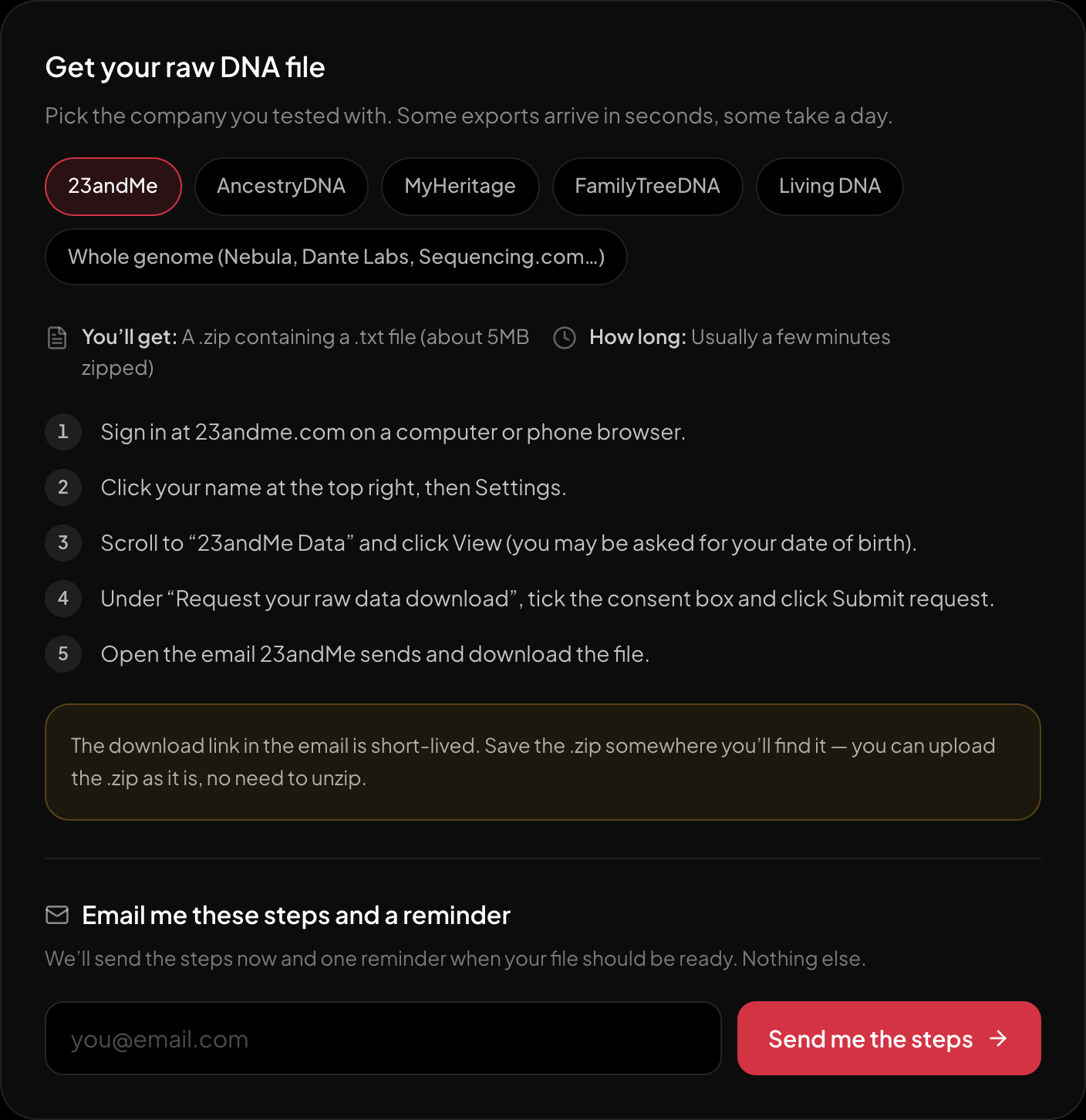
The download steps for 23andMe, on the page itself.
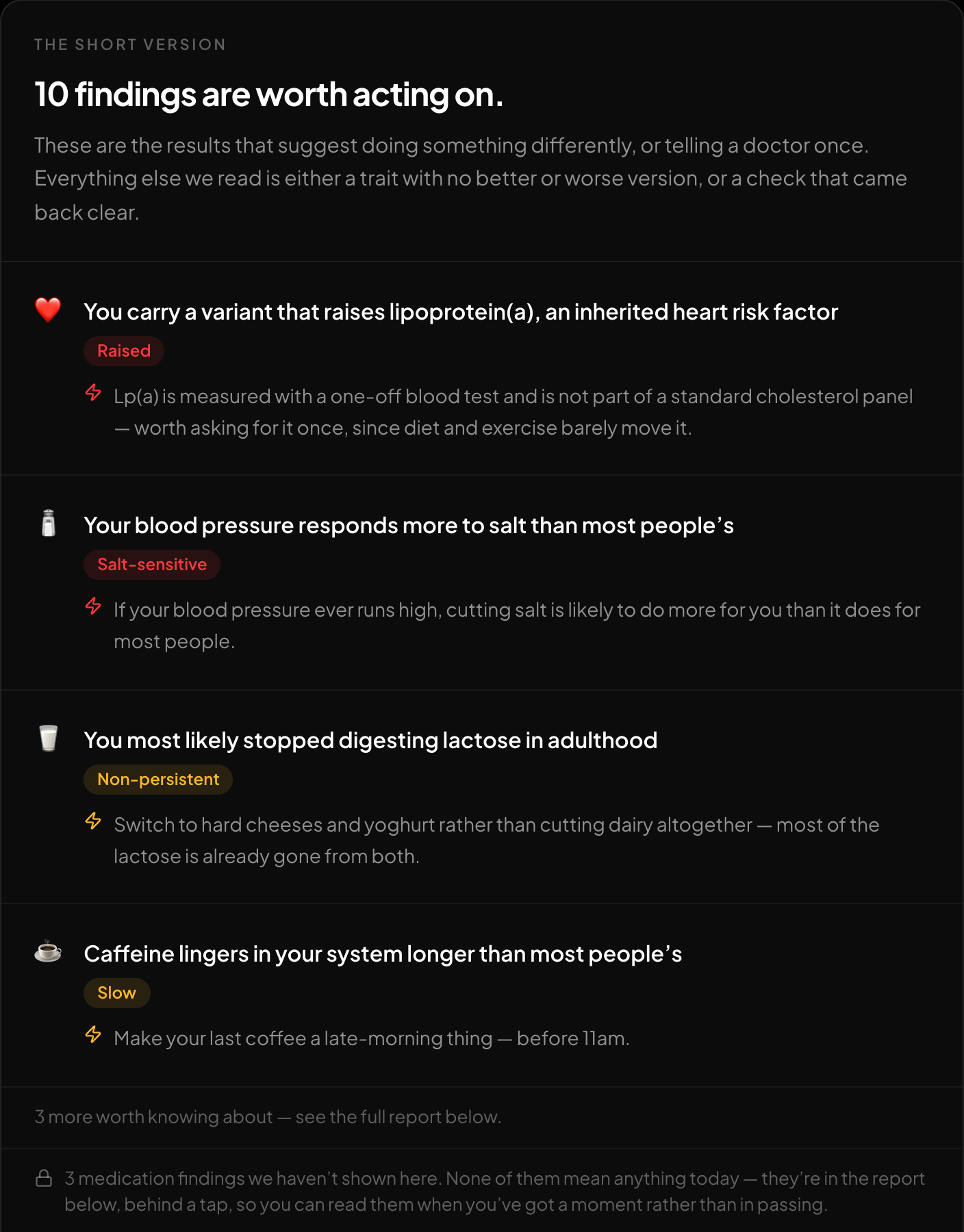
The short version: what is worth acting on, first.
The free DNA tool at HealthOSX reads a raw 23andMe, AncestryDNA or MyHeritage file in the browser, and its report includes a G6PD finding. If you are a man and that finding rests on a two-letter call, look at the call in your raw file and treat the result as unconfirmed.
New to raw DNA files? Start with the full guide: 23andMe Raw Data Interpretation Free in Your Browser
Written by
HealthOSX Research