Why Do Ashkenazi and Sephardic Jews Show Italian or Spanish Ancestry in DNA Results
'Italian-like' or 'Spanish-like' in a Jewish DNA result means a close statistical match to a reference group. It does not mean your family came from Italy or Spain.
Ashkenazi and Sephardic Jews can both see 'Italian', Southern European or 'Spanish' labels in a DNA result, because the test matches your DNA to the closest reference groups, not to your ancestors' country. Those matches reflect old Mediterranean ancestry blended with Middle Eastern ancestry, not a recent family link to Italy or Spain.
Ashkenazi results: a small founding group and an even mix
A test does not read ancestry off your DNA like a label. It compares your variants with panels of present-day people and finds the mix of those panels that fits you best. The name on the panel is a stand-in for a pattern of genetic variation.
For Ashkenazi Jews, the best-known figures come from two studies. Atzmon et al. 2010 found that Ashkenazi genomes sit close to other Jewish groups and to Southern Europeans, with both Middle Eastern and European ancestry. Carmi et al. 2014, which sequenced an Ashkenazi reference panel, put the Middle Eastern and European contributions at roughly 50/50 on average.
Carmi et al. 2014 also modelled the population as descending from a founding group of a few hundred people about 30 generations ago. All of these numbers are approximate and depend on the method and the reference samples used.
After that founding period the population stayed largely endogamous, which froze the mixture in place. That is why Ashkenazi results look so alike from one person to the next: the blend was fixed early and copied down every line.
Sephardic results: an Iberian signal mixed with the Maghreb and the Ottoman lands
'Sephardic' is a looser label. Strictly it means descendants of the Jews of Iberia, but in everyday use it often stretches to cover North African and Middle Eastern Jewish communities too. That is why the Sephardic answer is less tidy than the Ashkenazi one.
Studies of Jewish populations, including Atzmon et al. 2010, Behar et al. 2010 and Campbell et al. 2012, generally find that Sephardic and North African Jewish groups sit closest to other Middle Eastern Jewish groups. They carry a Southern European-like share, and the North African communities also carry a local North African share. These studies do not give one fixed split between Iberian, North African and Middle Eastern ancestry. The proportions differ by community and by study, so treat any single percentage as approximate.
The Iberian-like signal is harder to read because of what happened in the 1490s. Jews were expelled from Spain in 1492. In Portugal, an expulsion decree in 1496 was followed by forced conversions in 1497. Many of these families resettled in Morocco and the rest of the Maghreb, in Ottoman cities such as Salonica, Istanbul and Izmir, and in Italy and elsewhere.
Many joined Jewish communities that were already there and intermarried with them. A person from one of these lines can therefore carry Iberian-like, North African and Middle Eastern ancestry together, in different amounts from one family to the next.
The reference groups are tangled too. Adams et al. 2008 studied Y-chromosome lineages in men from the Iberian Peninsula. They estimated that about 20% had paternal lines of Sephardic Jewish origin and about 11% had lines of North African origin, with wide variation between regions. These figures cover male lines only, so they are not a whole-genome share.
Still, a 'Spanish' reference group is not purely non-Jewish, and a Spanish-like match can partly reflect Jewish ancestry in Spain itself. Because the label covers separate communities, compare your result with the specific community your family belongs to, not with 'Sephardic' as one block.
| Study | Population | What it reports |
|---|---|---|
| Atzmon et al. 2010 | Ashkenazi Jews | Close to other Jewish groups and to Southern Europeans, with both Middle Eastern and European ancestry |
| Carmi et al. 2014 | Ashkenazi Jews | Founded by a few hundred people about 30 generations ago; roughly 50/50 Middle Eastern and European ancestry on average |
| Behar et al. 2010; Campbell et al. 2012 | Sephardic and North African Jewish groups | Closest to other Middle Eastern Jewish groups, with a Southern European-like share; North African communities also carry a local North African share; no single fixed split |
| Adams et al. 2008 | Men from the Iberian Peninsula (Y chromosome) | About 20% of paternal lines of Sephardic Jewish origin and about 11% of North African origin, varying widely by region; male lines only |
Scroll the table sideways for the rest →
Approximate values as reported by each study. They depend on the method and the reference samples used.
'Closest to Sicilian' is a distance, not a birthplace
The closest-populations list ranks reference groups by genetic distance. It does not say your ancestors lived there. Two things make that matter for Jewish results.
First, a blended genome lands between its sources, and the nearest labelled point on the map may be a place neither source population occupied. The midpoint between two cities can sit closest to a town that neither road passes through.
Second, the reference groups are not independent of each other. Southern Europeans such as Sicilians carry ancestry that includes Neolithic farmers who came out of Anatolia, plus some later Near Eastern input. Southern European and Middle Eastern reference groups therefore overlap more than their names suggest. A genome with a large Levantine part and a smaller European part can come out nearest Sicilian without a single Italian in the tree.
What a Southern European share does and does not tell you
| Result | Can say | Cannot say |
|---|---|---|
| Closest to Sicilian or Spanish | Your variants resemble that reference group more than most others | That your ancestors lived there |
| A Southern European-like share | Is consistent with published studies of Ashkenazi and Sephardic genomes, such as Atzmon et al. 2010 and Carmi et al. 2014 | Which century, route or country it came through |
| A Middle Eastern share beside it | A real part of the mix, whose size differs by person and by community | A single homeland or an unbroken line |
| A small share with a wide ± range | Possibly nothing | A specific ancestor |
Scroll the table sideways for the rest →
Applies to a typical Ashkenazi or Sephardic result. Recent ancestry would look different.
A '25% Italian' line does not point to a named ancestor from Naples. It also does not show that Jewish people are 'really' European converts. The data supports neither reading. On average, a European-like component and a Middle Eastern-like component both went into the Ashkenazi founding population (Carmi et al. 2014).
Why one company says Italian and another says Jewish
The same genome can produce very different pages at different companies, for reasons that have nothing to do with you:
- Some panels have a dedicated Ashkenazi Jewish category, so most of your result lands there. Others do not, and the same variants get split into Eastern European, Southern European and Middle Eastern pieces.
- Reference panels differ in size and in which regions they cover well. Consumer panels generally have fewer Middle Eastern regions than the HealthOSX reader, so a Levantine signal has fewer specific places to land.
- Labels are chosen by the company. 'Italy' on one site and 'Southern Europe' on another can be the same cluster of reference people.
- Small shares are noisy. A 2% or 3% trace with a ± range as wide as the number itself is not a finding.
Four checks before you trust a Southern European share
The free HealthOSX ancestry reader gives you two outputs to read side by side. One ranks your closest reference populations, including Jewish groups (Ashkenazi, Moroccan, Iraqi, Iranian, Turkish and others) next to Sicilian, Spanish, Lebanese and Kurdish groups. It ranks you against 298 present-day groups.
The other fits you as a mixture of 157 present-day reference populations and reports shares across 15 world regions, each with a ± range. Levant, Arabia, Anatolia/Iran, the Caucasus and North Africa are separate regions, not one 'West Asian' block, so a Middle Eastern signal has somewhere specific to land.
A practical way through it:
- Look at the top of the closest list first. If an Ashkenazi group ranks near the top, that fits the published picture. If your family is Sephardic, look for whether Spanish or other Iberian groups appear alongside Jewish groups from North Africa or the Ottoman region, which would fit the mixing described above.
- Read each proportion with its ± range. If the range reaches zero, treat the share as unconfirmed.
- Check how the groups cluster. Several that sit nearly the same distance away are one signal, not several separate ancestries.
- Look at the PCA plot as an illustration, not a test. A dot between the Levantine and Southern European groups is consistent with a blend, but different mixes can land in similar places, and a single dot cannot prove which one you have. Use it alongside the proportions and the closest list.
Recent Italian or Spanish ancestry, Mizrahi profiles and open questions
Some people really do have recent Italian or Spanish ancestry, and Italian Jewish communities are very old. The tool shows proportions and nearest populations, not labelled ancestors. A recent Italian grandparent would appear as a larger Southern European share than a typical Ashkenazi profile, and Italian groups might move up the closest list, but it would not appear as an 'Italy' ancestor. Converts and intermarriage within the last few generations can do the same.
Mizrahi results, such as Iraqi or Iranian, usually carry much less European-like ancestry, so the pattern described here is not universal.
Some things are still argued. Researchers disagree about exactly when and where the European component entered, and about how much came through women versus men. A single result cannot settle any of that, because it gives you proportions, not dates or routes.
See it in your own numbers
Choosing a file. The report is read on your own device.
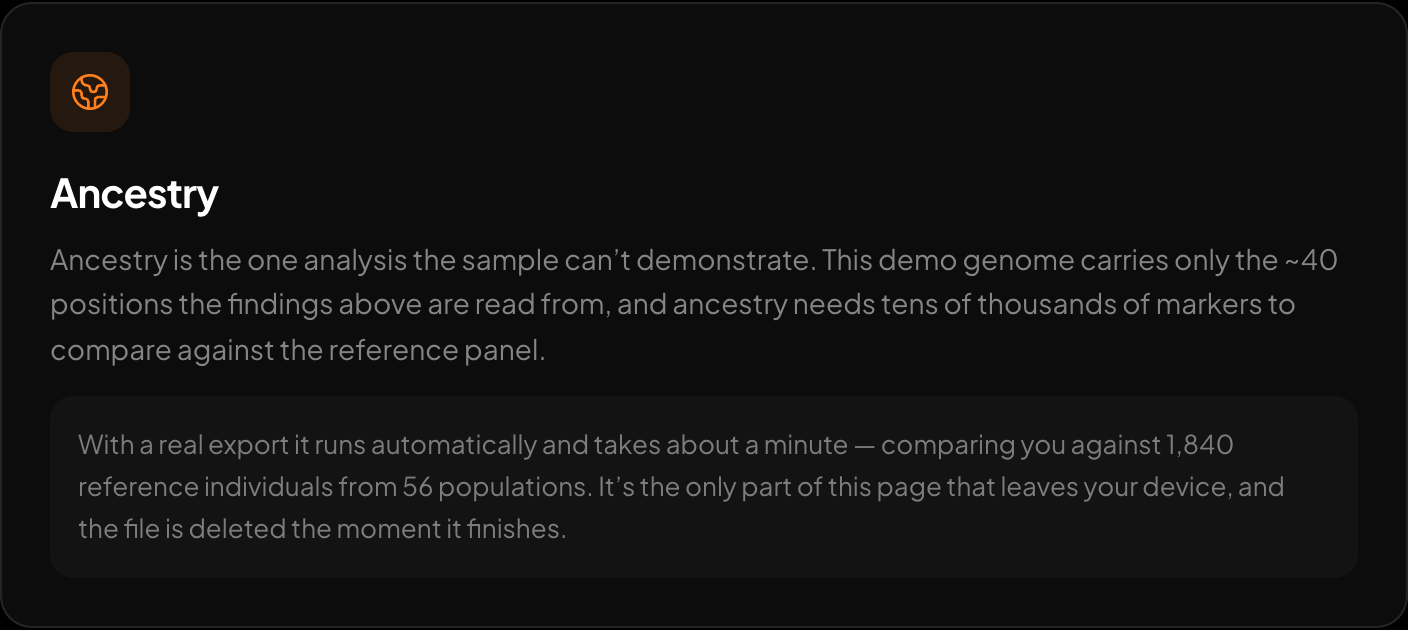
Ancestry across 15 regions and 157 reference populations.
If you have a raw file from 23andMe, AncestryDNA, MyHeritage or a whole-genome VCF, the free DNA tool can read it. Traits and health findings are parsed in your browser. Ancestry is separate and optional: it runs on the server only with your explicit consent, and it sends only the markers it needs. Those markers are kept until you delete them. It shows your closest populations, your regional proportions with ranges and your PCA position, so you can check what this post describes against your own list.
New to raw DNA files? Start with the full guide: 23andMe Raw Data Interpretation Free in Your Browser
Written by
HealthOSX Research